
It is 11pm in Dubai. A buyer has just decided she wants an apartment — somewhere in the Marina, under AED 1.8 million, good rental yield. She does not open Property Finder. She opens ChatGPT and types: “Best areas to invest in Dubai real estate 2026 under AED 2 million.”
A sponsored real estate ad appears alongside the AI’s organic response. One tap. She is on your landing page. She fills the form. By 11:05pm, your AI chatbot has responded, qualified her budget and timeline, and booked a call for tomorrow morning.
You are asleep. Your competitor is manually checking Property Finder. You just won that lead.
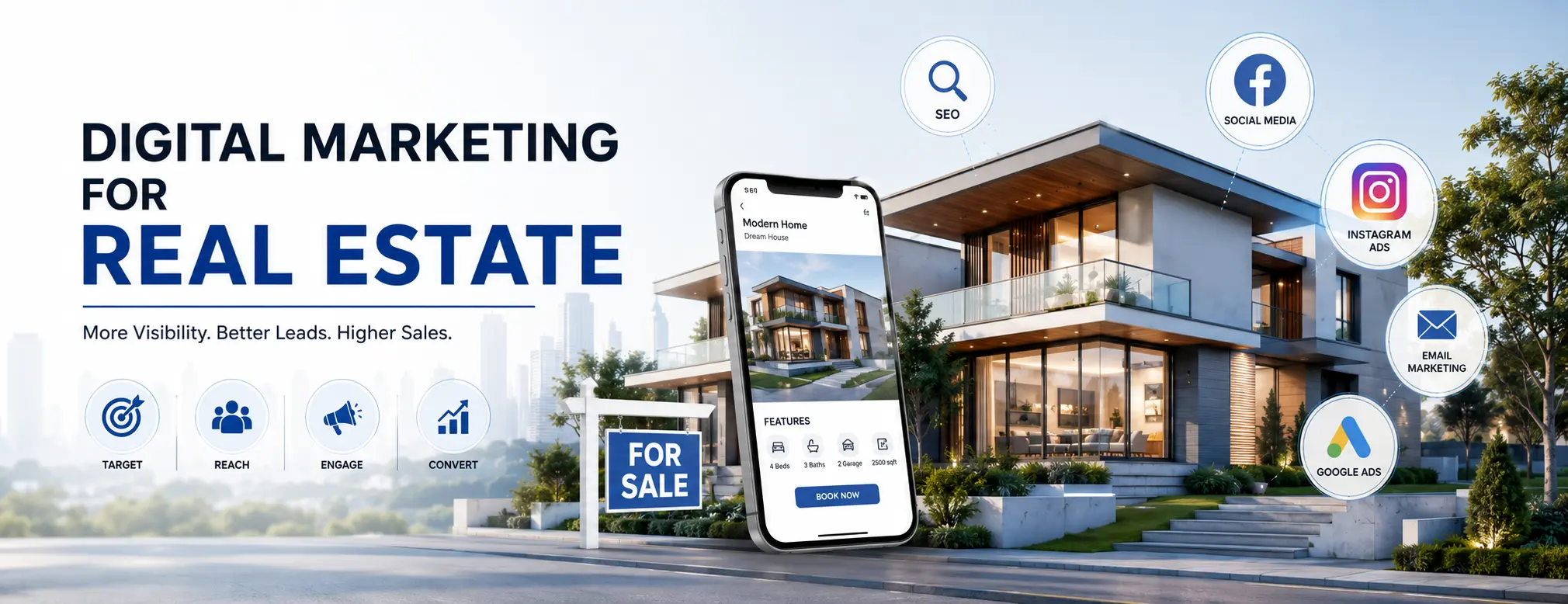
This is what digital marketing for real estate looks like in 2026. Not portals. Not brochures. Not cold calling. A connected, always-on, AI-powered lead generation system that works across time zones, across platforms, and across borders — whether your properties are in Valletta, Dubai, London, Sydney, or Mumbai.
This is the complete playbook. Built on fresh market data. Written for the developers, brokers, and agencies who want to dominate digital in 2026.
Table of Contents
Why the Old Real Estate Marketing Playbook Is Finished
Let me give you one number that changes everything.
94% of homebuyers now use the internet during their property search. Not some of the time. As the primary channel. And 76% of them are doing that search on a mobile device. The property portal is no longer the first step in the buyer journey. It is the third or fourth — after Google, after social media, after AI tools.
Here is the real problem with how most real estate businesses approach digital marketing in 2026. They are trying to win a 2026 buyer with 2019 tactics. They are paying for portal listings that are saturated and expensive. They are posting generic property photos on Instagram without a lead capture strategy. They are running Google Ads to a homepage that cannot convert. And they are following up on leads manually — sometimes the next day, sometimes never.
Meanwhile, the buyer has moved on.
Real estate is not like selling trainers or booking a restaurant. The purchase decision takes weeks, sometimes months. In the UAE, buyers often purchase properties they have never physically visited — from India, from the UK, from Russia. In India, a first-time buyer in Pune researches for 90 to 120 days before making an inquiry. In the UK, stamp duty changes and mortgage rate movements shift buyer psychology overnight. In Malta, an international investor in Amsterdam is comparing a Sliema apartment against a Lisbon rental yield before they even land at Malta International Airport.
Every single one of those buyers is findable. Every single one of them is leaving digital footprints — search queries, social media engagement, property page visits, ChatGPT conversations — that tell you exactly where they are in the buying journey.
The digital marketing system that captures those signals and converts them into consultations, site visits, and signed agreements is the competitive advantage in real estate marketing right now.
Building that system is what this guide is about.
The Core Real Estate Digital Marketing Stack — What Drives Leads in 2026
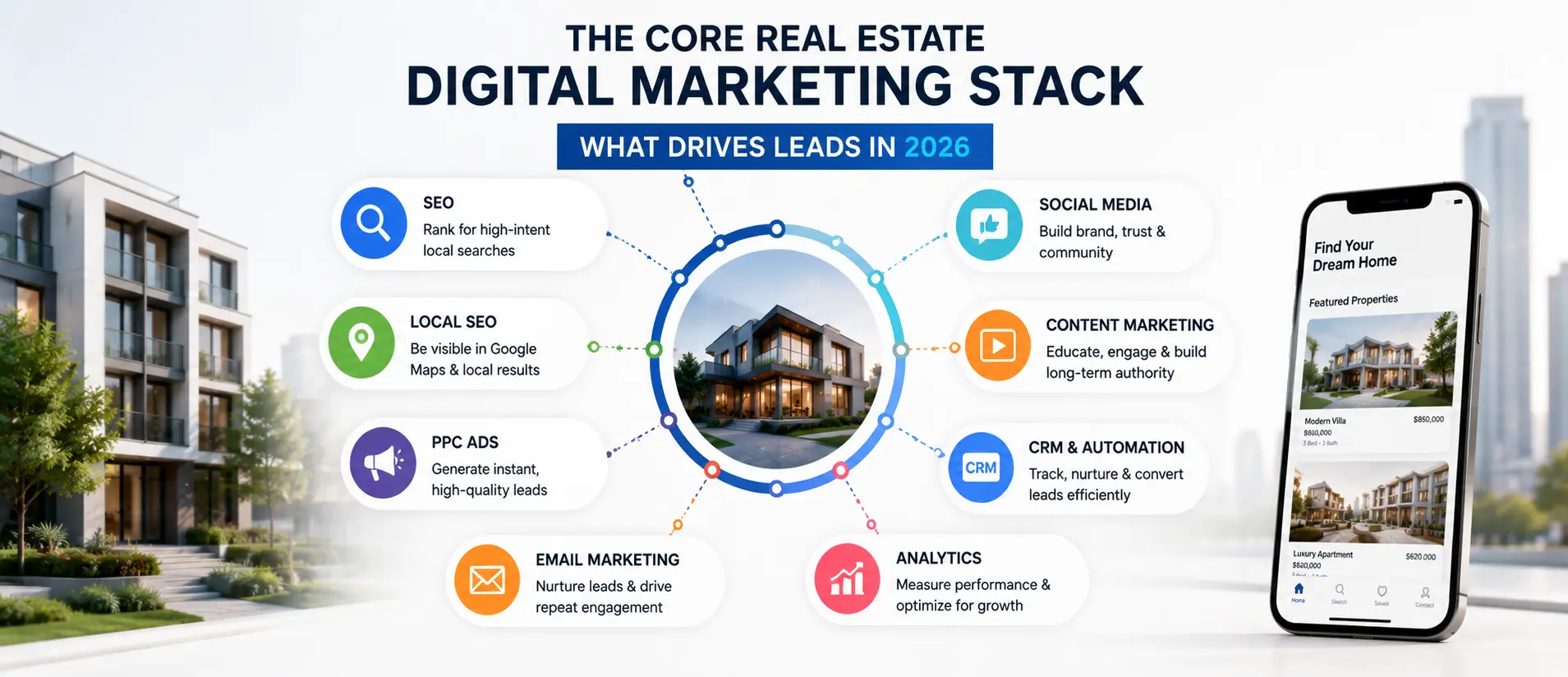
Every real estate developer, broker, or agency asks me the same question: where should we spend our marketing budget?
The answer in 2026 is not one channel. It is a connected stack — where each element feeds the next. Let me break it down.
SEO: The Owned Traffic Engine That Compounds
The single most underinvested channel in real estate marketing globally — especially at the developer and broker level — is SEO. Most real estate businesses spend heavily on portals and paid ads, and almost nothing on building organic search visibility that delivers leads without a per-click cost.
SEO for real estate in 2026 works across two distinct opportunity zones.
The first is hyper-local, micro-market content. In India, ranking for “apartments in Mumbai” is a waste of time — property portals with decade-long domain authority own those terms completely. But “RERA-approved 2BHK in Whitefield below ₹80 lakhs” or “under-construction flats near Pune airport possession 2026” — these micro-market queries carry strong purchase intent and minimal organic competition. The developer who captures them gets high-quality leads from buyers who are actively evaluating, not just browsing.
In the UAE, targeting “off-plan apartments JVC Dubai 2026” or “Golden Visa eligible property Abu Dhabi” captures investors at the moment of maximum intent — researching specific projects before committing. In Malta, “property for sale Sliema with EU residency permit” speaks directly to the international investor audience that drives a significant share of Malta’s property demand. In the UK, “2-bedroom flat [local area] first-time buyer” targets a specific buyer persona at a specific intent stage — and most estate agents in that area are not competing for it properly.
The second opportunity is AI search visibility — GEO and AEO for real estate. Buyers in 2026 will increasingly start property research not on Google but in ChatGPT, Perplexity, and Gemini. “Which area of Dubai is best for investment under AED 1 million?” “Should I buy or rent in London right now?” “What are the best suburbs in Sydney for families with a $900K budget?” These are not Google searches. They are AI conversations. And the property brands and agents whose content gets cited in AI-generated answers are capturing an entirely new discovery channel that most competitors are not even aware of.
Rightmove has already announced direct property search integration into ChatGPT. In February 2026, property searches became possible inside AI chat interfaces. The brands whose content is structured for AI citation — with clear FAQ sections, schema markup, geographic specificity, and authoritative data sourcing — will capture this channel. The ones still producing generic portal listings will be invisible in it.
Google Ads: Immediate Intent, Highest Quality Leads
Google Ads for real estate remains the most efficient channel for capturing buyers at peak purchase intent — the moment they type “property for sale [area]” or “best real estate agent [city]” into a search bar.
But the single biggest mistake across every market — UAE, UK, Australia, India, Malta — is sending paid traffic to a homepage. A buyer who clicks a Google Ad for “2BHK flat Bangalore” and lands on a developer’s homepage showing 12 projects, a corporate history section, and a contact form buried in the footer will bounce within 30 seconds. The solution is project-specific landing pages: one page per project, per market, with one goal — capture the inquiry.
In the UAE, Google Ads CPCs for competitive property search terms run AED 8 to AED 35 per click. Given that a single off-plan apartment sale in Dubai generates AED 30,000 to AED 200,000+ in commission revenue, even a cost per qualified lead of AED 500 to AED 1,500 is an extraordinary ROI. The math is undeniable — the issue is execution.
In the UK market, stamp duty changes and mortgage rate movements require Google Ads campaign adjustments within days, not months. A campaign optimized for a pre-stamp-duty-change market will fail completely in a post-change environment if the messaging and landing page content do not reflect the new buyer psychology.
In India, Google Ads for real estate should be built around project names, locality qualifiers, and intent modifiers — “ready to move,” “RERA registered,” “possession [year]” — with extensive negative keyword lists to exclude low-quality traffic from generic queries. Broad match campaigns for “apartments India” burn budget at scale with nearly zero conversion.
Meta Ads: The Visual Storytelling and Retargeting Machine
Meta Ads for real estate — Facebook and Instagram — work differently from search advertising. You are not capturing demand. You are creating aspiration, building awareness, and retargeting the buyers who showed interest but did not convert.
Property sells on emotion. A well-produced video walkthrough of a Palm Jumeirah penthouse, targeted at high-net-worth Indian and British expats browsing Instagram in their 30s and 40s — that ad does not need to produce an immediate lead. It puts your property in their mental consideration set. When they Google “off-plan apartments Dubai” three weeks later, they already know your project.
That is why retargeting is the highest-ROI Meta campaign type in real estate. Someone who visited your project page, watched 60% of your property tour video, or engaged with your Instagram profile last week is not a cold lead — they are a warm one. Retargeting campaigns showing these audiences specific floor plans, payment plans, or ROI calculators consistently convert at 3 to 5 times the rate of cold-audience campaigns.
In the UK, Meta advertising research found that female audiences significantly outperform male audiences on property ads — 11.39% CTR versus 8.99% — and the 55 to 64 age bracket achieves the highest click-through rates at 12.12%. These are not generic insights. These are the targeting parameters that improve campaign efficiency in the UK market specifically.
In India, Meta Ads are particularly effective for awareness and retargeting across residential real estate — especially in Tier 2 cities like Pune, Ahmedabad, and Jaipur, where property portals have less dominance and social media reaches a broader property-interested audience.
TikTok: The Property Discovery Channel Nobody Expects
TikTok is the most underestimated channel in real estate marketing in 2026. And it is producing some of the most surprising lead generation results for agents and developers across every target market.
Here is why. TikTok’s algorithm does not care about your follower count. A real estate video with zero followers can reach 500,000 views if the content resonates. And property content — “what AED 1.5 million buys you in Dubai Marina vs. JVC” comparisons, “£300,000 flat tour in Manchester,” “what ₹80 lakhs buys you in Bangalore right now” — these formats generate organic reach, saves, and DM inquiries at near-zero cost.
TikTok Ads for real estate — TopView ads, In-Feed ads, Branded Hashtag Challenges — extend that organic reach into a paid layer. In Australia, TikTok’s property content vertical is growing rapidly among 25 to 40-year-old first home buyers who use the platform for research in ways that defy traditional marketing assumptions. In the UAE, TikTok reaches the South Asian and Arab expat demographics that represent a significant share of Dubai’s property buyer profile.
The critical content strategy for TikTok real estate: show, do not tell. A 60-second walkthrough of a property — honest, handheld, real — consistently outperforms a polished advertisement. “What my clients got for AED 900K” or “Malta apartment tour — €280K with sea view” format drives both organic discovery and paid conversion more effectively than any produced commercial.
The AI Layer — How Intelligent Automation Is Winning the Lead Race
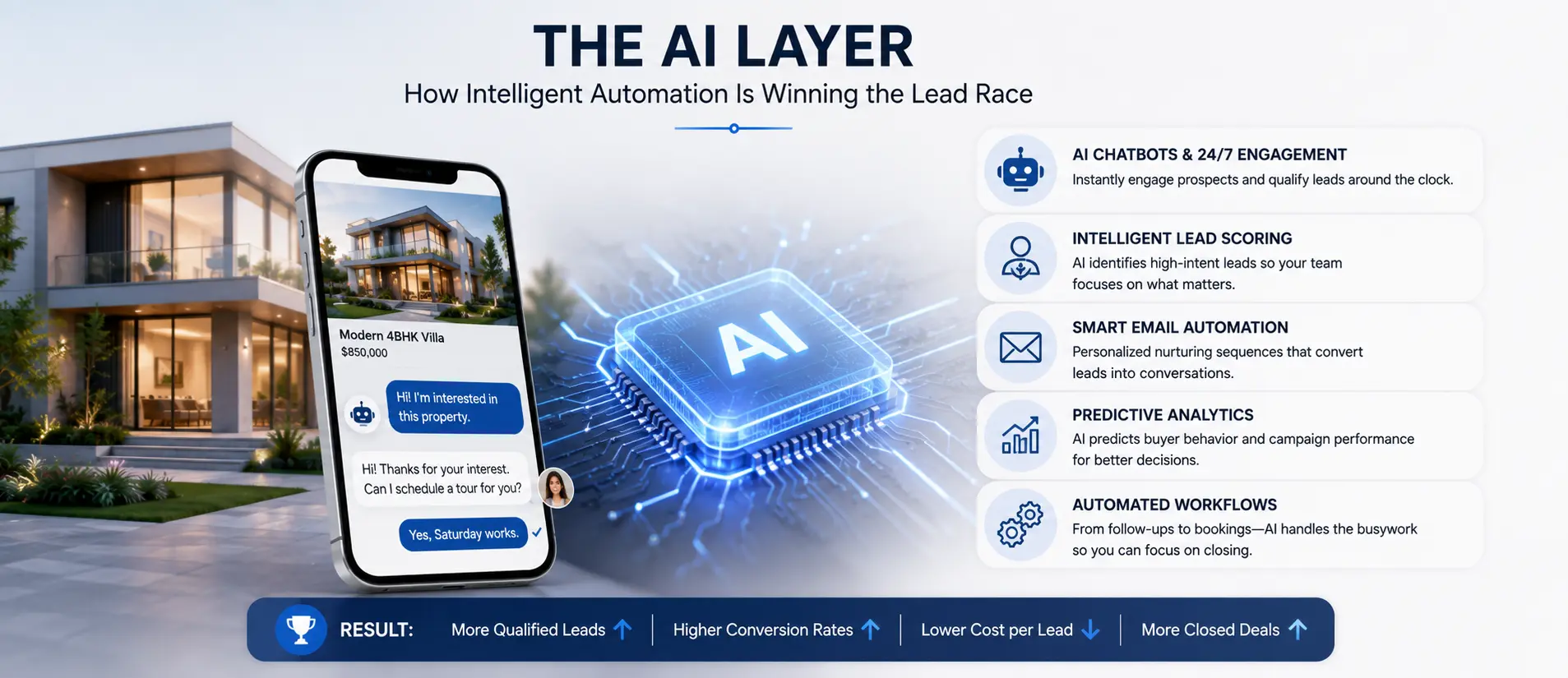
If there is one shift in real estate marketing that separates the top 5% of agencies from the rest in 2026, it is not TikTok. It is not even ChatGPT Ads.
It is the speed of response — at scale, without human involvement.
Here is the brutal reality. Real estate leads have a half-life of about 5 minutes. A buyer who submits an inquiry form on your website at 10:47pm and receives no response until 9:15am the next morning has already contacted two other agents, taken a virtual tour of a competitor’s project, and possibly moved to a different market altogether. You had the lead. You lost it to silence.
AI chatbots for real estate lead qualification solve this problem completely. An intelligent real estate chatbot — not the 2018-era “Hi, how can I help?” pop-up, but a genuinely conversational AI agent — qualifies every inbound inquiry within 90 seconds, regardless of time zone, regardless of day of week. It asks about budget, timeline, location preference, mortgage or cash buyer status, specific project interest, and nationality. It scores the lead. It segments by intent level. It books the human follow-up call for high-intent prospects and enters low-intent leads into a nurture sequence. All automatically. All immediately.
AI chatbot and agentic AI development for real estate is transforming inquiry-to-consultation conversion rates across every market. In the UAE, where buyers inquire from multiple time zones simultaneously — India, UK, Russia, Europe — a 24/7 AI qualification system ensures no lead goes unanswered. In India, WhatsApp automation extends this capability to the messaging platform, where 90% of Indian property inquiries prefer to communicate. A buyer who clicks a WhatsApp button on a Facebook Ad at 2am receives an instant qualifying message, a personalized property shortlist based on their stated budget, and a booking link for a morning consultation — all from an AI agent, before any human is involved.
ChatGPT Ads — The First-Mover Opportunity in Real Estate
On January 16, 2026, OpenAI officially announced it was testing ads within the ChatGPT interface. On May 5, OpenAI launched a self-serve Ads Manager, making ChatGPT advertising accessible to any business.
Nearly half of people planning to buy a home in 2026 say they will use AI tools during the process. The real estate buyer who types “what are the best areas to invest in Malta under €400,000” into ChatGPT is not browsing. They are researching a specific decision with a a the real budget and real timeline. A sponsored placement appearing alongside ChatGPT’s answer — clearly labeled as an ad, with a direct link to your project page — reaches that buyer at a moment of maximum intent that no other advertising platform can replicate.
The targeting works differently from Google and Meta. Rather than bidding on keywords, you match to conversational intent. The system reads the full context of the user’s conversation and serves your ad based on what they are genuinely trying to accomplish. Someone asking detailed questions about buying property in a specific city does not need to type “find me a real estate agent” for your ad to appear — the conversational context is enough.
This is an early-mover window. The real estate agencies running ChatGPT Ads today are paying CPCs significantly lower than equivalent Google Ads placements, reaching higher-intent buyers, and facing almost no competitive pressure from other property advertisers. The parallel to Google AdWords in 2005 and Facebook Ads in 2010 is not overstated. The window will not stay open indefinitely.
AI marketing automation for real estate extends beyond chatbots and ad platforms. AI lead scoring — using behavioral signals from website visits, video watch time, email engagement, and social media interaction — identifies which leads are in active research mode versus passive browsing. AI predictive analytics flag accounts most likely to transact within 90 days. AI-generated content creates listing descriptions, email nurture sequences, neighborhood guides, and social media captions at a speed and volume that no copywriting team can match manually.
AI video creation is transforming property marketing specifically. A developer launching 12 units across a Malta project cannot produce 12 individual property tour videos through traditional production. AI video tools generate professional-quality property walkthrough videos from photography, floor plans, and specification data — in hours, at a fraction of the cost. In a market where video content generates 3 to 4 times more inquiries than static images, this production advantage is directly translatable to lead volume.
Market-by-Market Strategy — What Works Where
The channels are consistent across markets. The execution differences are what determine whether you win or lose in each geography.
Malta — The Underserved Market With Global Buyer Demand
Malta is a property market powered by international demand. EU residency pathway, Mediterranean lifestyle, low tax environment, strong rental yields — Malta properties attract buyers from Germany, the Netherlands, Scandinavia, the Middle East, and beyond.
The digital marketing reality: most Malta property developers and agencies are running basic portal listings and generic Instagram posts. The international buyer — the one sitting in Amsterdam comparing a Sliema apartment against Lisbon alternatives — is finding Malta properties through property portals, but the agencies who create authoritativethat content (neighborhood guides in English and German, ROI calculators comparing Malta to Portugal, EU residency process explainers) are capturing inbound interest at a fraction of the cost of portal spend.
Malta real estate content marketing targeting English, German, and Dutch language searches for property investment, EU residency, and Mediterranean retirement is almost completely uncontested. A real estate agency investing in multilingual SEO and targeted Meta Ads reaching European high-net-worth audiences creates a first-mover content moat that will compound for years.
WhatsApp Business is the preferred communication channel for international buyers communicating with Maltese agents — automated WhatsApp sequences for inquiry follow-up are particularly effective here.
UAE — The Most Competitive, Most Rewarding Market
Dubai recorded over AED 761 billion in real estate transactions in 2024 — the highest ever. Competition among developers, brokers, and agencies has never been fiercer. Platforms like Property Finder, Bayut, and Dubizzle are saturated and expensive. Relying solely on them means competing on price and response speed, with no differentiation.
The digital marketing strategy that wins in UAE 2026 combines four elements. First, neighborhood-specific content — “apartments for sale in JVC Dubai 2026,” “best ROI areas Dubai for Indian investors” — targeting the source-market buyer rather than the broad Dubai market. Second, Google Ads with project-specific and intent-specific landing pages — not portals, not homepages. Third, social media is built around video property tours on Instagram and TikTok, with LinkedIn for investor and institutional outreach. And fourth, geofencing and behavioral retargeting — serving highly relevant ads to buyers who visited competitor showrooms, browsed at airport luxury lounges, or searched property terms while at specific residential communities.
The international buyer dimension is critical. Dubai buyers come from India, UK, Russia, China, and Europe. Marketing that speaks to the Indian investor’s specific concerns (rental yield, Golden Visa eligibility, connectivity to India) differently from the British buyer’s concerns (political stability, cultural infrastructure, payment plan terms) drives higher conversion than generic English-language campaigns.
UK — The Compliance-Aware Growth Market
The UK property market in 2026 is characterized by a specific set of market dynamics: stamp duty changes, mortgage rate reductions to 3.75%, and 10-year-high stock levels with 682,000 homes on the market as of March 2026. These conditions create competition between agents that digital marketing can decisively resolve.
Rightmove has already integrated ChatGPT property search — buyers are finding properties inside AI chat interfaces. UK estate agents who invest in AEO and GEO-optimized content, structured data markup, and FAQ-rich neighbourhood guides are appearing in these AI-generated property search results. The ones relying solely on Rightmove listings are invisible in this channel.
Nearly 50% of UK agents now use AI tools, up from 38% just months ago. Approximately 90% of agencies with 5+ branches plan AI implementation in 2026. The technology adoption is accelerating — agents who deploy AI chatbots for lead qualification, AI-generated listing descriptions, and automated buyer nurture sequences are operating at dramatically higher efficiency than manual-only competitors.
UK social media advertising for property must comply with Financial Conduct Authority guidance on property investment claims. Every testimonial must be authentic; every performance claim must be qualified. Compliance-aware campaign design — built into the creative from the start — avoids both regulatory risk and the reputational damage of content that feels promotional rather than genuinely informative.
Australia — The Content Gap Market
Australia’s real estate market is experiencing record demand pressure driven by sustained immigration, housing undersupply, and strong fundamentals in Sydney, Melbourne, Brisbane, and Perth. REA Group and Domain dominate the portal landscape — but content-driven organic traffic and social media reach are significantly underutilized by most agencies.
The real estate content gap in Australia is substantial. An agency publishing genuinely useful suburb guides, first home buyer calculators, rental yield comparison tools, and “what your budget buys” video series across YouTube and TikTok builds organic authority that portal listings cannot provide.
TikTok has emerged as a meaningful property discovery platform for Australian first home buyers aged 25 to 40 — a demographic that property portals reach poorly through paid channels but responds strongly to authentic video content. “What $700K buys in Brisbane vs. Melbourne” and “how we found our first home in Sydney under $850K” content formats generate significant organic reach and inbound inquiries.
India — WhatsApp First, Everything Second
India’s real estate digital marketing ecosystem has one feature that distinguishes it from every other market: WhatsApp is the primary communication channel for property inquiries. A buyer who inquires at 2am expects a WhatsApp response, not an email — and certainly not a voicemail.
WhatsApp automation — AI-powered instant responses, property shortlists, floor plan sharing, and consultation booking — is the single highest-ROI real estate marketing tool available in India. Combined with Google Ads targeting micro-market locality queries and Meta retargeting for buyers who engaged with video content, a full WhatsApp automation stack dramatically improves lead-to-site-visit conversion rates for developers across every Indian city.
RERA compliance signals — displaying RERA registration numbers prominently, referencing regulatory approvals in ad content, and creating content that explains RERA protections for buyers — build trust with a market that has been burned by project delays and developer defaults in the past. RERA-aware content marketing is not just ethically sound. It converts better.
Building Your Real Estate Marketing System — How It All Connects
Let me bring this together as a connected system rather than a list of tactics.
The buyer journey in real estate in 2026 moves like this. Awareness: they see your TikTok property comparison video or Meta Ads retargeted after a property portal visit. Discovery: they Google your project name or a locality search term and find your SEO-optimized neighbourhood guide. Research: they ask ChatGPT about investment returns in your market and see your sponsored placement alongside the AI response. Inquiry: They tap the WhatsApp button on your landing page at 10pm and receive an instant AI-qualified response. Nurture: over the next 14 days, automated email and WhatsApp sequences deliver floor plans, payment plan details, ROI calculations, and testimonials. Conversion: a human call with a fully briefed, fully warm, high-intent buyer closes the consultation.
Every element of your digital marketing strategy should serve one of these stages. The agencies and developers that build this connected system — SEO foundation, Google Ads acceleration, Meta and TikTok storytelling, social media trust building, YouTube authority, AI chatbot qualification, and marketing automation — are filling their pipelines while competitors debate which single channel to test next.
The metric that matters is not clicks, impressions, or portal views. It is the the cost per qualified lead and conversion rate from inquiry to site visit or consultation. Every channel, every piece of content, every AI automation should be measured against those two numbers.
Frequently Asked Questions
Digital marketing for real estate is a strategic system of online channels — SEO, Google Ads, Meta Ads, TikTok, social media, AI chatbots, and marketing automation — used by developers, brokers, and agents to attract, qualify, and convert property buyers and investors. It matters in 2026 because 94% of homebuyers use the internet to search for properties, and 76% do so on mobile devices. The buyer has moved almost entirely online — and the real estate businesses that win are the ones with the strongest, most connected digital presence.
ChatGPT Ads are sponsored placements that appear within the ChatGPT conversational interface, in clearly labeled tinted boxes alongside organic AI responses. Unlike Google Ads, which target keywords, ChatGPT Ads use contextual intent targeting — reading the full conversation to determine relevance. A buyer asking detailed questions about purchasing property in a specific city can see your ad without typing “find a real estate agent.” OpenAI officially launched a self-serve Ads Manager in May 2026. For real estate, this creates an early-mover opportunity to reach buyers at peak research intent at CPCs currently significantly below equivalent Google placements.
AI chatbots for real estate qualify every inbound inquiry within 90 seconds, regardless of time of day. They ask about budget, location preference, timeline, mortgage status, and specific project interest — capturing intent data that would otherwise require a human follow-up call. They score leads by qualification level, book consultation calls for high-intent prospects, and enter lower-intent leads into automated nurture sequences. Practices using AI chatbot lead qualification report dramatically improved conversion rates from inquiry to consultation — because no lead goes unanswered, and every response is immediate and relevant.
TikTok’s algorithm surfaces property content to highly relevant audiences based on viewing behavior rather than follower count. “What AED 1.2 million buys in Dubai Marina vs JVC,” “£300,000 flat tour Manchester,” and “₹80 lakh apartment Bangalore” comparison formats generate significant organic reach among buyers actively researching properties. TikTok Ads — In-Feed, TopView, and Branded content formats — extend that organic reach with paid targeting. TikTok is particularly effective for reaching 25 to 40-year-old buyers in Australia, India, and the UK — demographics that property portals reach poorly through paid channels.
Each market has distinct buyer profiles, regulatory environments, and platform dynamics. UAE marketing must target international investor audiences from India, UK, and Europe simultaneously, often for properties that the buyers have never physically visited. India requires WhatsApp automation as the primary lead response channel, RERA compliance signals in all advertising, and micro-market SEO rather than broad portal-competing keywords. Malta targets international EU residency and retirement buyers across European markets, requiring multilingual content and strong international investor trust signals. The channels are consistent; the execution, language, compliance requirements, and buyer psychology differ significantly by market.
A realistic monthly budget for a mid-sized UAE brokerage or developer starts at AED 15,000 to AED 25,000, covering paid ads, SEO, content, and management. In the UAE, well-optimized campaigns deliver qualified real estate leads at AED 150 to AED 400 each. In the UK, estate agency digital marketing budgets for competitive markets range from £2,000 to £8,000 monthly. In India, effective lead generation campaigns for mid-tier developers start at ₹1,50,000 to ₹3,00,000 monthly. The appropriate investment is always benchmarked against cost per qualified lead, and the value of a single transaction — a single Dubai property sale generating AED 80,000 in commission justifies months of marketing investment.
GEO — Generative Engine Optimization — is the practice of structuring website content, FAQ sections, neighbourhood guides, and market reports so that AI answer engines (ChatGPT, Perplexity, Gemini) select your content as a credible source when generating property-related answers. Rightmove already integrates with ChatGPT for property search. Buyers increasingly start research inside AI interfaces rather than on Google. Real estate businesses whose content is structured with FAQ schema, geographic specificity, authoritative data sourcing, and clear expertise signals appear in AI-generated answers — capturing a growing discovery channel that most competitors have not yet invested in.
DQOT Solutions builds complete digital marketing systems for real estate developers, brokers, and agencies — not isolated campaigns. We deliver SEO and GEO strategy to build organic discovery across Google and AI search, Google Ads management for high-intent lead capture, Meta and TikTok advertising for awareness and retargeting, AI chatbot development for 24/7 lead qualification, marketing automation for multi-stage buyer nurture, AI video creation for property tour content at scale, and comprehensive analytics tracking cost per qualified lead across every channel. We work across Malta, the the UAE, UK, Australia, and India with market-specific compliance and strategic knowledge built in.
The Property Buyer Has Changed — Your Marketing Has to Match
The buyer who purchased property in 2019 and the buyer searching for property in 2026 are using completely different tools to make the same decision.
They are asking AI platforms for neighborhood recommendations. They are discovering properties on TikTok at midnight. They are qualifying their own intent on WhatsApp before they ever speak to a human. They expect instant responses and personalized communication. And they are doing the research equivalent of 10 agent conversations before they step foot in a showroom.
The real estate businesses winning in Malta, Dubai, London, Sydney, and Mumbai in 2026 have built systems that match that behavior — that show up in AI search results, that run property tours on TikTok, that respond to WhatsApp inquiries at 2am, that retarget portal browsers with project-specific video, and that use AI to qualify and nurture leads at a scale no human team could sustain.
The ones still relying on portals, print advertising, and manual follow-up are not just losing market share. They are becoming invisible to a buyer who has completely moved on.
The window to build this advantage is open. The question is whether you build it now or watch competitors build it first.
Ready to build a real estate digital marketing system that generates qualified leads 24/7 across Malta, UAE, UK, Australia, and India?
Talk to the DQOT Solutions real estate marketing team today →