
A founder pitches an investor with a beautifully designed farm management app. The dashboard is gorgeous. The analytics are sophisticated. The AI model predicts yield with impressive accuracy. The investor is convinced.
Eight months later, adoption numbers come back. Fewer than 12% of the farmers who downloaded the app are still using it weekly. The reason is not the AI model. It is not the analytics. It is that the app needs a strong internet connection to load, requires six taps to log a single field activity, and was designed by a team that had never spent a day in an actual field watching how a 58-year-old farmer with calloused hands and a five-year-old Android phone actually interacts with software.
This happens constantly in agriculture technology. And it is the single biggest reason why agriculture software development services require a fundamentally different approach than building a typical SaaS product, an ecommerce app, or a fintech platform.
The global precision farming software market is valued at $2.79 billion in 2026, growing toward $9.82 billion by 2035. The broader farm management software market is projected to reach $3.73 billion in 2026, expanding to $13.48 billion by 2034 at a 17.40% compound annual growth rate. The demand for digital agriculture solutions is real, urgent, and accelerating — driven by climate pressure, rising input costs, and a generation of younger farmers who research and adopt technology online before they ever speak to a salesperson.
But demand for AgTech and successful AgTech adoption are two completely different problems. This is the complete 2026 guide to agriculture software development services — what it actually takes to build farm management, precision agriculture, and agritech platforms that farmers, cooperatives, and agribusinesses genuinely adopt and rely on.
Table of Contents
Why Most AgTech Software Fails — And What Actually Works
Written by Vikram Desai — AgTech Product Architect, 10 years building software for farming cooperatives, precision agriculture companies, and agribusiness platforms
The agriculture technology sector has a brutal, well-documented adoption problem that most software development agencies either do not understand or actively ignore because acknowledging it makes the sales conversation harder.
Here is the uncomfortable truth: a farmer does not evaluate software the way a corporate office worker evaluates software. A field worker is not sitting at a desk with a stable broadband connection and a large monitor. They are standing in a field with an intermittent cellular signal, a phone screen that has been cracked for eight months because replacing it is not a priority, sun glare making the display hard to read, and dirt on their hands that makes precise tapping difficult. If your application requires a strong, consistent internet connection to function, you have already excluded a significant share of your target users before they have evaluated a single feature.
This is the foundational principle that separates agriculture software development that actually gets adopted from agriculture software that looks impressive in a pitch deck and dies quietly six months after launch.
Offline-first architecture is not optional — it is the baseline requirement. Agriculture software must function fully or near-fully without an active internet connection, with data syncing automatically and silently whenever connectivity becomes available. A farmer logging a pesticide application, recording an irrigation cycle, or noting a pest observation cannot be told to “try again when you have signal.” The application needs local data storage, conflict resolution for when multiple devices sync the same field’s data, and a sync architecture that handles intermittent, low-bandwidth connections gracefully rather than failing silently or corrupting data.
Interface simplicity is a competitive advantage, not a limitation. The instinct of many software teams is to build comprehensive, feature-rich dashboards because more features feel like more value. In agriculture, this instinct is almost always wrong for the primary user-facing application. A field-level mobile app needs large touch targets that work with gloved or dirty hands, minimal text entry in favor of selection and toggle interactions, clear iconography that does not depend entirely on literacy, and a workflow that lets a farmer log a complete field activity in under 30 seconds. The sophisticated analytics, the AI predictions, the detailed reporting — those belong in a separate, desktop-oriented dashboard for the agronomist, the cooperative manager, or the agribusiness back office, not buried inside the same interface a farmer uses standing in a field.
Language and connectivity context determine real-world usability. Farmers increasingly speak their searches and their software interactions in regional languages on mobile devices, often on slower connections than urban software users. Agriculture software development that ignores this — shipping English-only interfaces, assuming consistent 4G connectivity, designing for desktop-class processing power — is building for a demographic that represents a fraction of the actual addressable market in most agricultural regions globally.
A genuinely effective agriculture software development partner treats these constraints as design requirements from day one, not retrofits applied after a pilot program reveals adoption problems. Custom software development built around real field conditions is the difference between an AgTech product that becomes essential daily infrastructure for a farming operation and one that becomes a forgotten app icon on a phone home screen.
The Core Categories of Agriculture Software Development
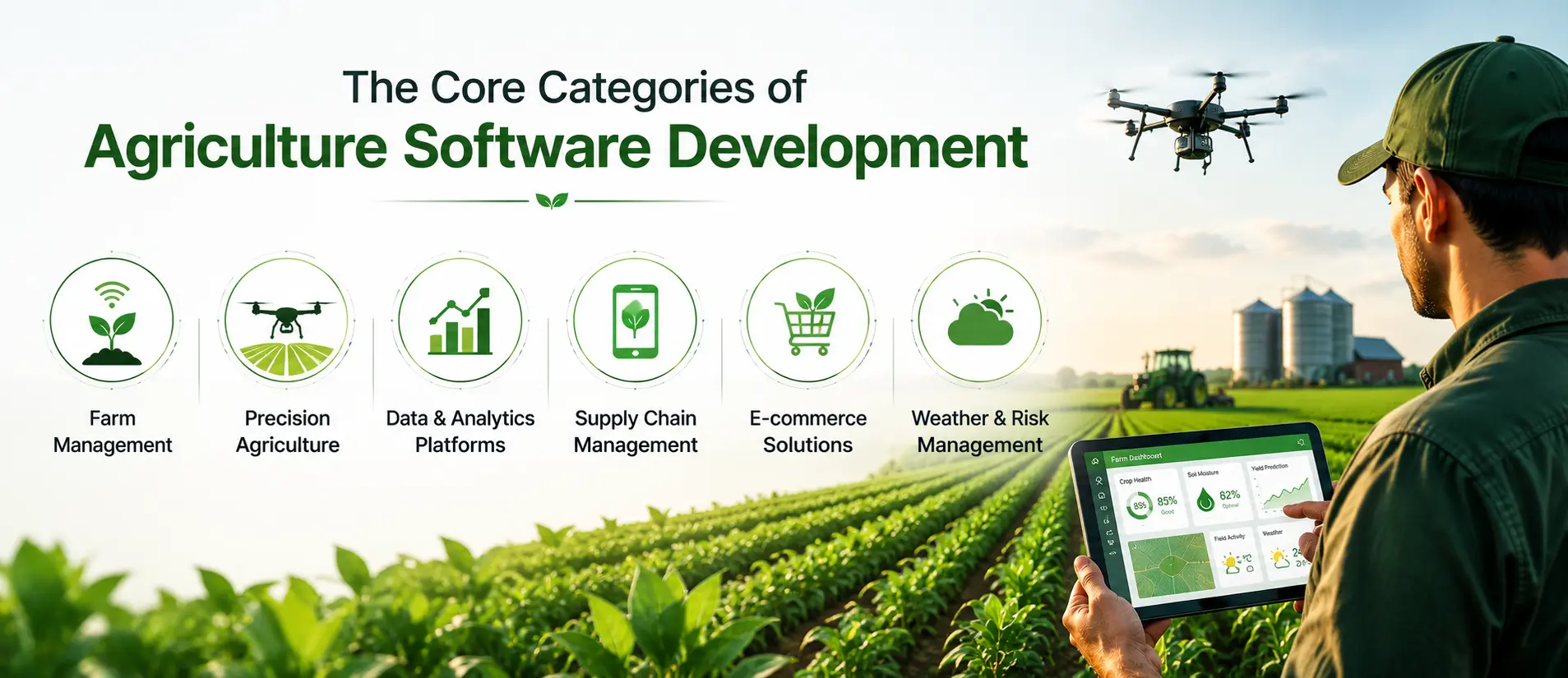
Agriculture software development spans a genuinely wide range of product categories, and understanding which category a project belongs to determines the entire technical approach, team composition, and development timeline.
Farm Management Software
Farm management software is the operational backbone of a farming business — tracking field activities, input usage, labor, equipment, financial records, and compliance documentation in a single connected system. This is the largest segment of the agricultural software market, valued at $0.83 billion in 2024 and projected to rise to $3.16 billion by 2035.
Building genuinely useful farm management software requires deep understanding of actual farm operations workflows — how a farm manager plans a planting season, how input costs are tracked against specific fields, how labor is scheduled across multiple operations, and how compliance reporting requirements vary by crop type, region, and certification program. Custom farm management software development succeeds when it mirrors a farm’s actual operational structure rather than forcing the farm to adapt its workflow to generic software logic.
Precision Agriculture Software
Precision agriculture software uses field-level data — soil composition, moisture levels, crop health indicators, yield variability — to enable site-specific management decisions rather than treating an entire field uniformly. The precision agriculture software segment is the fastest-growing category within agricultural technology, valued at $0.69 billion in 2024 with projected growth to $2.68 billion by 2035.
This category demands the most technically sophisticated development work. Integration with GPS and GNSS guidance systems, processing of satellite and drone imagery for crop health analysis, variable rate technology software that generates application maps for fertilizer and pesticide equipment, and yield monitoring systems that correlate harvest data back to specific field zones — each of these requires specialized expertise in geospatial data processing, sensor integration, and agricultural domain knowledge that a generalist development team typically does not possess.
IoT and Sensor-Integrated Software
Agriculture IoT software connects physical sensors — soil moisture probes, weather stations, livestock trackers, equipment telematics — to centralized software platforms that translate raw sensor data into actionable insights. Over 75% of large-scale farms in developed countries now utilize IoT sensors for monitoring soil moisture, nutrient levels, and crop health, making sensor integration capability a near-essential component of competitive agriculture software in 2026.
The development challenge here is twofold: building reliable hardware-to-software data pipelines that handle sensor failures, connectivity gaps, and data quality issues gracefully, and designing the software layer that transforms a continuous stream of raw sensor readings into the specific alerts and recommendations a farmer actually needs to act on — without overwhelming them with raw data they have neither the time nor the expertise to interpret manually.
Agriculture Marketplace and Supply Chain Platforms
Beyond on-farm management, a significant category of agriculture software development addresses the connections between farmers, buyers, input suppliers, and distributors. Agriculture marketplace platforms connecting producers directly to buyers, supply chain traceability systems tracking products from farm to processor to retailer, and agri-fintech platforms providing credit, insurance, and payment infrastructure to farming operations represent a rapidly growing segment, particularly relevant in markets with fragmented smallholder farming structures like India, Southeast Asia, and parts of Africa.
These platforms require careful attention to trust and verification mechanisms — since transactions often involve parties who have never met and operate with significant information asymmetry about product quality, pricing fairness, and counterparty reliability — alongside the standard ecommerce and marketplace development considerations of payment processing, logistics coordination, and dispute resolution.
Livestock and Aquaculture Management Software
Livestock management software tracks animal health records, breeding cycles, feed optimization, and herd or flock performance, while specialized variants address dairy operations, poultry production, and aquaculture facilities with their distinct operational requirements. This category increasingly incorporates computer vision for automated animal counting and health monitoring, RFID and sensor-based individual animal tracking, and predictive analytics for disease outbreak prevention — representing some of the most technically advanced applications within agricultural software.
AI and Agentic Systems — Where Agriculture Software Is Heading
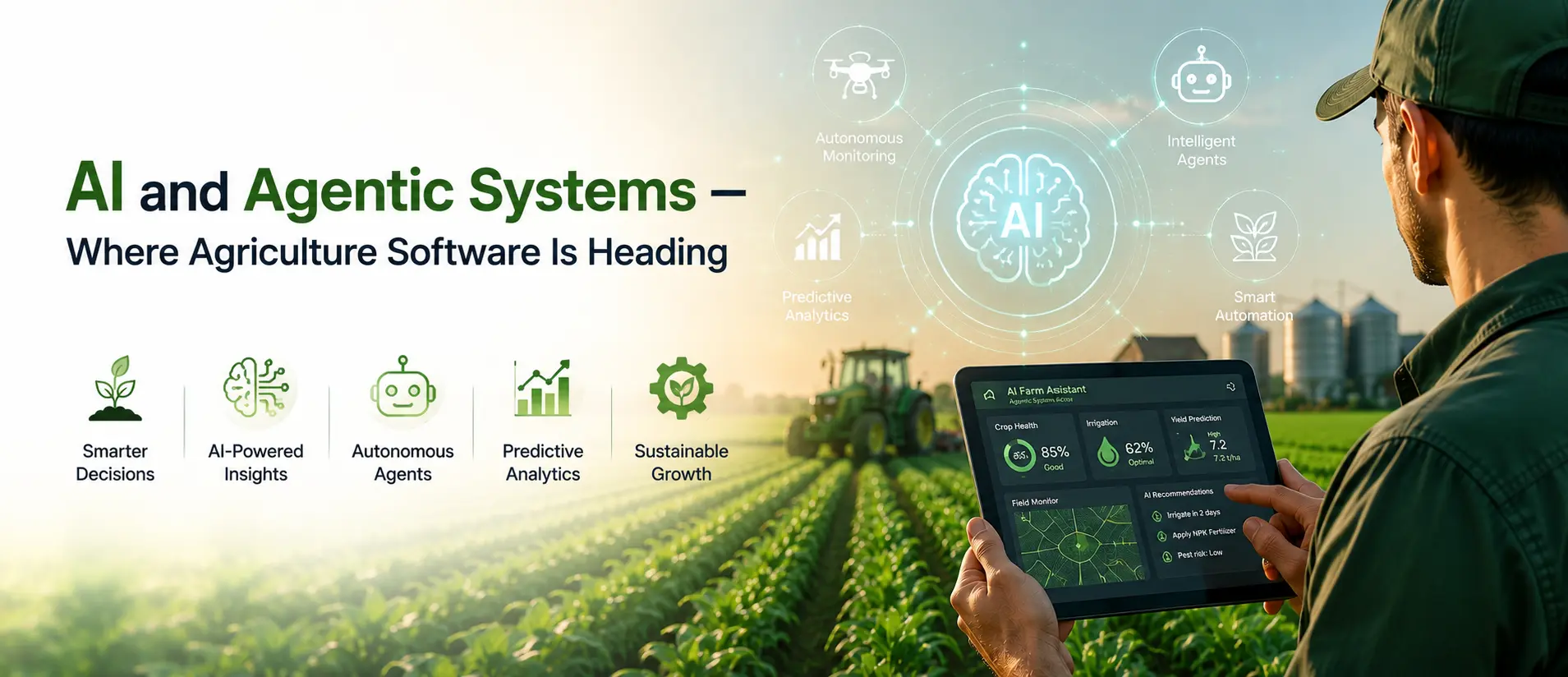
The integration of AI into agriculture software has moved decisively beyond proof-of-concept into operational, revenue-generating reality in 2026. AI-powered predictive analytics enables farmers to make informed decisions, optimizing input usage and enhancing crop yields, and this capability is increasingly the differentiating factor between agriculture software platforms that command premium pricing and those competing purely on basic feature parity.
Crop disease and pest detection through computer vision is among the most mature and immediately valuable AI applications in agriculture software. A farmer photographs an affected plant through a mobile app, and a trained computer vision model identifies the specific disease or pest with confidence scoring, cross-references regional outbreak data, and recommends treatment options appropriate to the farmer’s crop, region, and certification status (organic versus conventional, for instance). AI-powered software development for agriculture in this category requires training models on geographically and crop-specific datasets — a generic plant disease model trained primarily on North American crop varieties performs poorly when deployed for smallholder rice or cassava farmers in South Asia or East Africa, making domain-specific model development a critical technical differentiator.
Yield prediction and forecasting models combine historical yield data, current-season weather patterns, satellite-derived vegetation indices, and soil condition data to generate field-level yield forecasts weeks or months ahead of harvest. These predictions support both on-farm decision-making — whether additional inputs are economically justified given projected returns — and downstream applications in supply chain planning, crop insurance underwriting, and agricultural commodity trading.
Agentic AI systems represent the frontier of agriculture software development in 2026, moving beyond passive dashboards and alerts toward AI agents that can autonomously execute multi-step agricultural workflows. Agentic AI development for agriculture might involve an AI agent that monitors weather forecasts, soil moisture sensor data, and crop growth stage simultaneously, then automatically adjusts irrigation scheduling, alerts the farmer only when a decision genuinely requires human judgment, and logs the full reasoning trail for compliance and review purposes. This represents a meaningful shift from software that informs farmers to software that actively manages routine operational decisions on their behalf, freeing farmers’ attention for the judgment calls that genuinely require human expertise.
Conversational AI and agriculture chatbots are addressing a critical accessibility gap, particularly for farmers with lower digital literacy or limited comfort navigating complex app interfaces. An AI agriculture chatbot that allows a farmer to simply describe a problem in natural language — in their regional language, by voice if necessary — and receive accurate, contextually relevant agronomic guidance removes significant friction compared to navigating menu structures and input forms. This conversational layer is increasingly being built as a primary interface rather than a secondary support feature, particularly for platforms targeting smallholder and lower-literacy farming populations.
AI-generated content and communication address the persistent challenge of agricultural extension at scale. AI video creation is increasingly used within agriculture software platforms to generate localized, crop-specific educational video content — explaining a new pest management protocol or demonstrating proper application technique for a fertilizer product — in multiple regional languages without the cost and timeline of traditional video production for each language and crop variant.
This AI layer is not a feature to bolt onto agriculture software after the core platform is built. The most effective agriculture software development approaches in 2026 architect the data infrastructure — clean data collection, proper labeling, model training pipelines — from the earliest stages of development, because retrofitting genuine AI capability onto a platform that was not designed to capture and structure the necessary data is significantly more expensive and technically constrained than building it in from the start.
Building for the Real Buyer — Founders, Cooperatives, and Agribusinesses
Agriculture software development serves three genuinely distinct buyer categories, and a development partner needs different expertise and a different product approach for each.
AgTech startups building venture-backed products typically need to move from concept to a credible minimum viable product within a tight runway, with enough technical sophistication to demonstrate genuine differentiation to investors and early pilot customers, while maintaining architectural decisions that will not require a complete rebuild as the product scales. Agritech MVP development for this segment prioritizes speed without sacrificing the core offline-first, field-tested fundamentals that determine whether the eventual pilot program produces genuine adoption data or simply confirms that, once again, a beautifully designed app failed in real field conditions.
Farming cooperatives and FPOs (Farmer Producer Organizations) represent a fundamentally different development context, particularly significant in markets like India,Farmer-Producer where cooperative and collective farming structures serve millions of smallholder farmers. Software for this segment must accommodate aggregated data across hundreds or thousands of member farmers, support cooperative-level decision-making and resource allocation, integrate with government subsidy and scheme administration where relevant, and function reliably for a member base with widely varying digital literacy and device access. The technical architecture here often centers on a robust back-office system for cooperative staff combined with a radically simplified, possibly even SMS or voice-based interface layer for individual farmer members who may not have smartphones at all.
Established agribusinesses and enterprise agricultural companies — input manufacturers, processors, large commercial farming operations, agricultural equipment companies — typically need software that integrates deeply with existing enterprise systems (ERP, CRM, financial software), supports complex multi-stakeholder workflows across procurement, production, and distribution functions, and meets enterprise-grade security, compliance, and reliability standards. This segment values proven technical architecture and integration capability over rapid feature iteration, and development partners working in this space need genuine enterprise software development experience alongside agricultural domain knowledge.
Understanding which of these three buyer profiles a project serves shapes nearly every subsequent technical and product decision — from the technology stack selected, to the development timeline and methodology, to how success is measured during and after the build.
Technical Architecture Considerations for Agriculture Software
Beyond the offline-first and simplicity principles already covered, several specific technical architecture decisions consistently determine whether agriculture software performs reliably at scale.
Geospatial data handling is a near-universal requirement across agriculture software categories, since virtually every meaningful data point in agriculture — a field boundary, a sensor location, a satellite image pixel, a yield monitor reading — is inherently tied to a specific geographic location. Building proper GIS (Geographic Information System) capability into the data architecture from the start, rather than treating location as an afterthought field in a database, determines whether the eventual analytics and visualization layers can deliver the field-zone-level precision that differentiates genuinely useful precision agriculture software from basic farm record-keeping.
Data pipeline reliability for sensor and satellite integration requires architecture that gracefully handles the inherent unreliability of agricultural data sources — sensors that lose power or connectivity in remote field locations, satellite imagery affected by cloud cover, and drone data collection interrupted by weather. The software needs to handle gaps, flag low-confidence data, and avoid presenting farmers with false precision based on incomplete or compromised underlying data.
Scalable architecture for seasonal usage patterns matters because agricultural software usage is rarely consistent throughout the year — planting and harvest seasons drive intense, concentrated usage spikes, while other periods see significantly lower activity. Infrastructure that scales elastically with these seasonal patterns, rather than being provisioned for constant peak load or risking performance degradation during critical planting and harvest windows, is a specific architectural consideration that generalist software teams often underestimate.
Multi-language and localization infrastructure needs to be built into the application architecture from the start rather than retrofitted, particularly for products targeting multiple regional or national markets. This extends beyond simple text translation to include appropriate handling of regional units of measurement, currency, date formats, and crop and livestock terminology that varies meaningfully across agricultural regions and languages.
Security and data ownership considerations carry particular weight in agriculture software because farm-level data — yield performance, financial records, land details — is commercially sensitive, and farmers and agribusinesses are increasingly aware of and concerned about who has access to and control over their operational data. Building clear data ownership frameworks, transparent data usage policies, and robust access controls into the platform architecture is both an ethical requirement and an increasingly important trust signal that affects adoption rates, particularly among more sophisticated commercial farming operations.
Agriculture web and mobile application development that accounts for these technical realities from the architecture phase — rather than discovering them as expensive retrofits after a pilot reveals the gaps — is the difference between a development timeline and budget that holds, and one that balloons as fundamental architectural limitations surface during real-world deployment.
What to Look for in an Agriculture Software Development Partner
The agriculture software development landscape includes everyone from large enterprise software consultancies treating AgTech as one vertical among dozens, to boutique specialists who work exclusively within agricultural technology. Several evaluation criteria matter significantly regardless of agency size.
Demonstrated understanding of offline-first and field-condition design, evidenced through specific technical case studies rather than general claims of agricultural expertise. Ask directly how a prospective partner has handled offline data sync, low-bandwidth performance optimization, and interface design for non-desk-based field users in previous projects.
Genuine agricultural domain knowledge within the technical team, not just sales and account management staff who understand agriculture while the engineering team treats the project as a generic CRUD application with an agricultural theme applied superficially. The development team building the actual software needs to understand farming operations, seasonal patterns, and agricultural terminology deeply enough to make sound architectural and product decisions independently, not merely implement exactly what is specified without questioning gaps or inconsistencies that agricultural domain expertise would catch.
AI and data science capability appropriate to the project’s actual requirements, particularly for precision agriculture, crop prediction, or computer vision-based features. Verify specific experience training and deploying machine learning models on agricultural datasets, since general AI development experience does not automatically transfer to the specific challenges of agricultural computer vision, geospatial machine learning, or time-series yield prediction.
A realistic, field-tested development and validation approach that includes actual farmer or end-user testing under real field conditions before full-scale deployment, rather than relying solely on internal QA testing in controlled office environments that fail to surface the connectivity, usability, and contextual issues that only emerge in genuine field use.
Post-launch support and iteration capability, since agriculture software development rarely concludes at initial launch. Seasonal agricultural cycles mean that meaningful usage feedback often only becomes available after a full crop season, requiring a development partner committed to iterative improvement based on real adoption data rather than a one-time build-and-deliver engagement.
At DQOT Solutions, we build agriculture software with the field-first architectural discipline this sector genuinely requires — offline-capable mobile applications, AI-powered precision agriculture tools, farm management systems, and agentic AI agriculture agents — designed from the ground up around how farmers, cooperative staff, and agribusiness teams actually work, not how software teams assume they work.
Frequently Asked Questions
Agriculture software development services encompass the design, building, and maintenance of custom digital tools for the agricultural sector — including farm management systems, precision agriculture platforms, IoT-integrated sensor software, agriculture mobile applications, livestock management systems, agritech marketplaces, and AI-powered crop intelligence tools. These services differ significantly from general software development because they must account for unique field conditions including limited connectivity, varied digital literacy among end users, and deep agricultural domain knowledge requirements that affect both technical architecture and product design decisions.
Because the primary end users of much agriculture software — farmers working in fields — operate under conditions fundamentally different from typical desk-based SaaS users. They face intermittent internet connectivity, often use older or damaged devices, frequently have limited time for complex interface navigation, and in many markets speak languages and operate in literacy contexts that standard software design patterns do not accommodate. Agriculture software development requires offline-first architecture, radically simplified field-level interfaces, and design decisions made around real field conditions rather than assumptions carried over from conventional business software development.
Costs vary significantly based on product complexity, platform scope, and the specific technical requirements involved. A focused agritech MVP — a farm management mobile app with core logging and basic reporting functionality — typically represents a meaningfully different investment than a comprehensive precision agriculture platform incorporating satellite imagery analysis, IoT sensor integration, and AI-powered yield prediction. Projects involving custom AI model training for crop disease detection or yield forecasting, geospatial data processing infrastructure, and multi-language localization require correspondingly larger development investments than simpler record-keeping and workflow management tools. A development partner should provide a detailed scope-based estimate rather than generic per-project pricing, given how widely agriculture software requirements vary across use cases.
Farm management software focuses on operational record-keeping and workflow management — tracking field activities, input usage, labor, equipment, and financial records across a farming operation. Precision agriculture software goes further, using field-level data such as soil composition, satellite imagery, and sensor readings to enable site-specific, zone-by-zone management decisions rather than treating entire fields uniformly. Precision agriculture software is technically more complex, typically requiring geospatial data processing, GPS and GNSS integration, and often AI or machine learning capability, while farm management software can be effectively built with more conventional application development approaches focused on usability and data organization.
AI integration in agriculture software in 2026 spans several mature, operationally valuable applications: computer vision-based crop disease and pest detection from photographed plant images, yield prediction models combining historical, weather, and satellite data, predictive analytics for irrigation and input optimization, and increasingly, agentic AI systems capable of autonomously managing routine operational decisions like irrigation scheduling based on continuous sensor monitoring. Conversational AI and agriculture chatbots are also addressing accessibility gaps for farmers with lower digital literacy, allowing natural language interaction in regional languages rather than requiring navigation of complex menu-driven interfaces.
Development timelines depend heavily on scope and technical complexity. A focused MVP-stage farm management mobile application with core field-logging functionality can typically reach a pilot-ready state within a few months of development. Projects involving custom AI model training, IoT sensor hardware integration, satellite imagery processing pipelines, or comprehensive multi-stakeholder platforms serving cooperatives or enterprise agribusiness clients require substantially longer development timelines, often extending across multiple agricultural seasons to properly validate functionality against real-world seasonal usage patterns and gather meaningful adoption feedback for iteration.
For nearly any agriculture software with field-level data collection components — meaning any application a farmer, field worker, or agronomist would use while physically present in a field or farm location — offline functionality is essentially a baseline requirement rather than an optional enhancement. A significant share of agricultural land globally, including substantial portions of commercial farming regions in developed markets, experiences inconsistent or unreliable cellular and internet connectivity. Software requiring constant connectivity to function will see meaningfully lower adoption rates among the field-based user base, meaningfully, regardless of how sophisticated its features are when network access is available.
DQOT Solutions builds agriculture software around the field-first technical and design discipline the sector genuinely requires — offline-capable mobile applications, AI-powered precision agriculture and crop intelligence tools, farm management systems suited to real operational workflows, agentic AI agriculture agents for autonomous decision support, and the geospatial and IoT integration capability that precision agriculture products demand. Our development approach is grounded in understanding how farmers, cooperative staff, and agribusiness teams actually operate in real field and operational conditions, not generic software patterns applied with an agricultural label.
The Software the Agriculture Industry Actually Needs
The precision farming software market, reaching $2.79 billion in 2026, growing toward $9.82 billion by 2035, represents genuine, accelerating demand for digital agricultural transformation. Climate pressure, rising input costs, shrinking farm labor availability, and a generation of younger, more digitally engaged farmers are all converging to make agriculture technology adoption an operational necessity rather than an optional efficiency upgrade.
But that demand only converts into successful products and durable businesses when the software is built around the reality of how agriculture actually works — in the field, under inconsistent connectivity, by people whose hands are often dirty and whose attention is genuinely scarce during planting and harvest seasons.
The AgTech products succeeding in 2026 are not the ones with the most impressive feature lists in a pitch deck. They are the ones built by development teams who understood, from the very first architectural decision, that a farmer standing in a field with a cracked phone screen and no signal is the actual primary user — and who built every layer of the product, from offline data sync to AI model training, around that reality.
That is the discipline agriculture software development genuinely requires. And it is the discipline that determines whether an AgTech investment becomes essential daily infrastructure for the farms and businesses it serves, or another forgotten app icon.
Ready to build agriculture software that farmers, cooperatives, and agribusinesses actually adopt and depend on?