
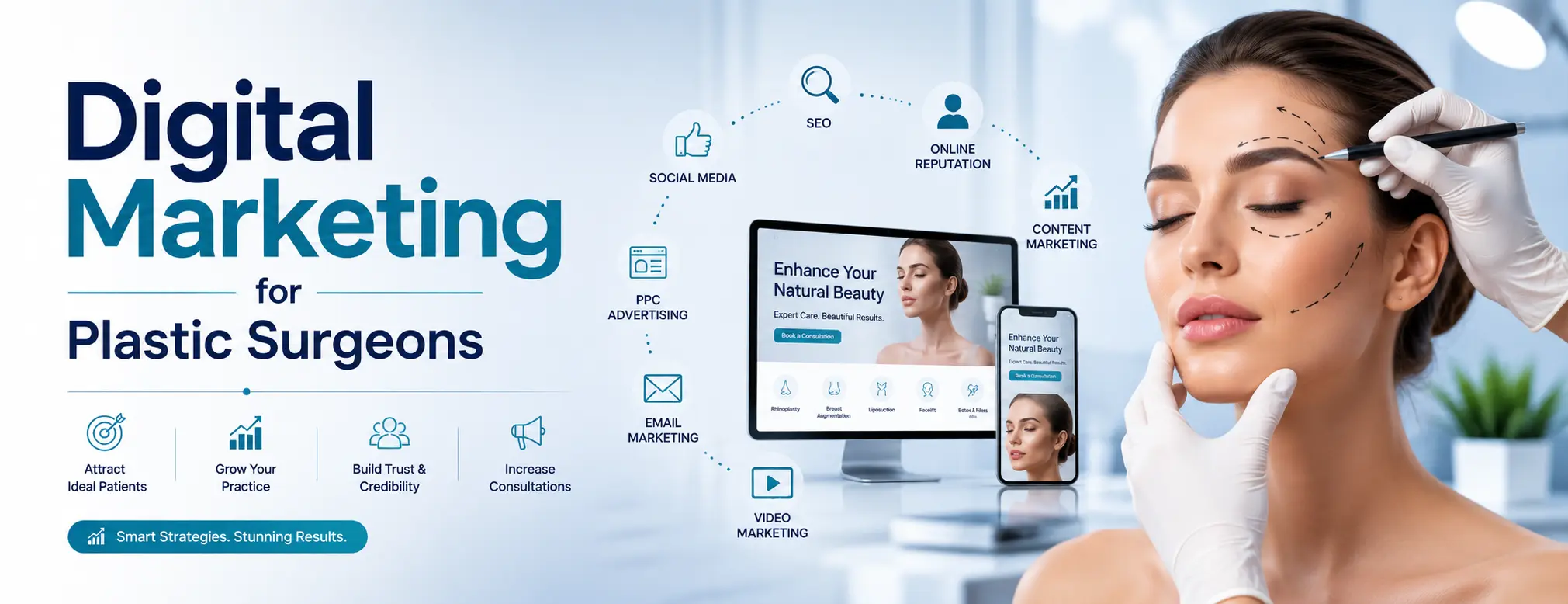
A prospective patient in Dubai wakes up at 7am. She has been thinking about rhinoplasty for six months. She opens Instagram. She scrolls for twelve minutes. She sees a before-and-after video from a clinic in Jumeirah — a real patient, confident smile, natural result. She taps the profile. She reads five more posts. She clicks the link in bio. She books a consultation for 7:20am.
That surgeon did not cold-call her. Did not advertise in a magazine. Did not hand out a brochure at a mall.
They simply had the right digital presence at the right moment — and they captured a high-value patient before their competitors even finished their morning coffee.
That is what digital marketing for plastic surgeons looks like in 2026. And across nine of the world’s most competitive aesthetic markets — UAE, Kuwait, Saudi Arabia, UK, Australia, Canada, Netherlands, New Zealand, and India — the surgeons who understand this are filling consultation calendars while others wonder why their referral numbers are stagnating.
This is the complete playbook. Built on real market data. Written for surgeons who want to grow
Table of Contents
The Market Has Changed — Your Marketing Needs to Keep Up
Let me give you a number that reframes everything.
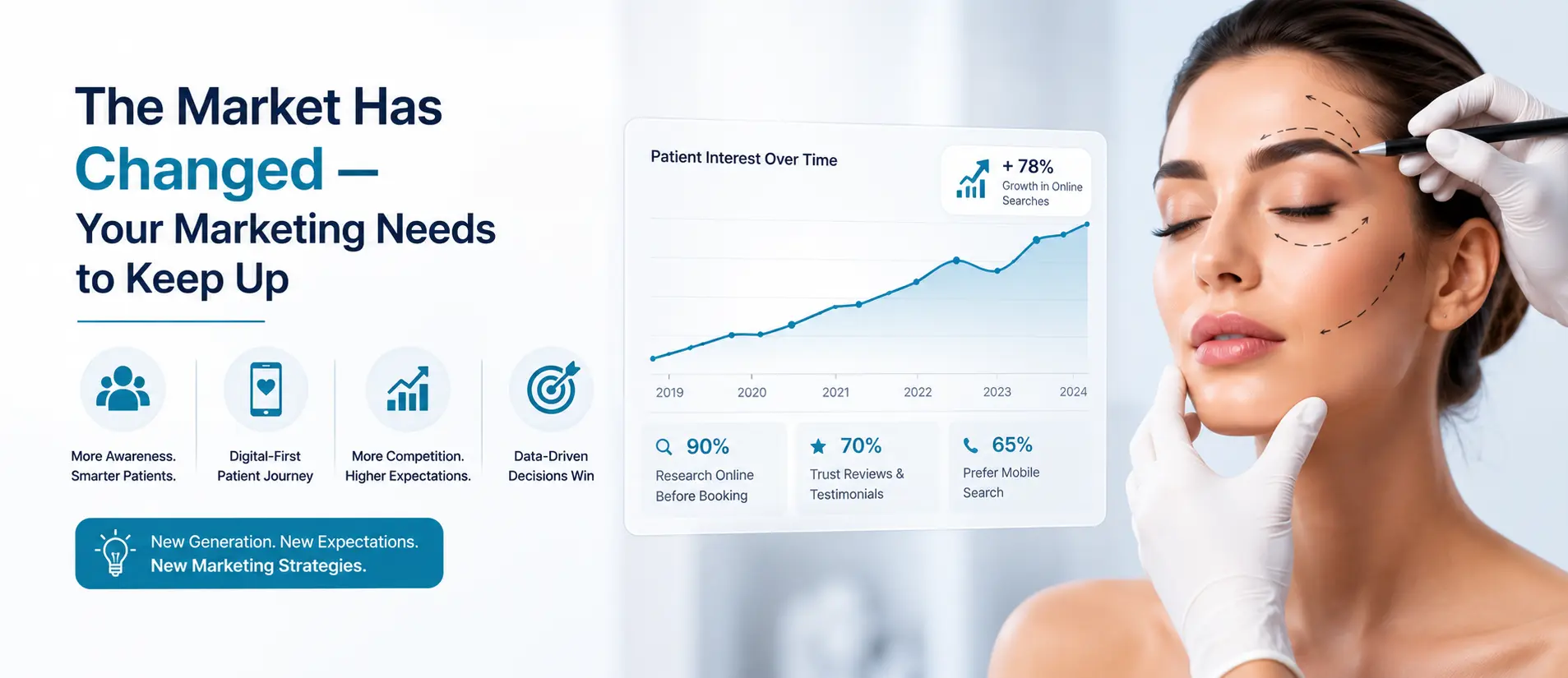
The global plastic surgery market is valued at $95.49 billion in 2026 and is projected to reach $245.46 billion by 2035, growing at an 11.06% annual rate.
The Middle East alone — your UAE, Kuwait, and Saudi markets — is a $1.93 billion cosmetic surgery sector on its way to $4.27 billion by 2033, growing at 9.39% annually. In the UAE specifically, the cosmetic surgery market is forecast to reach $880.9 million by 2033 at an 8.7% growth rate. Saudi Arabia is the fastest-growing regional market in the Middle East, projected to hit $1.8 billion by 2030.
These numbers tell you one thing: demand is not the problem. Discovery is.
Here is what has fundamentally shifted in the plastic surgery patient journey — and it applies whether you practice in Dubai, London, Toronto, Sydney, or Delhi.
Search engines now generate three times more patient leads than traditional referrals for plastic surgery practices. Three times. That means the patient who used to hear about you from a friend, then call to book, now researches you on Google for 14 days first. They read your procedure pages. They watch your Instagram Reels. They check your Google reviews. They ask ChatGPT which rhinoplasty surgeons in Dubai have the best results. And only after all of that trust has been built — silently, without you knowing — do they fill out your consultation form.
If your digital presence does not hold up during those 14 days of silent research, you are not being rejected. You are simply never being considered.
The markets in focus — UAE, Kuwait, Saudi Arabia, UK, Australia, Canada, Netherlands, New Zealand, and India — share one common characteristic despite their geographic and cultural differences. In every one of these markets, social media influence plays a defining role in whether a patient considers cosmetic enhancement in the first place, and digital search determines which surgeon they ultimately trust. In the Middle East, 95% of the population actively uses Instagram and TikTok, and approximately 65% report being influenced by social media content when considering aesthetic procedures.
That influence is your opportunity. And digital marketing for plastic surgeons is the system that captures it.
The Complete Digital Marketing Stack for Plastic Surgeons in 2026
Before we go channel by channel, let me say something that most marketing agencies will not tell you.
Plastic surgery marketing is not like marketing a restaurant or a clothing brand. Your patients are making a decision that involves their body, their appearance, their confidence, and often $5,000 to $50,000+ in investment. The research phase is long — typically 2 to 6 months. The emotional stakes are high. And the trust threshold required before someone books a consultation with you is significantly higher than in almost any other consumer category.
This means your digital marketing system must do two things simultaneously. Build authority fast enough to appear in search results. And build trust slowly enough that patients feel safe choosing you.
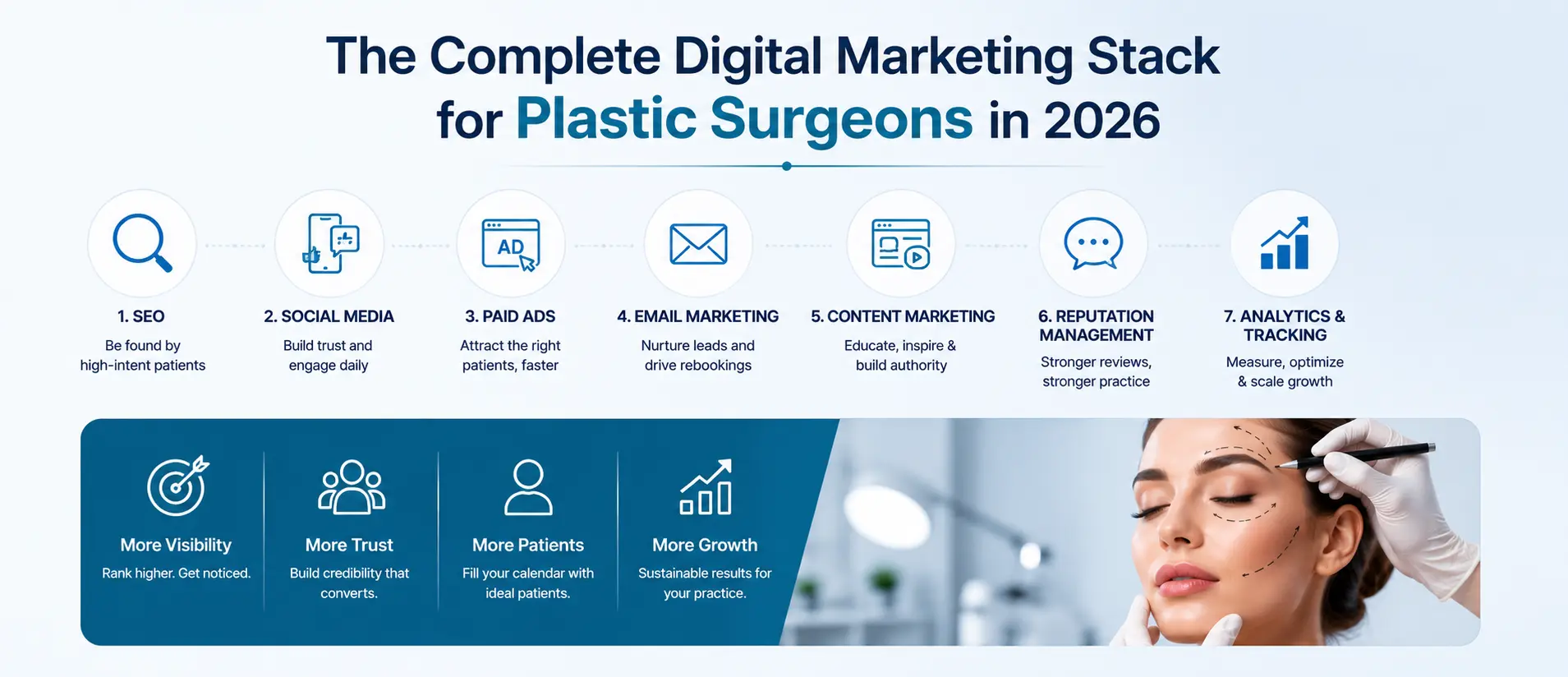
Here is how each channel contributes to that dual objective.
SEO: The Foundation That Compounds Across Every Market
SEO for plastic surgeons across international markets works on a consistent set of principles — but each geography has critical differences that determine whether you rank or disappear.
Every procedure your practice offers needs its own dedicated, SEO-optimized page. Not a list on a general “services” page. A dedicated page for rhinoplasty. A dedicated page for liposuction. A dedicated page for breast augmentation. Each page should include medically accurate procedure information, realistic outcome descriptions, your specific approach and technique differentiation, before-and-after photo galleries, FAQs, structured data markup, and a clear consultation booking pathway.
Why? Because a patient in London searching “rhinoplasty surgeon Harley Street” and a patient in Dubai searching “best rhinoplasty clinic Dubai” both land on procedure-specific results. Generic websites with a one-page services list rank for nothing specific and convert no one.
In the UAE and Saudi markets specifically, cosmetic surgery SEO carries the additional complexity of dual-language optimization. Arabic-language search queries represent a significant and growing share of cosmetic procedure research in these markets — and almost no international clinics have invested seriously in Arabic SEO infrastructure. That gap is enormous for surgeons with Arabic-speaking patient bases.
In the UK market, local SEO around the Harley Street corridor and major metropolitan areas — London, Manchester, Birmingham — requires high domain authority, strong review profiles on platforms like Trustpilot and Google, and consistent published content that signals clinical expertise. The UK’s Advertising Standards Authority (ASA) also regulates cosmetic surgery advertising with specific restrictions around before-and-after imagery and outcome claims — compliance-aware SEO content is non-negotiable here.
In Australia, TGA (Therapeutic Goods Administration) guidelines restrict certain types of cosmetic surgery advertising. Australian plastic surgeon SEO must work within these constraints while still generating discovery traffic — a balance that requires healthcare-native content expertise.
In Canada, PIPEDA privacy regulations shape how patient data is collected and used in digital campaigns. Canadian plastic surgery SEO campaigns must be designed with these compliance requirements embedded from the start, not retrofitted later.
Across all markets, local search visibility — your Google Business Profile, your Google Maps ranking, your review volume and rating on Google, RealSelf, and market-specific platforms — determines whether a local patient even reaches your website. A plastic surgery practice with 200 five-star Google reviews and an optimized GBP listing consistently outperforms a competitor with better clinical results but a neglected digital presence
Google Ads: The Fast Lane to High-Intent Patients
Google Ads for plastic surgeons is the most direct route to patients who are already searching for what you offer. Unlike social media, where you interrupt someone’s scroll, search ads appear when someone types “rhinoplasty surgeon Dubai” or “tummy tuck consultant London.” The intent is explicit. The conversion potential is immediate.
In the UAE and Gulf markets, Google Ads CPCs for cosmetic surgery terms range from AED 15 to AED 80, depending on procedure and competition level. Given that a single rhinoplasty in Dubai commands AED 18,000 to AED 45,000 and a full facelift significantly more, even a cost per consultation of AED 800 to AED 1,500 produces extraordinary ROI on high-ticket procedures.
The single biggest mistake plastic surgeons make with Google Ads across every market is sending paid traffic to their homepage. A patient who clicks an ad for “rhinoplasty Dubai” and lands on a general homepage showing all procedures, a team intro, a news section, and four navigation menus — that patient bounces within 45 seconds. The solution is procedure-specific landing pages: dedicated pages for each procedure, in each market, with one objective — book a consultation. Practices with optimized landing pages see 30 to 40% higher consultation rates than those sending traffic to their main site.
In the UK, Google’s advertising policies around cosmetic surgery have been updated in recent years. Campaigns must comply with ASA guidelines, meaning no guaranteed outcome claims, carefully worded testimonials, and specific image restrictions on before-and-after content. A Google Ads specialist who understands these constraints designs campaigns that convert within compliance — an expertise that generalist agencies often lack.
In Australia and New Zealand, the Google Ads landscape for cosmetic surgery follows TGA advertising guidelines, which restrict promotional claims about surgical outcomes. Campaigns must focus on informational angles — procedure education, surgeon credentials, practice values — rather than direct outcome promises.
Meta Ads: Where the Decision Begins Before the Search
Meta Ads for plastic surgery clinics — Facebook and Instagram — operate differently from search advertising because you are not capturing demand. You are creating it. Or more precisely, you are accelerating a consideration that a potential patient has been sitting with privately for months.
Before-and-after photo content remains the highest-performing creative format for plastic surgery Meta campaigns across every market — UAE, UK, Australia, Canada, and India included. Meta’s own advertising policies restrict certain types of before-and-after imagery, but properly presented, consent-cleared patient transformation content consistently generates 3 to 4 times more consultation inquiries than any other ad format.
In the Middle East markets — UAE, Kuwait, and Saudi Arabia — Instagram is particularly dominant. Instagram Reels featuring real patient journeys, surgeon technique videos, and clinic tour content generate significant organic reach that amplifies paid campaign performance. Snapchat is also meaningfully relevant in the Gulf, particularly for younger demographic patient acquisition in Saudi Arabia and Kuwait, where Snapchat usage rates are among the highest globally.
In the UK and the 55-year-oldNetherlands, Facebook’s demographic skew toward 35 to 55 year-old users aligns perfectly with the highest-spending age bracket in cosmetic surgery. Targeted Facebook campaigns reaching women aged 35 to 55 within specific postcodes in London, Manchester, or Amsterdam — filtering by income indicators and interest signals — deliver consultation leads at cost-per-acquisition levels that justify significant monthly ad investment.
The critical strategic element in Meta Ads for plastic surgeons is retargeting. Someone who visited your rhinoplasty page but did not book is a warm prospect, not a lost one. Retargeting campaigns — showing before-and-after carousels, surgeon credential content, and patient testimonial videos to website visitors who did not convert — recover 15 to 25% of those near-misses into booked consultations. Across a practice seeing 500 website visitors per month, that recovery rate represents meaningful additional revenue with no additional traffic spend.
Social Media and YouTube: The Trust Engine That Never Sleeps
Social media management for plastic surgery clinics serves a purpose that paid advertising cannot replicate. It is the evidence file that a prospective patient reviews when they are trying to decide whether to trust you with their face or body.
When a patient in Toronto finds a plastic surgeon through Google, the next thing they do — consistently, across every market — is visit the Instagram profile. What they find there determines whether they book or move to the next search result.
The highest-performing Instagram profiles for plastic surgeons in 2026 share three characteristics. First, consistent before-and-after content posted with patient consent, procedure-specific hashtags, and geo-targeting captions. Second, educational Reels — 30 to 90 second videos explaining procedures, recovery timelines, and what realistic results look like — that build clinical authority without selling. Third, human content — surgeon behind-the-scenes, consultation day clips, practice culture moments — that makes the surgeon feel like a person, not just a credential.
TikTok is now a significant patient discovery platform for plastic surgeons in UK, Australia, Canada, and New Zealand — particularly for attracting the 25 to 40 year old demographic seeking facial procedures, non-surgical treatments, and body contouring. The TikTok algorithm rewards educational, authentic content from medical professionals. A surgeon explaining the recovery process from a rhinoplasty in a three-minute TikTok — matter-of-fact, honest, visually engaging — outperforms heavily produced advertisement content in every engagement metric.
YouTube marketing for cosmetic surgeons builds the deepest form of patient trust available through digital channels. A potential patient who watches a 12-minute YouTube video of a surgeon explaining the facelift procedure they are considering — seeing the surgeon’s communication style, clinical approach, and patient empathy — arrives at the consultation already 80% decided. The consultation becomes a confirmation rather than a sales process.
Market-by-Market Strategy — What Actually Works Where
The digital channels are consistent across markets. But the execution differences are significant. Let me go market by market.
UAE and Dubai
Dubai is a global destination for medical tourism in cosmetic surgery. Patients from across the GCC, South Asia, and even Europe travel specifically for procedures at premium Dubai clinics. Marketing for a UAE plastic surgeon must therefore serve two audiences simultaneously: local residents and international medical tourists.
For local resident acquisition, Arabic-language SEO, Google Ads in both English and Arabic, and Instagram content in bilingual captions consistently expand reach to the Arabic-speaking patient base that English-only marketing completely misses. For international patient acquisition, the Google search terms “best plastic surgeon Dubai,” “rhinoplasty Dubai cost,” and “liposuction Dubai clinic review” receive substantial global search volume and should be the primary organic traffic focus.
Dubai Health Authority (DHA) regulations govern cosmetic surgery advertising in Dubai, including requirements around practitioner licensing verification, prohibited outcome guarantees, and specific restrictions on before-and-after content in public advertising. A compliance-aware digital marketing strategy works within these regulations rather than around them.
Saudi Arabia
Saudi Vision 2030 has positioned Saudi Arabia as a regional healthcare hub with significant investment in medical infrastructure. Riyadh and Jeddah are both growing centers for cosmetic procedures, particularly among Saudi women aged 25 to 45 and a fast-growing male patient segment interested in facial procedures and hair restoration.
Snapchat is the dominant social media platform among Saudi audiences — significantly more than in any other target market — and Snapchat advertising for cosmetic clinics in Saudi Arabia is genuinely underutilized. A plastic surgery clinic running targeted Snapchat campaigns in Riyadh and Jeddah, alongside Google Ads and Instagram, builds reach into audience segments that competitor clinics running only Meta campaigns completely miss.
Kuwait
Kuwait’s cosmetic surgery market is driven by high disposable incomes and strong social media influence. Instagram and Snapchat are the primary discovery platforms. The patient demographic skews younger — 22 to 35 — compared to many other markets, with significant interest in rhinoplasty, lip fillers, and non-surgical facial procedures. Kuwait-specific local SEO, combined with targeted Instagram Reels featuring Gulf-culturally appropriate content, is the most effective acquisition strategy here.
UK and the Netherlands
The UK market is highly competitive for plastic surgery, particularly in London. The Harley Street brand carries significant patient trust, and practices operating outside that corridor compete uphill for the same patient pool. SEO authority building — through medical press mentions, published clinical content, and backlinks from UK health publications — combined with Google Ads targeting procedure-plus-location keyword combinations, is the primary patient acquisition strategy that works.
In the Netherlands — Amsterdam and Rotterdam particularly — the aesthetic clinic market is growing rapidly with increasing cultural acceptance of cosmetic procedures. Dutch-language SEO is almost entirely unclaimed by serious plastic surgery content marketing. A clinic investing in Nederlandse content about rhinoplasty, abdominoplasty, and facial rejuvenation procedures is operating in a near-empty organic search landscape.
Australia and New Zealand
Australia’s cosmetic surgery market is sophisticated, with patients conducting detailed online research before any consultation. TGA compliance shapes everything from ad copy to website content — but within those guidelines, significant growth is achievable through local SEO dominance, Google Ads, and Instagram content. RealSelf, while US-centered, has meaningful Australian usage for procedure research.
New Zealand’s market is smaller but less competitive. A plastic surgeon in Auckland or Wellington investing in SEO-optimized procedure pages and a consistently managed Google Business Profile can achieve local search dominance within six to nine months with considerably less investment than the equivalent effort in Sydney or Melbourne.
Canada
Canada’s plastic surgery market spans major metro centers — Toronto, Vancouver, Montreal, Calgary — each with distinct competitive dynamics. Toronto is the most competitive; smaller cities offer first-mover SEO advantage. PIPEDA-compliant data collection, privacy-first form design, and Canadian-specific review platform presence (RealSelf, Google, RateMDs) shape the local digital marketing environment.
India
India’s cosmetic surgery market is undergoing rapid growth, driven by rising disposable incomes, social media influence, and decreasing stigma around aesthetic procedures. Rhinoplasty, liposuction, and hair transplant procedures are particularly high-search-volume categories. WhatsApp marketing automation — instant consultation inquiry response through WhatsApp, followed by automated procedure information sequences — is the single highest-ROI conversion tool for plastic surgery practices in India. A patient who inquires through a website form and receives a WhatsApp response within 90 seconds converts to a consultation at dramatically higher rates than one who receives a callback the next morning.
The AI Layer — Where Plastic Surgery Marketing Leads in 2026
Every plastic surgeon competing in 2026 is asking some version of the same question: Why is my marketing not performing the way it did two or three years ago?
Part of the answer is increased competition. More clinics. More spend. More sophisticated advertising. But the larger answer is that the patient discovery environment has fundamentally changed — and most practices have not updated their marketing infrastructure to match.
AI-driven search is reshaping how patients discover plastic surgeons. Patients in Dubai, London, Toronto, and Sydney are increasingly starting their cosmetic procedure research not with a Google search — but with a question to ChatGPT, Perplexity, or Gemini. “Which plastic surgeons in Dubai specialize in rhinoplasty?” “What should I ask a cosmetic surgeon before booking a facelift in London?” “Best breast augmentation clinics in Toronto with natural results?”
The AI answers that appear come from practices with structured, authoritative, entity-rich content that AI models can interpret and cite confidently. GEO for plastic surgeons — Generative Engine Optimization — is the practice of structuring your website content, FAQ sections, procedure pages, and medical articles so that AI answer engines select your practice as a credible, citable source.
Practices that appear consistently across Google, Google Maps, AI-generated answers, and social platforms are significantly more likely to earn the trust — and the consultation booking — of patients conducting multi-platform research.
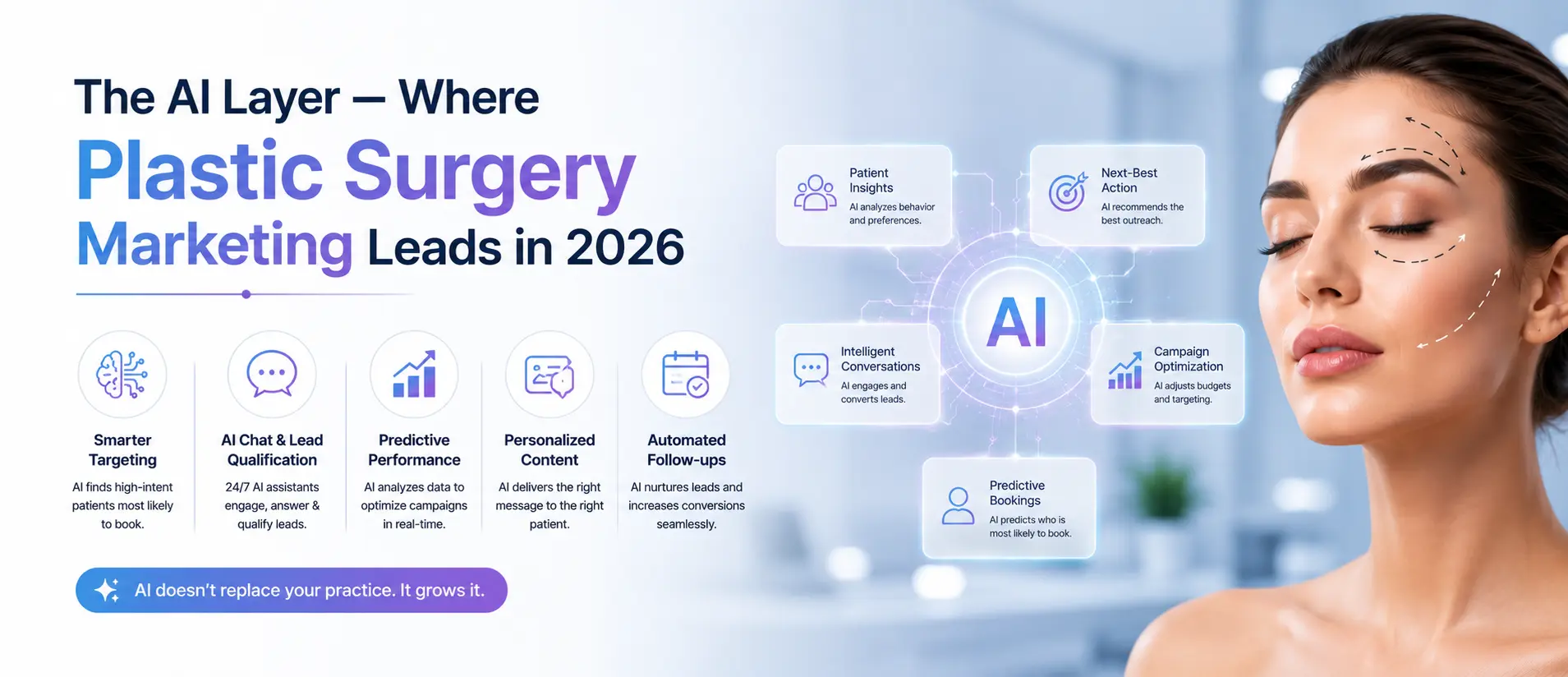
AI marketing automation for aesthetic clinics delivers three concrete benefits for plastic surgery practices in 2026.
Instant lead response. 75% of cosmetic surgery patients research procedures outside business hours. A patient who submits a consultation inquiry at 10pm and receives an automated, personalized response within 90 seconds — with procedure-specific information, surgeon credentials, a consultation booking link, and a warm acknowledgment — converts at dramatically higher rates than one who receives a callback the next morning. Agentic AI development services allow plastic surgery practices to deploy intelligent intake systems that qualify, respond to, and nurture leads around the clock without a receptionist.
AI video content at scale. AI video creation for plastic surgery clinics enables practices to produce before-and-after case study videos, procedure explanation content, and patient journey narratives at a fraction of traditional production costs. In 2026, the aesthetic practices posting 8 to 12 video pieces per month across YouTube, Instagram, and TikTok outperform those posting 2 to 3 polished pieces — because volume of authentic content compounds reach and trust faster than production quality alone.
Predictive patient profiling. AI analytics tools identify which website visitors, social media followers, and email subscribers are in active research phases for specific procedures — based on behavioral signals like page visit frequency, video watch time, and content type engagement. This allows your marketing to shift budget and attention toward the highest-intent prospects before they even contact you, improving conversion efficiency significantly.
What to Look for in a Digital Marketing Partner for Your Plastic Surgery Practice
The plastic surgery digital marketing agency landscape has grown substantially. Every generalist agency now claims healthcare expertise. Every social media manager claims aesthetic industry experience. The difference between a partner who grows your practice and one who takes your monthly retainer without results comes down to five specific competencies.
Healthcare and compliance-native thinking. An agency that has never navigated DHA regulations in Dubai, ASA guidelines in the UK, TGA restrictions in Australia, or PIPEDA requirements in Canada will make expensive mistakes — in ad copy, in content claims, in data handling. These are not minor risks. Compliance violations in medical advertising carry significant legal and reputational consequences. Your marketing partner must understand the regulatory environment of your specific market.
Before-and-after content strategy. The highest-converting content in plastic surgery marketing is also the most legally and platform-policy-sensitive. An agency that understands how to publish, promote, and optimize patient transformation content within the specific constraints of Meta’s advertising policies, Instagram’s organic guidelines, and your local regulatory requirements is worth significantly more than one that avoids before-and-after content because “it is complicated.”
GEO and AEO capability. SEO alone is no longer sufficient. As AI search grows in every target market, digital marketing services for aesthetic practices that incorporate Generative Engine Optimization — structured content designed to appear in ChatGPT, Perplexity, and Gemini responses — are building a search visibility moat that purely technical SEO cannot provide.
Multi-market expertise. A plastic surgery clinic targeting both local patients and international medical tourists — particularly relevant in UAE, UK, and India — requires an agency that understands how to build simultaneous digital strategies for different geographic audiences with different search behaviors, language preferences, and trust signals.
Consultation-focused metrics. If your marketing agency’s monthly report leads with clicks, impressions, and follower count — and nowhere mentions consultation bookings, cost per consultation, or patient acquisition cost — they are measuring the wrong things. The only metric that matters is consultations booked and the cost at which they were generated. Every channel, every piece of content, every campaign should be evaluated against that single output.
At DQOT Solutions, we build connected digital marketing systems for plastic surgeons and aesthetic practices — combining SEO, Google Ads, Meta Ads, social media management, YouTube growth, AI automation, and video content into a unified patient acquisition engine. We measure everything against consultations — not traffic.
Frequently Asked Questions
Digital marketing for plastic surgeons is a comprehensive online strategy that helps cosmetic surgery practices attract high-value patients through search engines, social media, paid advertising, reputation management, and AI-powered automation. It encompasses SEO to rank procedure pages in local search results, Google Ads to capture high-intent patient searches, Meta and Instagram campaigns to build awareness and trust, YouTube content to establish clinical authority, and AI systems to respond to leads instantly and nurture prospects through the research-to-consultation journey.
Because search engines now generate three times more patient leads than traditional referrals for aesthetic practices. The global plastic surgery market is valued at $95.49 billion in 2026, and patients in every major market — UAE, UK, Canada, Australia, and India — research cosmetic procedures online for weeks before contacting a surgeon. Without a strong, multi-channel digital presence, even exceptional surgeons with outstanding results remain invisible during the most critical phase of the patient decision journey.
The highest-ROI combination for plastic surgeons in 2026 is: procedure-specific SEO for each service offered, Google Ads targeting high-intent search queries with dedicated landing pages, Meta Ads using before-and-after and patient testimonial content, Instagram and TikTok for organic trust building and reach, YouTube for long-form clinical authority content, reputation management across Google and specialty platforms like RealSelf, and AI-powered lead response and nurture automation. GEO and AEO optimization for AI search engines is rapidly becoming essential across all target markets.
The core digital channels are consistent, but regulatory environments and platform dynamics differ significantly. UAE requires DHA-compliant advertising and benefits from Arabic-language SEO and Snapchat campaigns for Gulf audiences. UK marketing must comply with ASA cosmetic surgery advertising guidelines with specific restrictions on outcome claims and imagery. Australia operates under TGA restrictions on promotional content. Each market also has different dominant review platforms — Google, Trustpilot, RealSelf, and market-specific directories — where reputation management strategies must be tailored accordingly.
AI transforms plastic surgery patient acquisition in three major ways. First, GEO and AEO optimization ensures your practice appears in AI-generated search answers on ChatGPT, Perplexity, and Gemini — where an increasing share of cosmetic procedure research begins. Second, AI-powered lead response systems reply to consultation inquiries within 90 seconds, regardless of the time of day, dramatically improving conversion rates from inquiry to booked consultation. Third, AI analytics identify which website visitors and social media followers are in active research phases for specific procedures, allowing targeted follow-up before they contact competitors.
Digital marketing investment for plastic surgery practices varies by market, practice size, and growth goals. A foundational setup — local SEO, Google Business Profile optimization, basic Google Ads, and Instagram management — typically begins at $2,000 to $4,000 per month in Western markets. Full-service campaigns including procedure-specific SEO, Google Ads, Meta Ads, social media management, reputation management, and AI automation for established practices, range from $5,000 to $15,000+ monthly. In Middle Eastern markets, packages can be structured in equivalent local currency. The appropriate investment is always benchmarked against cost per consultation and patient lifetime value — a single rhinoplasty or facelift more than justifies a month of comprehensive marketing investment.
Before-and-after photo and video content is the highest-converting content format in cosmetic surgery marketing because it is the most direct evidence of surgical capability that a prospective patient can evaluate. Practices with optimized before-and-after galleries generate 3 to 4 times more consultation requests than practices with limited visual proof. Prospective patients — whether in Dubai, London, Sydney, or Toronto — are making a high-stakes decision about their physical appearance and want visual confirmation that a surgeon consistently produces natural, high-quality results before they book.
Google Ads and paid social campaigns can generate consultation inquiries within 2 to 4 weeks of launch when properly configured with optimized landing pages. SEO for plastic surgeons typically produces meaningful organic traffic growth within 4 to 8 months, with compounding returns that continue to grow without proportional increases in spending. AI-powered lead nurture systems improve consultation conversion rates from existing traffic within the first month of deployment. The practices that invest across all channels simultaneously — building organic authority while generating paid consultations — see the strongest growth trajectories at 6, 12, and 24 months.
The Consultation Calendar Is Fillable — If You Build the Right System
The results your patients experience are extraordinary. The skill you bring to each procedure is years in the making. The trust that a patient places in you when they choose your clinic for something this personal is profound.
None of that matters if the right patients cannot find you.
In Dubai, patients are booking rhinoplasty consultations with surgeons they discovered on Instagram at 7am. In London, facelift consultations are going to practices ranked first on Google — not necessarily the best surgeons in the city, but the best-marketed ones. In Toronto and Sydney, AI tools are recommending specific plastic surgeons by name to patients who ask a question about cosmetic procedures without ever typing a search term.
The plastic surgery market in 2026 rewards visibility. It rewards trust signals. It rewards the practice that shows up consistently, credibly, and compellingly across every platform a prospective patient uses to research their decision.
Digital marketing for plastic surgeons — when built as a connected system rather than a collection of separate campaigns — is how you fill that consultation calendar. Not with volume. With the right patients. The ones who arrive ready to trust you, already educated about the procedure, already convinced of your expertise.
That is what this playbook builds.
Ready to build a digital marketing system that fills your consultation calendar with high-value patients across the UAE, UK, Canada, Australia, and India?
Talk to the DQOT Solutions aesthetics marketing team today →