

The world sold nearly one trillion semiconductors in 2023. Let that number sit with you for a second.
One trillion chips. Powering your phone, your car, your hospital monitor, your AI assistant, your factory floor. And yet — if you walk into the marketing department of most semiconductor companies today, you will find one person, maybe two, running trade show logistics and updating a product brochure from 2021.
That gap between the size of this industry and the maturity of its marketing is not a problem. It is a massive, wide-open opportunity.
This is the 2026 playbook for digital marketing for semiconductor companies — written for the decision-makers, CMOs, founders, and business leaders who are ready to stop leaving pipeline on the table.

Table of Contents
The Numbers Do Not Lie — Why This Industry Cannot Afford Bad Marketing Anymore
Here is something most chip companies do not want to say out loud: the marketing hasn’t kept pace with the product.
The global semiconductor market hit $772 billion in revenue in 2025. It is on track to cross $975 billion in 2026 and touch $1 trillion by 2030. AI accelerator chips alone are forecast to drive nearly 50% of industry revenue — from less than 0.2% of total chip volume. That tells you everything about how concentrated, high-stakes, and relationship-driven this buying market really is.
But here is the other number nobody talks about at earnings calls.
66% of semiconductor manufacturers say their own content does not prompt action. Over two-thirds. Of a trillion-dollar industry.
B2B buyers in semiconductors now complete 57% of their buying journey before they ever speak to a sales rep. They are reading technical papers, watching product teardowns on YouTube, scrolling LinkedIn, and Googling things like “semiconductor B2B lead generation” and “chip company marketing strategy” at midnight before a procurement meeting. If your brand is not showing up during that research phase — with clear, trustworthy, technically accurate content — you are not in the consideration set. Full stop.
And India is becoming the center of gravity. The India Semiconductor Mission has 13 approved projects operational or under development as of mid-2026, including the first ATMP/OSAT semiconductor facility in Bhiwadi, Rajasthan. That is not a future opportunity. It is happening right now. Companies investing in India semiconductor sector digital strategy today are building a first-mover content moat that will compound for years.
Digital marketing for semiconductor companies is no longer a nice-to-have. It is a survival skill.

Why Semiconductor Marketing Fails — And What to Do Differently in 2026
I have worked with enough chip companies to know exactly where the marketing breaks down.
It always starts the same way. The engineering team builds something genuinely extraordinary. The product is real. The specs are impressive. The reliability data is there. And then the marketing team takes all of that and turns it into a PDF.
A PDF that nobody reads.
Here is the fundamental misdiagnosis: semiconductor marketing is not about generating leads the way a SaaS company generates leads. The real prize — the thing that moves revenue — is the design win. That is the moment when a buyer qualifies your chip, material, or process technology into their production line. That qualification cycle takes 12 to 24 months. The buying committee involves design engineers, SoC architects, procurement leads, and C-suite simultaneously. None of them want the same content.
Standard B2B marketing tactics fall apart in this environment because they are built for 30-day sales cycles, not 18-month ones.
What actually works in 2026:
The most effective digital marketing strategy for semiconductor industry brands right now combines four things working together — not separately.
First, problem-first content. Not “here is our chip’s performance benchmark.” Instead: “here is how our power IC solves the thermal management challenge in your EV battery management system.” Content organized around the buyer’s engineering problem, not the product’s feature sheet, generates 3x more engagement in this market.
Second, LinkedIn ABM at the account level. LinkedIn allows targeting by job title, company, and seniority. A 240-day ABM campaign targeting system architects, SoC verification leads, and procurement heads at 15 target accounts consistently outperforms mass-reach digital advertising in this space. The qualification timeline is long — but the deal sizes make the patience worth it. A single design win from a Tier-1 automotive OEM can be worth $12M+ in contract value over the program lifecycle.
Third, search-first content architecture. 89% of semiconductor engineers use search engines to stay current on technology. That means every question your buyer has during their research phase is a keyword opportunity for your brand. Investing in SEO for semiconductor companies through a proper pillar-and-cluster content structure — with a central resource like this one — creates compounding visibility that trade show booths never can. A well-executed SEO agency services approach builds organic traffic that works 24 hours a day without an additional media budget.
Fourth, gated technical assets. Whitepapers, application notes, teardown guides, and qualification reports — gated behind a lead capture form — convert high-intent researchers into marketing-qualified leads. Engineers downloading your PCB design guide at 11pm are the highest quality lead in your pipeline. Do not ignore them.
The semiconductor industry’s unique buying cycle demands marketing that sustains trust across 18 months. Not a single campaign. A content engine.
How AI Is Transforming Semiconductor Sales and Marketing Right Now
When people ask me how AI transforms semiconductor sales and marketing, I always tell them: stop thinking about it as a tool, and start thinking about it as a team member.
A smart, tireless team member who reads every piece of content your competitors publish, scores every inbound lead by their real likelihood to convert, personalizes every email sequence without you touching a keyboard, and can generate a technically accurate application note for a new power management IC in under four hours.
That is not science fiction. That is 2026.

AI-driven demand generation for semiconductor companies works across three layers.
The first is content production at scale. Semiconductor companies struggle with content volume — because writing accurate, technical content for engineers requires subject matter expertise that is hard to scale with a small marketing team. AI marketing automation, when trained on your product documentation and engineering IP, can generate first drafts of datasheets, application notes, blog posts, and social copy that your engineering team then reviews and approves. The output is not perfect on day one. But it is 70% of the way there — and that saves three weeks of calendar time per content piece.
The second is lead intelligence. AI intent data tools can identify companies in active design cycles — based on behavioral signals like white paper downloads, specification page visits, and LinkedIn content engagement — before those companies ever fill out a form. That gives your sales team a warm list of accounts to pursue before the RFQ lands on your desk. Getting ahead of the design cycle is the most valuable thing marketing can do for semiconductor sales.
The third is personalization across the buying committee. In semiconductor deals, you are marketing to an engineer, a procurement lead, and a C-suite executive simultaneously — with completely different information needs. AI-powered generative content tools allow a single campaign to deliver technically detailed product content to the engineer, TCO and supply chain analysis to procurement, and strategic market positioning to the CEO — without a separate copywriter for each audience.
AI marketing agent development and agentic AI development services are not experimental budgets anymore for forward-thinking semiconductor brands. They are core infrastructure. Companies that deploy AI-driven marketing automation in 2026 are compressing qualification cycles and getting to design wins faster than competitors still running manual outreach.
One more thing. AI video creation is rewriting the product demo format for chip companies. A 90-second AI-generated explainer showing thermal performance under load, cross-section chip architecture, and real application scenarios — produced from CAD data and product specs without a film crew — is now the most-shared technical content format on LinkedIn among semiconductor professionals. AI video creation for semiconductor brands is not a creative luxury. It is demand generation with a play button on it.
India’s Semiconductor Moment — And Why Your Digital Marketing Strategy Must Reflect It
India’s semiconductor story is no longer a government press release. It is construction crews, cleanroom installations, and engineering talent pipelines moving in real time.
Thirteen approved semiconductor projects. A dedicated India Semiconductor Mission with 12 schemes. The country’s first ATMP/OSAT facility now operational in Bhiwadi. Samsung, Tata, and multiple fab partners committing to domestic chip manufacturing. The Design Linked Incentive scheme actively subsidizing IC design companies building in India.
For semiconductor companies — whether they are global players entering India or Indian brands building internationally — the digital marketing for semiconductor companies in India space is almost completely uncontested right now. The content gap is extraordinary. There is almost nothing authoritative, well-researched, and search-optimized being written about semiconductor marketing strategy from an India perspective.
That is your advantage. And it will not last.
Here is what a smart India semiconductor sector digital marketing strategy looks like in 2026:
India-specific content architecture. Write for Indian procurement leads, engineering graduates from IITs and NITs entering the chip design workforce, and policy-facing marketing targeting ISM stakeholders. A dedicated content cluster around India semiconductor market opportunities, ATMP marketing, and semiconductor manufacturing India marketing is virtually unconquered from an SEO standpoint. KD scores are below 15 on most of these terms. You can own this space within six months with consistent, high-quality publishing.
Regional language SEO. English-only content leaves 70% of India’s technical talent on the table. Hindi, Telugu, Tamil, and Kannada semiconductor content is three to five years behind English in competitive density. First-mover advantage in regional language technical content for engineers in India is one of the highest-ROI plays available to any electronics or semiconductor brand marketing in this country right now.
LinkedIn for the Indian chip ecosystem. India’s LinkedIn user base in the semiconductor and electronics space has grown 40%+ year-over-year. Design engineers, VLSI professionals, chip layout specialists — they are active, they are scrolling, and almost none of their feeds contain semiconductor brand marketing that speaks to them with any real specificity or cultural fluency.
Google Ads for design-win acceleration. High-intent keywords around specific semiconductor applications — power management for EV battery systems, MOSFET specifications for solar inverters, CMOS sensor specs for surveillance cameras — are available at CPCs that would make a SaaS marketer cry. Google Ads management for semiconductor companies targeting procurement-phase keywords in the Indian market is among the most capital-efficient paid media plays available in B2B tech right now.
The India semiconductor sector is not a future bet. It is a present market — and the marketing landscape is empty.
Building Your Full Digital Marketing Stack for Semiconductor Growth
Let’s bring this together practically. You are a CMO, a VP of Marketing, or a founder at a semiconductor or electronics company. You know your product is strong. You want a clear picture of what your digital marketing stack should look like in 2026 and beyond.
Here is the architecture — not as a list of tools, but as a system.
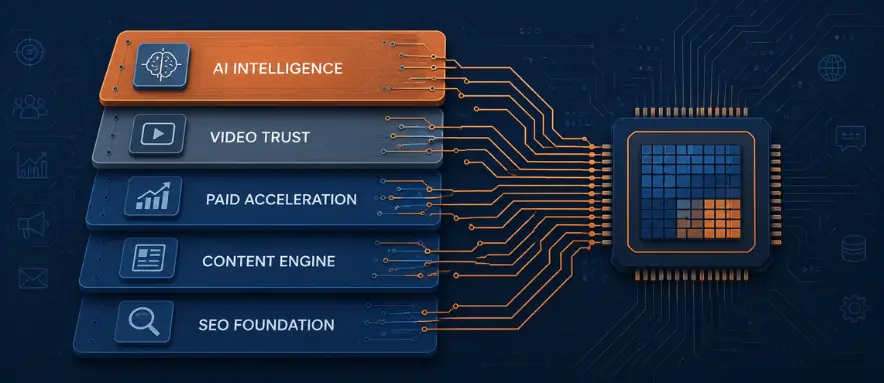
The Foundation: SEO and Content
Your website is a 24-hour salesperson. Digital marketing company services that understand the semiconductor buying journey will build your content around pillar pages targeting high-volume industry terms — like this one — supported by cluster content targeting specific engineering queries. Every content piece should load with schema markup, target PAA boxes, and build toward Featured Snippet capture on informational queries. That is how your brand stays visible during the 57% of the buying journey that happens before sales contact.
The Acceleration Layer: Paid Media
Organic content builds trust. Paid media accelerates reach. For semiconductor brands in 2026, the most effective paid channels are:
Google Ads targeting procurement-intent search terms — “power semiconductor supplier”, “automotive-grade MCU sourcing”, “OSAT packaging services” — where a single conversion can justify months of spend.
Meta Ads for reaching electronics engineers, procurement managers, and startup founders in the consumer electronics and EV segments — audiences that are harder to reach on LinkedIn but large and engaged on Meta platforms.
LinkedIn Ads and social media management for direct ABM targeting of decision-makers at OEMs, Tier-1 automotive suppliers, and hyperscaler data center procurement teams.
The Trust Engine: Video and Thought Leadership
YouTube marketing for semiconductor brands is criminally underutilized. Video content — product teardowns, application demos, founder interviews, fab tour footage — increases engineer engagement by 40% in tech-heavy industries. Your competitors are not doing this well. The YouTube channel with technically credible, well-produced semiconductor content has almost no real competition outside of a handful of large players.
The Intelligence Layer: AI and Automation
Marketing automation for the semiconductor industry is not optional at scale. Agentic AI development services allow semiconductor marketers to deploy intelligent agents that score leads by intent signal, trigger personalized nurture sequences by buyer role, and surface sales intelligence at the right moment in a 12-month qualification cycle.
This is not a future stack. Every piece of it is operational and deployable today.
What Semiconductor Brands Get Wrong About Branding and Web
Here is the uncomfortable truth about most semiconductor company websites.
They were designed to impress other engineers. Not to convert buyers.
The specs are there. The datasheets are downloadable. The certifications are listed. And there is almost nothing on the homepage that tells a new visitor — in under eight seconds — what problem this company solves, for whom, and why they are the right choice.

Brand awareness in the semiconductor space is driven by performance benchmarks in 85% of cases. That means your brand story should lead with performance proof — not with company history, not with founding year, not with a photo of your headquarters.
Semiconductor branding and web solutions in 2026 start with one question: what is the single most painful problem your buyer faces, and how does your product solve it more reliably than anyone else?
The answer to that question should be in your H1.
It should be in your meta title.
It should be the first thing a design engineer reads when they land on your product page at 11:45pm, running a specification comparison before a procurement committee meeting the next morning.
The brands winning in 2026 treat their website as a strategic marketing asset — with continuous A/B testing, heat mapping, content refresh cycles, and conversion optimization built into the quarterly roadmap. Not a static brochure. A living system.
Strategic semiconductor brand growth is not about being louder. It is about being clearer, faster, and more trusted than the alternative.
The SEO and LLM Visibility Layer — How Search and AI Answer Engines Find You in 2026
There are two kinds of search in 2026. Google search. And AI search.
Perplexity, ChatGPT with Browse, Gemini, Claude — these AI answer engines are already directing research traffic. When a procurement lead at a Tier-1 EV manufacturer asks ChatGPT “what are the best semiconductor marketing agencies in India,” the answer that appears is not the one with the most backlinks. It is the one with the clearest, most entity-dense, most authoritatively structured content on the topic.
For Google SERP visibility, your semiconductor digital marketing content needs:
- Featured Snippet targeting through clean 40–60 word definition blocks under every informational H2
- People Also Ask (PAA) coverage through a structured FAQ section with schema markup
- Core Web Vitals compliance — speed, stability, interactivity — because Google’s ranking signals in 2026 punish slow, unstable pages more harshly than ever
- Internal linking between pillar content and service pages to distribute authority signals
- E-E-A-T signals — Experience, Expertise, Authoritativeness, Trustworthiness — built through author bios, cited data, linked credentials, and consistent publishing
For LLM citation visibility, your content needs:
- Precise entity usage — terms like Design Win, ATMP, OSAT, SoC, Fab, Foundry, ABM, chiplet architecture — used accurately and in context
- Structured answers that directly address the most common questions your audience searches
- Original data points, research citations, and real industry statistics that give AI answer engines something worth quoting
- A clear, authoritative voice — not neutral, not hedged, not generic — because AI models select content from sources that read like experts, not aggregators
The semiconductor marketing agency landscape is almost entirely missing this layer. The companies that build it now — that optimize simultaneously for Google, for Perplexity, for ChatGPT Browse, and for Gemini — will dominate search-driven B2B discovery for the next three to five years.
That window is open right now. It will not stay open.
Frequently Asked Questions
Digital marketing for the semiconductor industry is a specialized B2B growth strategy that uses SEO, content marketing, paid advertising, LinkedIn campaigns, AI automation, and video to help chip manufacturers, fab operators, OSAT facilities, and electronics brands generate qualified leads, accelerate design wins, and build lasting brand authority with engineers, procurement teams, and executive decision-makers.
Semiconductor marketing operates on 12–24 month qualification cycles rather than 30-day sales funnels. The goal is a design win — not just a lead. Buying committees include design engineers, SoC architects, procurement managers, and CEOs simultaneously. Content must be technically precise, problem-first, and sustained across a much longer relationship timeline than standard B2B campaigns.
Because 89% of semiconductor engineers use search engines to research technology, and B2B buyers complete 57% of their purchase journey online before contacting sales. Without strong SEO for semiconductor companies, technical content, and a visible digital presence, brands are invisible during the most influential phase of the buyer’s decision-making process.
The highest-ROI strategies for semiconductor companies in 2026 are: pillar-page SEO content targeting engineering search queries, LinkedIn ABM campaigns for design-win acceleration, Google Ads targeting procurement-intent keywords, AI-powered marketing automation for long nurture cycles, gated technical assets for lead capture, and YouTube video content for product demonstrations and thought leadership.
AI transforms semiconductor marketing through predictive lead scoring, content personalization across multiple buyer roles, automated nurture sequences for 18-month sales cycles, AI-generated technical content drafts, and intent data that identifies accounts in active design cycles before they raise their hand. Agentic AI systems are now being deployed by leading semiconductor brands to compress qualification timelines and improve design-win rates.
India has 13 approved semiconductor projects under development as of mid-2026, a growing base of VLSI and chip design engineers, and almost no authoritative digital marketing content targeting the Indian semiconductor ecosystem specifically. Keyword difficulty scores for India-specific semiconductor terms are below 15 in most cases. Companies investing in India semiconductor mission marketing and regional digital strategy now have a first-mover advantage that will compound significantly over the next three to five years.
Paid media (Google Ads, LinkedIn Ads) typically generates qualified traffic within 30–60 days. SEO and content marketing builds compounding organic traffic over 6–12 months. ABM campaigns targeting design-win accounts operate on the 12–24 month timeline of the semiconductor qualification cycle itself. The companies that invest consistently across all three layers — rather than looking for a quick win — build the most durable competitive advantage.
DQOT Solutions brings together deep B2B technical content expertise, full-service digital marketing capabilities — from SEO and Google Ads to AI marketing automation and video creation — and a data-driven approach built specifically for complex, long-cycle industries. Our team understands the semiconductor marketing stack end to end: from driving top-of-funnel awareness through search and social, to enabling design-win conversations with technically credible content that engineers and procurement teams actually trust.
The Bottom Line
The semiconductor industry is building the infrastructure of the next century. AI chips, EV power systems, 5G networks, autonomous vehicles, smart cities — all of it runs on silicon. And the companies that will win the most valuable customer relationships in this market are not necessarily the ones with the best chips.
They are the ones that show up — consistently, credibly, clearly — at every stage of the buyer’s research journey.
Digital marketing for semiconductor companies is not about being louder than your competitors. It is about being findable, trustworthy, and genuinely useful when your buyer needs you most.
The playbook is written. The market is moving.
The question is whether your brand will be in the room when the decision gets made — or whether you’ll still be updating that brochure from 2021.
Ready to build a semiconductor marketing strategy that wins design-ins and drives real pipeline?