

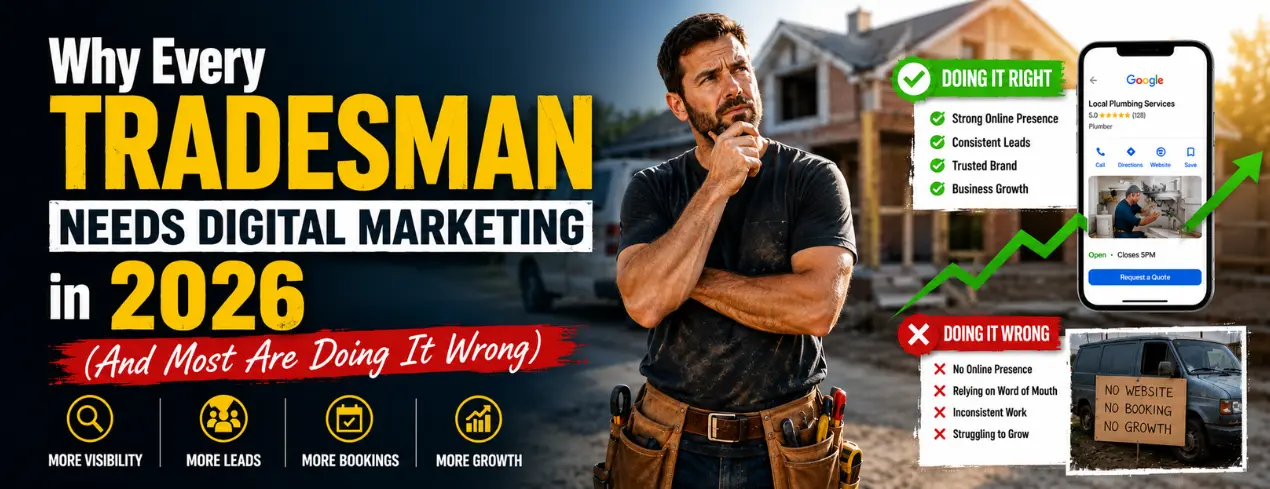
You didn’t get into the trades to become a marketer. You got in because you’re good with your hands, you solve real problems, and there’s genuine satisfaction in work that’s built to last. Whether you’re an electrician rewiring a terraced house in Leeds, a plumber clearing drains in Melbourne, a builder laying foundations in Toronto, or a multi-skilled tradesman juggling five job types in Auckland — you got here because of skill, grit, and reputation.
But here’s the uncomfortable truth that most trade businesses are waking up to in 2026: the way people find a tradesman has changed completely. Word of mouth alone won’t keep your calendar full anymore. Your neighbour’s recommendation is now a Google search. That yellow pages ad you ran in 2014 is now a Google Business Profile listing. And the client who used to ask around at the pub is now typing “find a tradesman near me” on their phone while standing in their flooded kitchen.
The trades businesses winning right now — the ones with booked-out schedules, premium rates, and crews of ten — they’re not necessarily better tradies than you. They’ve just learned how to be found.
This guide is the honest, no-fluff breakdown of what digital marketing for tradespeople actually looks like when it’s done right. We’ll cover everything from local SEO to Google Ads to AI chatbots — and we’ll tell you what genuinely moves the needle versus what’s just noise.
Table of Contents
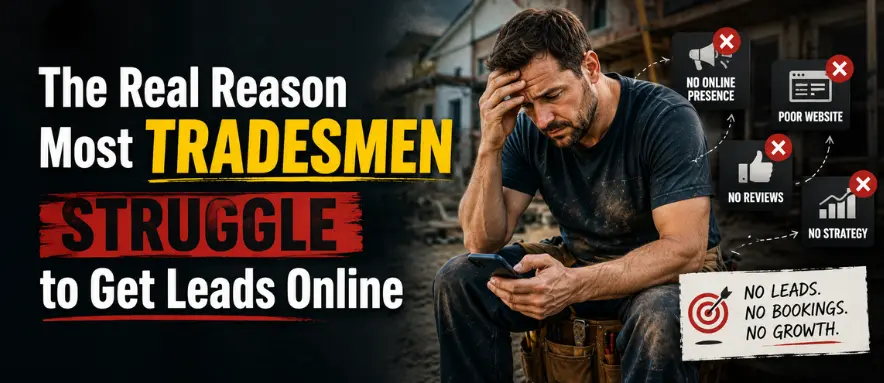
The Real Reason Most Tradesmen Struggle to Get Leads Online
Before we get into tactics, it’s worth understanding why most trades businesses are invisible online — even the good ones.
It comes down to three things:
1. They rely entirely on job platforms instead of owning their presence
Platforms like Checkatrade, Rated People, MyBuilder (UK), HiPages, ServiceSeeking (Australia), HomeAdvisor, Thumbtack (USA), HomeStars (Canada), and similar directories are where most tradespeople start. And they work — up to a point. But here’s the problem: you’re renting visibility on someone else’s platform. You’re paying for leads that could be going directly to you. You’re one algorithm change away from your pipeline drying up overnight.
The tradesmen who scale sustainably own their digital real estate. They have a website that ranks. They have a Google Business Profile that dominates local search. They run ads that they control.
2. They have no system for turning satisfied customers into digital proof
In the physical world, a happy customer tells three people. In the digital world, a happy customer leaving a Google review tells three thousand. The trusted tradesmen who dominate search results in every city have one thing in common: they have a consistent, systemised process for collecting reviews, responding to them, and displaying them prominently. It’s not luck. It’s process. read this digital marketing for roofers.
3. They’re invisible to the algorithm because nobody built them a digital foundation
If Google can’t find you, your customers can’t find you. It’s as simple as that. And Google’s algorithm — especially for local searches like “find a tradesman near me” or “local tradesmen [city]” — rewards businesses that have invested in the basics: a properly set up Google Business Profile, a fast mobile-optimised website, consistent NAP (name, address, phone) citations across directories, and a steady stream of fresh, relevant content.
None of this is complicated. But someone has to do it.
Local SEO for Tradesmen — The Foundation of Everything
If you only do one thing from this entire guide, do this: get your local SEO right.
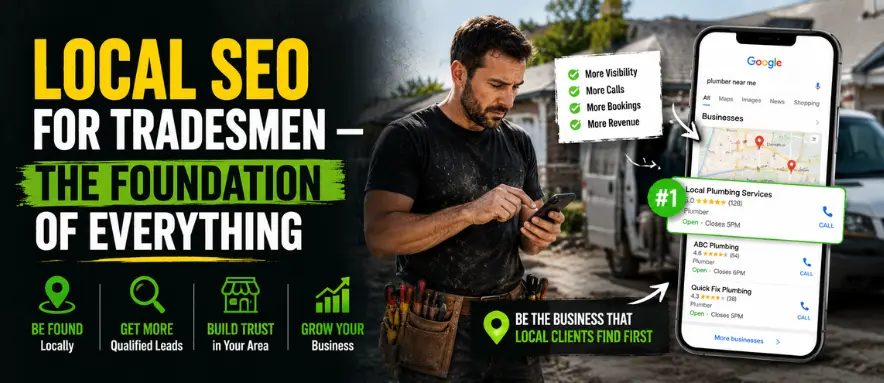
Local SEO for tradesmen is the process of making your business appear when someone in your area searches for your service. When someone types “electrician near me,” “find a plumber in [city],” or “local tradesmen [suburb]” — local SEO is what determines whether your business appears in the top three results or disappears into page two where nobody looks.
Google Business Profile: Your Most Powerful Free Tool
Your Google Business Profile (formerly Google My Business) is the single most impactful thing you can optimise right now. It’s free, it directly feeds the local pack (those three map results that appear at the top of local searches), and it’s where most of your first-impression happens.
Here’s what most tradesmen get wrong: they set it up once, leave it, and wonder why competitors are outranking them. Optimising your GBP is an ongoing job, not a one-time task.
What actually works:
- Choose the most specific primary category (don’t just pick “Contractor” when “Electrician” or “Plumber” is available)
- Write a description that naturally includes phrases like “trusted tradesman,” “local tradesmen,” and your specific service area — but write it for humans first, algorithms second
- Add photos of completed jobs regularly. Real photos outperform stock images every single time
- Post weekly updates — job completions, seasonal service reminders, before/after shots
- Respond to every single review, positive and negative. This signals to Google that you’re active and to customers that you care
- Enable messaging so potential clients can contact you directly from search results
In the UK, the tradesman directory ecosystem is competitive. In the US, local markets like Texas, Florida, and California are flooded with contractors. In Australia, the major cities (Sydney, Melbourne, Brisbane) have fierce local competition. In Canada and New Zealand, smaller markets actually reward good local SEO faster because fewer tradespeople are doing it properly. The fundamentals are the same everywhere.
On-Page SEO for Tradesman Websites
Your website needs to tell Google exactly what you do, where you do it, and who you serve. That sounds obvious, but you’d be amazed how many trades websites have a homepage that just says “Welcome to Dave’s Plumbing” with no suburb mentions, no service descriptions, and no signals for search engines to work with.
Every service page on your website should:
- Target a specific service + location combination (“Emergency Electrician Manchester,” “Roof Tiling Sydney,” “Bathroom Fitting Toronto”)
- Include natural mentions of related terms: rated tradesmen, recommended tradesmen, experienced contractor, trusted local tradesman
- Have genuine customer testimonials with specific details (first name, suburb, job type)
- Include a clear call to action above the fold — phone number, contact form, or WhatsApp button
- Load in under three seconds on mobile. More than half of people looking for a tradesman are doing it on a phone
For tradesmen operating across multiple areas, creating individual location pages for each service area isn’t over-engineering — it’s how you rank in five suburbs instead of one.
Citation Building and Directory Listings
Beyond your website and GBP, Google cross-references your business information across the web. This is why being listed — correctly and consistently — on trade directories matters.
In the UK: Checkatrade, Rated People, MyBuilder, TrustATrader, Which? Trusted Traders
In Australia: HiPages, ServiceSeeking, Oneflare, hipages
In the USA: HomeAdvisor, Thumbtack, Angi (formerly Angie’s List), Houzz
In Canada: HomeStars, Kijiji Services, Houzz
In New Zealand: Builderscrack, Neighbourly, No Cowboys
In the Netherlands, France, Malta, and Brazil: local equivalents vary, but Google Business Profile and Yelp remain universally relevant
The key is consistency. If your business is listed as “Dave’s Electrical Services” on your website but “D&J Electrical” on a directory with a different phone number, those inconsistencies confuse Google and hurt your ranking.
Building a Website That Actually Wins You Work
A trades website doesn’t need to be fancy. It needs to be functional, trustworthy, and built to convert.
The best website to find a tradesman — from the customer’s perspective — is one that answers their three core questions instantly: Can you do the job? Are you in my area? Can I trust you?
Your website needs to answer all three in the first ten seconds of someone landing on it.
What a High-Converting Tradesman Website Includes
A clear, specific headline — not “Quality Work at Competitive Prices” (everyone says this, it means nothing). Instead: “Emergency Electrician Covering [City] & Surrounding Areas — Available 7 Days.”
Social proof front and centre — your star rating, number of completed jobs, how long you’ve been trading. Customers looking for trusted tradesmen are making a risk assessment. Make it easy for them to trust you.
Real photos, not stock images — photos of your actual work, your actual team, your actual van with your logo on it. These build trust faster than any copywritten line.
A mobile-first click-to-call button — if someone is standing in their bathroom watching water pour through the ceiling, they’re not filling out a form. They need to call you in one tap.
A services page for each core service — not a single page that lists everything. Individual pages for each service (electrical, plumbing, roofing, etc.) rank separately and convert better because they speak directly to what the visitor searched for.
A reviews page or embedded Google reviews — rated tradesmen and recommended tradesmen consistently outperform unreviewed ones in conversion. 87% of consumers read reviews before choosing a local service provider.
Clear service area — list every suburb, city, and region you cover. This helps both SEO and conversion. Customers want to know you’re actually local.
FAQ section — this is underused and genuinely powerful. Answer the questions your customers actually ask: How much does a rewire cost? Do you offer free quotes? Are you insured? How quickly can you come out? This content ranks for question-based searches AND builds trust.
Google Ads for Tradesmen — Fastest Route to Qualified Leads
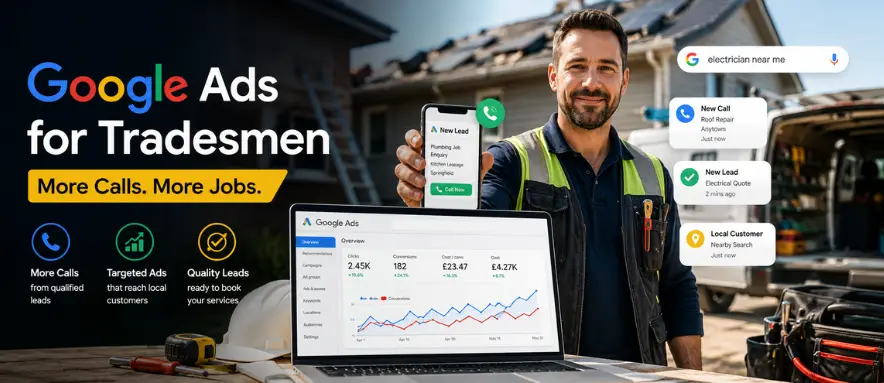
SEO takes time. If you need leads now — next week, not next year — Google Ads is the most direct route to getting your phone to ring.
Google Ads for tradesmen works on a simple principle: you appear at the top of search results when someone in your area searches for exactly what you do. You only pay when someone clicks. Done properly, it’s the most cost-effective paid advertising channel available to trades businesses.
The word “done properly” is doing a lot of work in that sentence, though. Most tradespeople who’ve tried Google Ads and said “it doesn’t work” ran campaigns that were poorly structured, targeted too broad an audience, bid on the wrong keywords, or sent traffic to a homepage that didn’t convert. The ads weren’t the problem. The setup was.
What Good Google Ads Looks Like for a Tradesman
Tight, specific ad groups — one ad group per service type. Your plumbing ads shouldn’t be lumped with your heating ads. Each service needs its own keywords, its own ad copy, its own landing page.
Location targeting done correctly — targeting your actual service radius, not some arbitrary city-wide or nationwide setting that wastes budget on clicks from areas you don’t serve.
Negative keywords from day one — if you’re an electrical contractor, you don’t want to pay for clicks from people searching “electrical engineering jobs” or “electrical tradesman salary.” Negative keywords prevent this waste. This is where most DIY campaigns haemorrhage money.
Ad copy that speaks to urgency and trust — “Emergency Electrician Available Now,” “Fully Insured, Free Quote, 5-Star Rated.” People searching for a tradesman are often in a reactive state. Speak to that.
Call extensions and call-only ads — for emergency services especially, a call extension (which puts your phone number directly in the ad) dramatically increases conversion rate. Many trade searches end in a phone call, not a website visit.
Landing pages built for conversion — sending ad traffic to your homepage is like putting a billboard outside your house and telling people to walk around the back to find the entrance. Each service ad should go to a dedicated page for that exact service, in that exact area.
Working with a Google Ads management company that has specific experience in trades means campaigns are built from the ground up with all of these elements in place — and continuously optimised based on actual conversion data.
Local Services Ads (Google Guaranteed)
In the US, UK, Canada, and Australia, Google’s Local Services Ads (LSA) product deserves a special mention. These appear above regular Google Ads and organic results with a “Google Guaranteed” or “Google Screened” badge. For trades specifically — plumbers, electricians, HVAC, locksmiths — this placement is enormously powerful.
The Google Guaranteed badge directly addresses the “can I trust this person in my home” anxiety that every customer has. It’s essentially Google vouching for you. The conversion rates are consistently higher than standard search ads for trade services.
Getting set up involves a background check and license verification — a process similar in concept to tradesmen international onboarding procedures that established global platforms use to verify contractor credentials before listing them. It’s a bit of admin upfront, but the trust signal it creates is worth every minute.
Meta Ads for Tradesmen — Building a Pipeline Before People Are Ready to Buy
Google Ads capture demand that already exists. Meta Ads (Facebook and Instagram) create demand. These are fundamentally different — and both have a place in a mature trades marketing strategy.
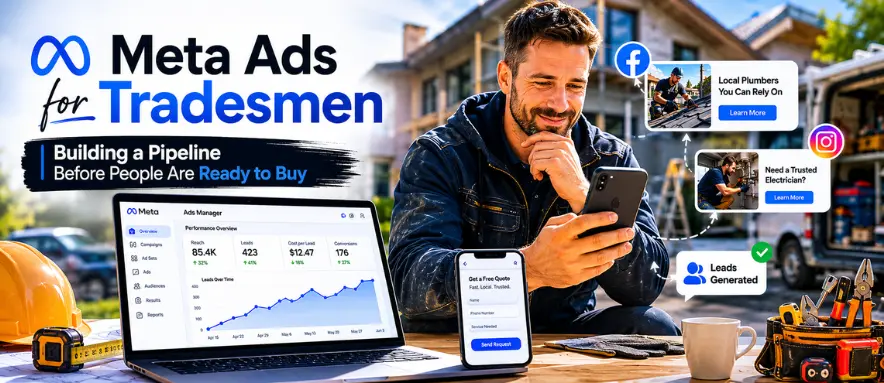
Most tradespeople underestimate Meta. They think it’s for B2C brands selling trainers and skincare. But consider the reality: a homeowner who’s been thinking about getting their bathroom redone, planning a loft conversion, or budgeting for new central heating doesn’t start that journey with a Google search. They get inspired. They see a before-and-after on Instagram. They notice a Facebook ad from a local tradesman showcasing a kitchen they installed. They save the post. Six weeks later, they’re ready to get quotes.
Meta Ads for tradesmen work by getting in front of the right people before they’re in “buy now” mode, so that when they are ready, you’re already top of mind.
What Works on Meta for Trades Businesses
Before-and-after content — this is the format that consistently performs best for trades on Meta. A bathroom transformation. A garden that went from scrub to landscaped paradise. A house exterior that went from dated to contemporary. These posts stop the scroll because the contrast is visually striking.
Video walkthroughs of completed jobs — a 60-second phone-filmed walkthrough of a finished job, with a brief voiceover explaining the challenge and how you solved it, routinely outperforms polished corporate content. Authenticity wins on social media.
Retargeting website visitors — if someone has visited your website, they’ve shown interest. A retargeting ad that follows them across Facebook and Instagram is a cost-effective way to stay visible to warm prospects.
Seasonal campaigns — boiler servicing before winter. Air conditioning before summer. Guttering after autumn. Decking and fencing in spring. The trades calendar has natural peaks. Meta Ads let you front-run them with targeted campaigns in your exact service area.
Lead form ads — Meta’s native lead form ads (where the contact form is built into the ad itself, without the user needing to visit your website) work particularly well for services like free quotes, inspections, or consultations.
A specialist Meta Ads management company with trades experience understands how to structure these campaigns for the longer consideration cycles typical of home improvement and trade services — not the impulse-buy logic that works for ecommerce.
Social Media Management for Tradesmen — Turning Followers into Customers
Social media is where trades businesses build brand equity over time. It’s not where you’ll get an emergency call-out tomorrow — that’s Google’s job. It’s where you build the reputation that makes someone choose you over the faceless contractor two listings below you.
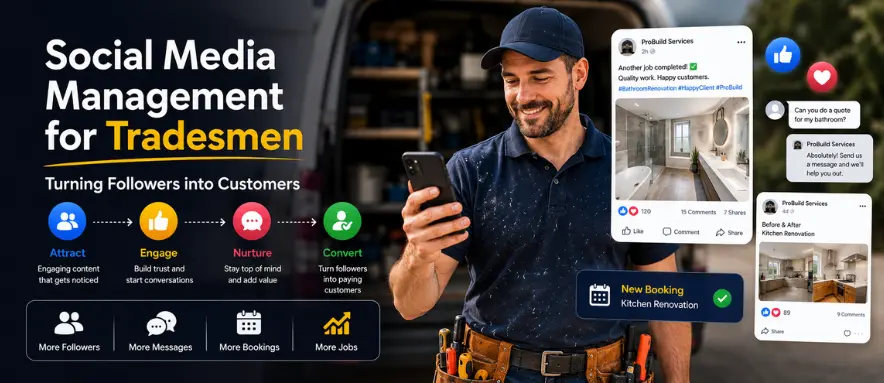
Here’s what consistent social media presence does for a tradesman:
It shows you’re active and established. A business with 200 posts and a history of completed jobs looks radically more trustworthy than one with three posts from 2021.
It creates shareable proof of your work. Every satisfied customer who shares your post, tags your business, or comments on your work is extending your reach into their social network — for free.
It allows you to speak directly to your local community. Trades businesses are hyperlocal. Social media — especially Facebook local groups, Nextdoor, and Instagram location tags — lets you show up in those community conversations.
The challenge most tradespeople face is time. You’re on the tools from seven in the morning. The last thing you want to do at eight in the evening is write captions and schedule posts. This is precisely where social media management services add genuine value — maintaining a consistent presence that builds your brand without taking time away from the work itself.
SEO Services for Tradesmen — The Long Game That Pays Off
We covered local SEO earlier in terms of GBP and on-page basics. But there’s a wider SEO picture worth addressing for tradesmen who are thinking about long-term growth.
Technical SEO, content marketing, link building, and structured data (schema markup) all play a role in how prominently your website ranks — both in traditional search results and increasingly in AI-powered search experiences.
Why SEO Matters More Than Ever in an AI-Driven World
This is worth pausing on. Search is changing. Google’s AI Overviews, ChatGPT search, Perplexity, and similar AI tools are increasingly the first place people get answers to questions like “how much does a rewire cost in [city]” or “how do I find a trusted tradesman for a loft conversion.”
For tradespeople, this matters because if your website has genuinely helpful, authoritative content that answers these questions well, AI search tools will reference your business in their answers. This is sometimes called Generative Engine Optimisation (GEO) — optimising not just for Google’s traditional algorithm but for how AI systems surface and cite information.
Practically, this means:
- Writing genuine FAQ content that answers real questions your customers have
- Publishing blog posts or guides about your service processes, pricing transparency, and what to look for when choosing a tradesman
- Building the kind of authoritative, trustworthy content that makes AI systems treat you as a credible source rather than just another contractor website
An experienced SEO agency that understands both traditional search and emerging AI search behaviour can build this foundation systematically.
Structured Data for Tradesmen
Schema markup — a type of code that tells search engines exactly what your page is about — is underused by most trades websites and represents a real opportunity for competitive advantage. LocalBusiness schema, Service schema, Review schema, and FAQ schema all help search engines (and AI tools) understand and surface your business more prominently.
AI Chatbots for Tradesmen — The Lead Capture Tool You’re Probably Missing
Here’s a scenario that plays out thousands of times every day. A potential customer visits a tradesman’s website at 10pm. They have a question. Maybe it’s about pricing, availability, or whether you cover their area. The website has no chat function, so they click the back button and go to the next listing.
That’s a lead that walked out the door while you were asleep.
AI chatbot development for tradesmen leads solves this problem by providing an intelligent, conversational interface that’s available on your website 24 hours a day, seven days a week. It can:
- Answer common questions about your services, pricing, and coverage area
- Qualify leads by asking for job type, urgency, and location before connecting to you
- Collect contact details so you can follow up the next morning
- Book callbacks or schedule visits directly into your calendar
- Handle multiple enquiries simultaneously without you lifting a finger
The technology has matured significantly. Modern AI chatbots aren’t the clunky, frustrating FAQ trees of five years ago. They have genuine conversational capability, can handle nuanced questions, and can seamlessly escalate to a human when needed.
For emergency services especially — where a customer at midnight with no hot water needs a response — even an AI that captures their details and promises a callback within the hour is infinitely better than silence.
For tradesmen operating at scale — multiple crews, multiple service lines, multiple geographic markets — AI chatbots integrated with your CRM and booking systems can dramatically reduce the admin load on your office team while improving response times and lead capture rates.
Video Marketing for Tradesmen — The Underused Growth Channel
YouTube is the second largest search engine in the world. When a homeowner wants to know “how much does a bathroom renovation cost” or “what questions should I ask an electrician before hiring them,” a significant portion of them go to YouTube for the answer.
Tradespeople who create genuinely useful video content — not promotional fluff, but actual educational value — build trust at a depth that no static webpage can match. Watching a tradesman walk through a job, explain their process, point out the common mistakes they see, and demonstrate their expertise is as close as you get to a free in-person consultation.
YouTube also has excellent local search capability, and videos rank in Google search results as well. A well-optimised YouTube video can bring in leads for years after it’s published.
For tradespeople thinking about video:
- Start with your most common customer questions. What do people ask you on every quote?
- Film on site — don’t overthink production. A modern smartphone with decent lighting is enough.
- Be consistent — one video every two weeks over six months builds an audience. Sporadic uploads don’t.
- Optimise your video titles and descriptions for actual search terms people use
A YouTube marketing agency with trades experience can manage everything from scripting and shooting through to upload optimisation and channel growth strategy.
The Full Digital Marketing Stack for Trades Businesses
Different stages of business growth need different marketing tools. Here’s a practical framework:
Just Starting Out (Solo Tradesman, Getting First 20 Clients)
- Google Business Profile — set up and optimised fully
- Basic website — five to seven pages, built for local SEO
- Google Ads — small budget, tight local targeting, one or two service types
- Review collection system — systematic ask after every job
Growing (Established Tradesman, Building a Team)
- Full local SEO implementation across all service areas
- Google Ads scaled across all service types
- Meta Ads for awareness and retargeting
- Social media presence with consistent posting
- AI chatbot for out-of-hours lead capture
Scaling (Multi-Crew Operation, Multi-Location)
- Full SEO and content marketing programme
- Google Ads + Local Services Ads
- Meta Ads with full funnel (awareness, consideration, conversion)
- YouTube channel building authority
- AI chatbot integrated with CRM
- Reputation management at scale
A full-service digital marketing company that specialises in trades can manage the entire stack, providing one point of contact rather than juggling five different agencies or trying to do it all yourself.
Choosing the Right Digital Marketing Agency for Tradesmen
Not every digital marketing agency understands trades. A generalist agency that spends most of its time working with SaaS companies or fashion brands will apply the same frameworks to your business — and they won’t map onto the way trade services are bought and sold.
What to look for when choosing a digital marketing agency for tradesmen:
Trade-specific case studies — have they actually grown a plumbing business or an electrical contractor’s pipeline? Ask for numbers. Not just “we increased traffic” but “we generated 40 additional qualified leads per month at £X cost per lead.”
Understanding of local search — the agency should speak fluently about Google Business Profile, local pack rankings, citation building, and the specific dynamics of competing in local markets across different countries and regions.
Cross-channel expertise — SEO, Google Ads, Meta Ads, social media, and content should be treated as parts of one integrated strategy, not siloed campaigns that don’t talk to each other.
Transparent reporting — you should know exactly what’s being spent, where it’s going, and what results it’s producing. Cost per lead, lead volume, conversion rates, and ROI should be visible and reported regularly.
Geographic experience — if you’re in the USA, UK, Australia, Canada, New Zealand, Netherlands, Malta, France, or Brazil, the agency should understand the specific platforms, directories, and search behaviour relevant to your market. A UK tradesman’s digital landscape looks different from an Australian one.
The Countries Where Trades Digital Marketing Is Growing Fastest
It’s worth noting that the opportunity in digital marketing for tradespeople varies significantly by geography — and in many markets, there’s still a significant first-mover advantage available.
United Kingdom — highly competitive in major cities (London, Manchester, Birmingham), but significant opportunity in mid-sized cities and towns where local SEO is underutilised. Platform culture (Checkatrade, Rated People) is mature, making own-channel marketing relatively more differentiated.
USA — enormous market, highly varied by state and city. Local Services Ads (Google Guaranteed) are particularly powerful here. The sheer scale means even small percentage gains in visibility translate to significant revenue.
Australia — growing fast. Major cities are competitive but regional markets are underserved. Video content is performing particularly well for Australian tradies. HiPages and ServiceSeeking dominate directory listings, making independent website SEO more differentiating.
Canada — similar to Australia in many ways. HomeStars is the dominant directory. Google Ads competition is lower than in US markets, making it a more cost-effective channel.
New Zealand — small market, but tradespeople here are often more digitally sophisticated as early adopters. Builderscrack and No Cowboys are popular platforms, but independent website SEO offers real advantage.
Netherlands — strong digital infrastructure, high smartphone penetration. Google dominates search. Local SEO and Google Ads are the primary growth channels for Dutch tradespeople.
Malta — small market with tight community dynamics. Facebook groups and social proof are particularly influential. Hyperlocal Facebook Ads can be highly cost-effective.
Brazil — rapidly growing digital market. WhatsApp integration is essential — Brazilian customers heavily prefer WhatsApp over traditional contact forms. Meta Ads are strong here given Facebook/Instagram penetration.
France — strong search culture. Google Ads and local SEO are primary channels. PagesJaunes (Yellow Pages equivalent) remains more relevant here than in other markets.
Frequently Asked Questions: Digital Marketing for Tradesmen
As a starting point, most solo tradespeople should aim to spend 5-10% of their revenue target on marketing. A tradesman looking to generate £80,000 in annual revenue should be investing £4,000-£8,000 per year across website, SEO, and paid advertising. As you scale, the percentage typically decreases as efficiencies compound.
Both. SEO is the long game — it builds compound value over time and generates free traffic once you’re ranking. Google Ads is immediate — it can generate leads from day one but stops the moment you stop paying. The smartest strategy uses both: Google Ads to get immediate leads while SEO builds towards reducing your long-term paid advertising dependency.
Typically three to six months for meaningful local ranking improvements, six to twelve months for significant organic traffic gains. Local SEO (Google Business Profile optimisation in particular) can produce results faster than this — sometimes within four to eight weeks with consistent effort.
From a tradesperson’s perspective, the goal is to BE the best place people find when they search. But the major platforms vary by country: Checkatrade, Rated People, TrustATrader (UK); HomeAdvisor, Thumbtack, Angi (USA); HiPages, ServiceSeeking (Australia); HomeStars (Canada); Builderscrack (NZ). Being listed on relevant platforms while also investing in your own website and Google presence is the optimal approach.
Yes, but the priority is lower than website, SEO, and Google Ads. Social media supports trust-building, brand awareness, and community presence. It’s rarely where emergency or urgent trade enquiries come from — that’s predominantly search. Start with the high-return channels first.
Tradesmen International is a staffing company primarily operating in the USA that places skilled tradespeople with contractors. Their onboarding process involves credential verification, skills assessment, and placement matching. In a broader sense, “onboarding” for tradespeople in digital contexts refers to the verification processes that platforms use to establish trust — background checks, insurance verification, license checks — before listing a tradesman. The digital equivalent is establishing verified credentials visibly on your own website and profiles.
Yes — particularly for capturing out-of-hours enquiries, qualifying prospects before a phone call, and reducing the friction in the first contact. AI chatbots for tradesmen leads aren’t a replacement for human conversation; they’re a way to ensure no enquiry is lost because you were on a job or asleep when someone visited your website.
Final Word: The Tradesmen Who Win Are the Ones Who Show Up Consistently
Here’s what separates the trades businesses that thrive from the ones that are always one quiet month away from stress: consistency.
The tradespeople who show up in search every time a potential customer in their area looks for someone to find a tradesman near them. The ones who have 180 Google reviews when the next competitor has 12. The ones whose ads appear when someone searches “electrical tradesman [city]” on a Monday morning after a weekend power fault. The ones who have a website that still generates enquiries on bank holidays because the SEO was built properly two years ago.
None of this is beyond any tradesperson. It requires investment — of time, money, or both. But it is, without question, the highest-return investment most trade businesses can make in 2026.
The question is whether you build this now, or watch a competitor do it first.
DQOT Solutions is a full-service digital marketing agency with specialist experience in growing trades businesses across the UK, USA, Australia, Canada, New Zealand, and beyond. From local SEO and Google Ads through to AI chatbot development and social media management, we build the complete digital presence that keeps your calendar full.
Get a free trades marketing audit →