
Somewhere right now, someone is sitting on their couch with their phone open to Pinterest, searching “small bathroom renovation ideas.” They are not killing time. They are not scrolling mindlessly, waiting for something entertaining to appear. They have a bathroom that needs renovating, a budget in mind, and a timeline. They are three weeks away from hiring a contractor and six weeks away from buying tile, a vanity, and fixtures.
That search behavior — concrete, purchase-oriented, planning-stage — is the entire reason Pinterest exists as an advertising platform. And it is the reason brands working with the right Pinterest advertising agency are seeing returns that consistently outperform Meta and TikTok in specific categories, while most marketers continue to ignore the platform entirely because they have not updated their mental model of what Pinterest actually is.
Pinterest reported $1.008 billion in revenue for the first quarter of 2026, up 18% year over year, alongside 631 million monthly active users, up 11%. Pinterest users are seven times more likely to say the platform influenced their purchase decisions compared to users on other social networks. And 75% of Pinners are in active purchase mode when they open the app — compared to 28% on Facebook.
This is the complete 2026 guide to Pinterest advertising — what a specialized Pinterest advertising agency actually does, why the platform deserves a dedicated strategy rather than recycled Meta creative, and how to evaluate whether an agency partner will turn this underutilized channel into your most efficient source of revenue.
Table of Contents
Why Pinterest Is Not a Social Media Platform — And Why That Changes Everything
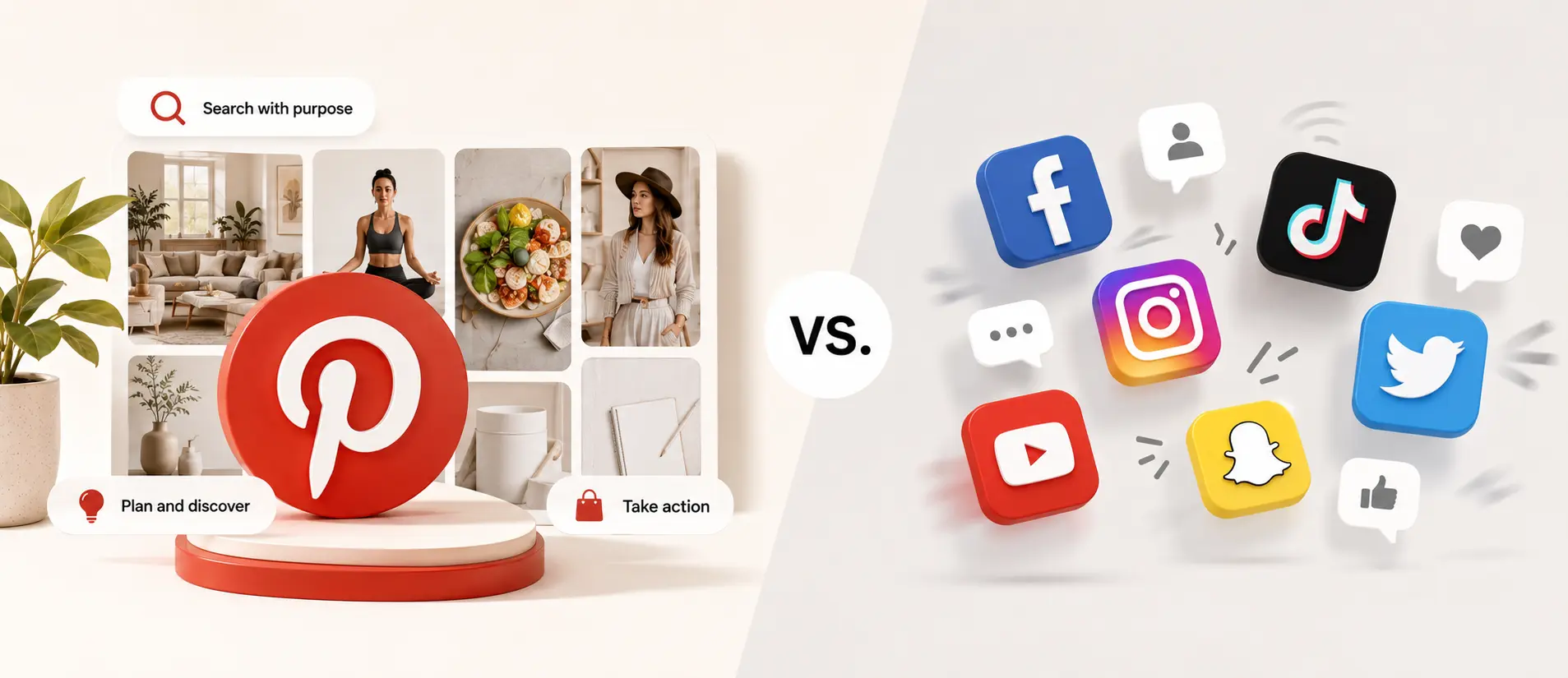
The single biggest mistake brands make with Pinterest is treating it like Instagram with a different layout.
It is not. Pinterest behaves like Google. Search intent drives discovery, and keywords power visibility. Pinterest is genuinely best understood as a visual search and shopping engine that happens to have social features — not the other way around. Ninety-seven percent of top Pinterest searches are unbranded — meaning people are not searching for specific brands, they are searching for ideas, solutions, and inspiration, which means the brand that shows up with the most relevant, well-optimized content captures that intent regardless of brand recognition.
This distinction matters enormously for how a campaign should be built. On Instagram and TikTok, you are interrupting someone’s entertainment scroll and asking them to consider something they were not actively looking for. On Pinterest, someone has already decided they want to renovate a bathroom, plan a wedding, redecorate a living room, or update their wardrobe for fall. They are actively searching for the exact thing your brand sells. Your job is not to create demand. Your job is to be the most relevant, most compelling answer to a search that already exists.
The data backs this up decisively. The purchase intent index on Pinterest runs at 5.6 times the social platform average. Eighty percent of weekly Pinners have made a purchase via Pinterest. Eighty-nine percent of US Pinterest users utilize the platform specifically for purchase inspiration, and 83% have made purchases based on brand pins they discovered. This is not a platform where you are hoping for a moment of impulse. This is a platform where the audience arrived with intent, and your ad is genuinely useful information at the right moment.
The second critical difference is timing and durability. Unlike Instagram or TikTok, where a post peaks within 48 hours and then disappears into algorithmic obscurity, a single well-optimized pin can keep driving traffic for 6 to 12 months. Pinterest users save more than 1.5 billion pins every week, and saved content resurfaces repeatedly in relevant searches for months after publication. This means a Pinterest advertising strategy compounds in a way that paid social on other platforms simply does not — your best-performing pins keep working long after the campaign technically ends, and a properly built Pinterest SEO and paid strategy creates a content asset that appreciates rather than depreciates.
A specialized Pinterest advertising agency understands these structural differences and builds campaigns around them — search-first keyword strategy, vertical creative built for the platform’s native format, and patience built into the performance timeline. An agency that simply repurposes your Instagram creative for Pinterest is leaving the platform’s most valuable characteristic — intent — completely unaddressed.
What a Pinterest Advertising Agency Actually Does — Inside the Full Service Stack
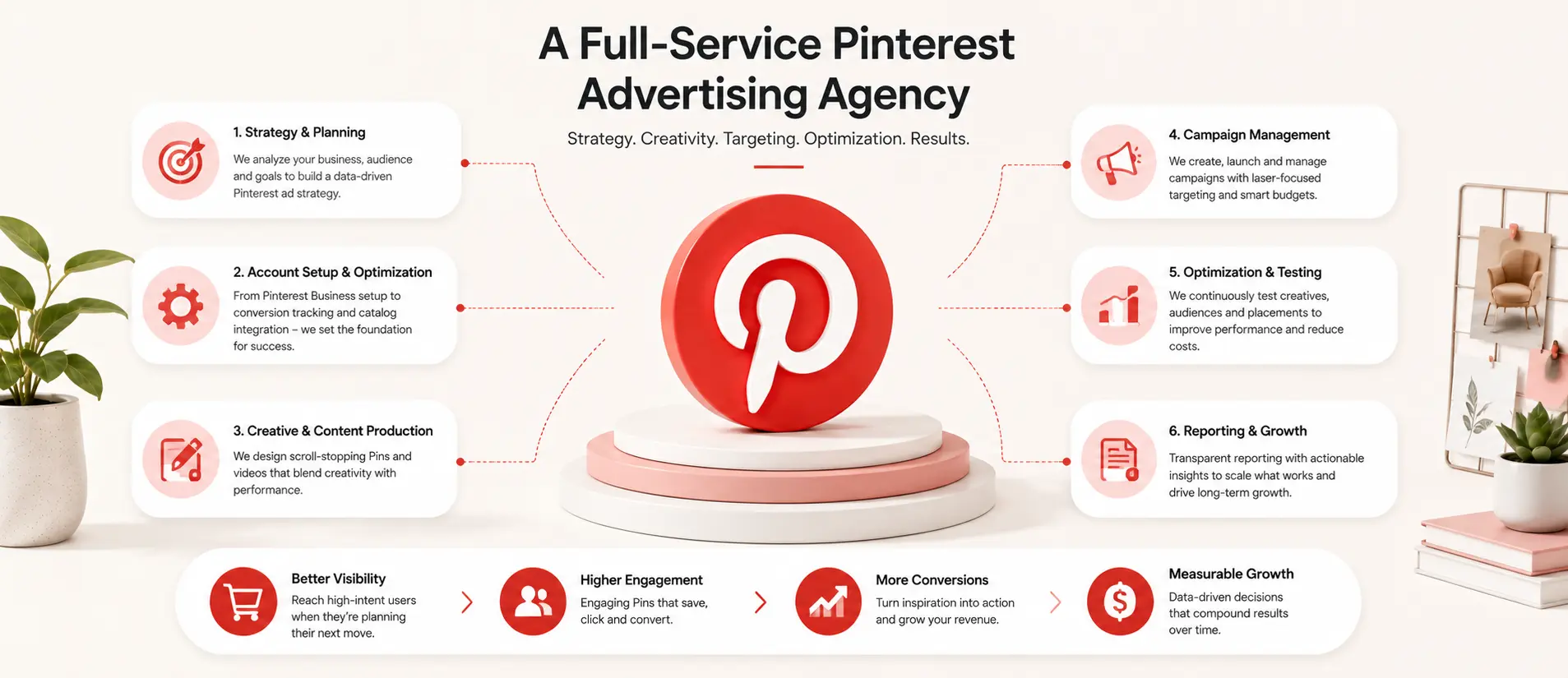
When brands ask what a Pinterest advertising agency does differently from a general social media agency, the honest answer is that the entire campaign architecture is built around search behavior rather than interruption advertising. Let me walk through the full service stack.
Pinterest SEO: The Foundation That Makes Everything Else Work
Before a single dollar of paid spend goes into Pinterest, the foundational organic presence needs to be built correctly — because Pinterest’s algorithm scans titles, pin descriptions, board topics, and linked domains to understand relevance, and that same relevance signal affects both organic reach and paid ad performance.
Pinterest SEO strategy starts with keyword research using Pinterest’s own search autocomplete, related pins, and the Pinterest Trends tool to identify the exact language real users are typing into the search bar. High-intent, long-tail keywords carry significantly more weight here than broad terms — “modern farmhouse kitchen backsplash ideas” performs better than “kitchen ideas” because it matches a more specific search and a buyer closer to a purchase decision.
Every pin needs a clear title containing the target keyword and stating a clear benefit, a detailed description with two or three keyword phrases used naturally, properly categorized boards that reinforce topical relevance, and consistent publishing that signals an active, valuable account to Pinterest’s algorithm. Pinterest rewards fresh content with an early visibility boost, particularly when it picks up engagement quickly — which means a steady publishing cadence strengthens domain quality while improving visibility for evergreen pins over time.
This organic foundation is not optional pre-work before paid advertising. It directly improves paid campaign performance, because Pinterest’s ad auction considers relevance signals alongside bid amount — a well-optimized account with strong organic engagement gets more efficient delivery and lower costs than an account running cold ads into an unoptimized profile.
Campaign Architecture: Building for Pinterest’s Specific Funnel Logic
Pinterest offers a genuinely diverse set of ad formats, and a specialized agency selects and sequences them based on where the prospect sits in their decision journey — not by defaulting to whatever performed on another platform.
Standard image pins remain the foundation format, optimized for the platform’s native 2:3 vertical aspect ratio with bold, readable text overlays that sell the click before someone reads the description. Video pins are increasingly prioritized by Pinterest’s algorithm in 2026, with watch time becoming a primary optimization metric — meaning brands adding at least two video pins per week to their content calendar see disproportionate reach gains relative to static-only accounts. Carousel and collection ads work particularly well for product-led brands showcasing multiple SKUs or styling options within a single ad unit. Idea Pins — Pinterest’s native long-form video and multi-page format — are increasingly favored by the algorithm and serve top-of-funnel brand discovery exceptionally well, particularly for service businesses and creators who need to demonstrate expertise rather than just sell a product.
Pinterest ad campaign management for a mature account typically runs three campaign layers simultaneously: awareness campaigns built on idea pins and standard pins targeting broad interest and keyword categories to build top-of-funnel reach; consideration campaigns using video and carousel formats targeting users who have engaged with the brand’s organic content or website; and conversion campaigns running catalog and shopping ads targeted at warm audiences and high-intent keyword searches with direct purchase pathways.
The strategic sequencing matters because Pinterest rewards patience for organic growth, but performs as a genuinely different game for paid. Promoted pins built on top of organic performers — pins that already earn saves and clicks for free — scale faster on a paid budget than brand-new creative with no proof of relevance. The most effective Pinterest advertising agencies identify their client’s strongest organic performers and use those as the foundation for the paid budget, rather than starting every paid campaign from a blank creative slate.
Catalog and Shopping Ads: Where Pinterest Becomes a Direct Revenue Channel
For ecommerce and D2C brands, Pinterest’s shopping and catalog ad infrastructure has become one of the platform’s most compelling capabilities in 2026. Advertisers using Pinterest’s API for shopping see 35% lower cost per acquisition on catalog ads compared to standard shopping ads, and 38% of ecommerce advertisers now feed their catalogs through the API — a number that has grown significantly as the performance gap between catalog-driven and static shopping ads has widened.
Free product tagging allows businesses to tag up to 24 products in a single pin, turning every organic image into a mini storefront. Rich Pins — which automatically pull in price, availability, and product details from a brand’s website — generate 40% more clicks than standard pins because they display this additional purchase-relevant information directly in the feed before a user even clicks through.
A specialized agency manages the technical integration of a brand’s product catalog with Pinterest’s shopping infrastructure, ensures pricing and availability data stays synchronized in real time, builds dynamic retargeting campaigns that show specific products to users who viewed them on the brand’s site, and optimizes the catalog feed structure for maximum relevance matching to Pinterest’s search behavior.
Industry Verticals — Why Pinterest Works Differently for Different Categories
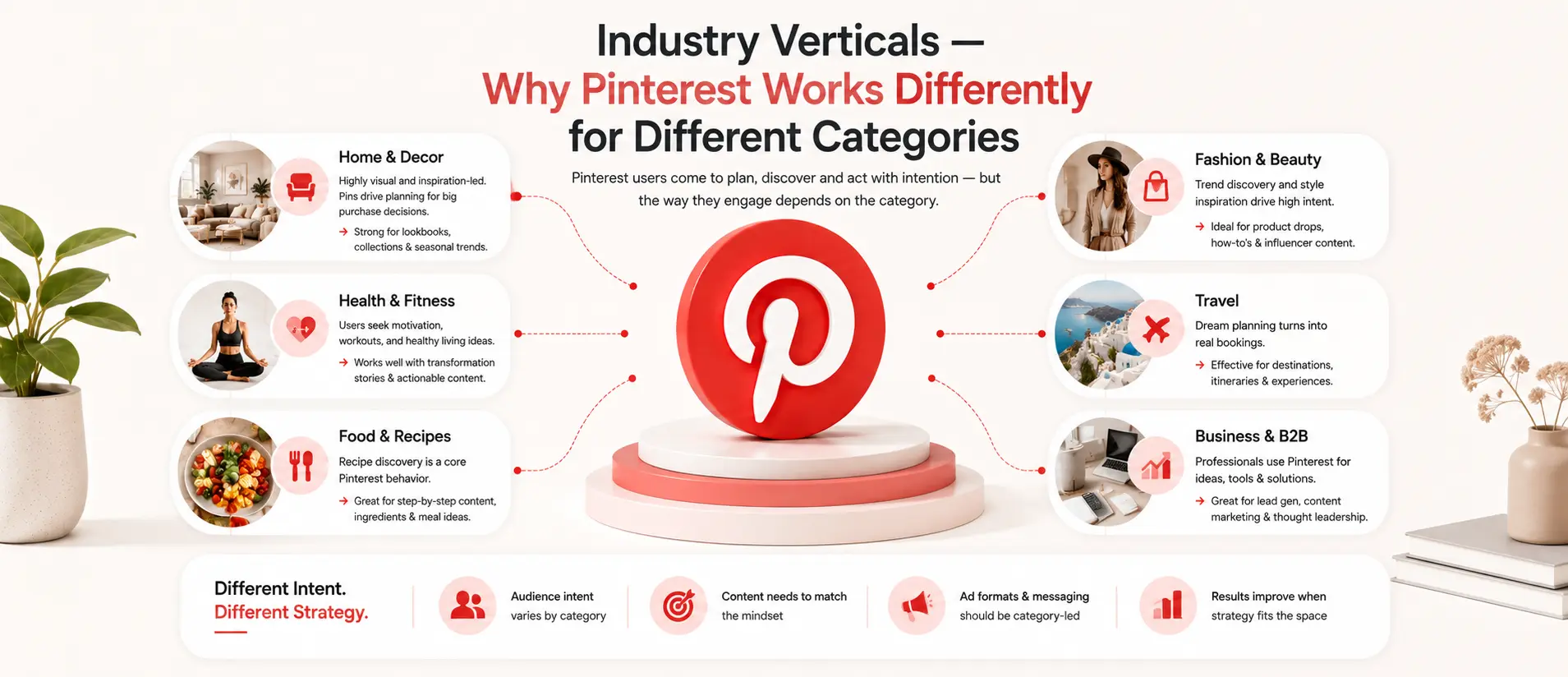
Pinterest is not equally powerful for every business category, and an agency worth its retainer will tell you this honestly rather than promising universal results.
Home decor, fashion, beauty, food, DIY, wedding, and parenting categories represent the platform’s strongest commercial intent, and for brands in these spaces, Pinterest is often the single most efficient channel in the marketing mix. A home decor brand running properly optimized catalog ads against high-intent renovation and design search terms competes for an audience that is, by definition, already shopping for exactly what the brand sells, which produces meaningfully lower acquisition costs than the same budget spent fighting for attention on Instagram.
The wedding industry deserves particular attention because of how deeply Pinterest is embedded in the planning process. A significant share of Pinterest users use the platform specifically to plan major life events — weddings, parties, home projects — and wedding-related searches sustain extremely high engagement for 12 to 18 months before the actual event, giving brands in venues, photography, florals, attire, and decor an unusually long window to capture and nurture intent through Pinterest’s discovery mechanics.
For fashion and beauty brands, Pinterest functions as a moodboard-to-purchase pipeline. Users build boards of aspirational looks, products, and aesthetics over months, and brands that appear consistently within those searches — through both organic SEO and strategically placed promoted pins — build the kind of repeated visual familiarity that converts when the user is finally ready to purchase.
Service businesses — consultants, agencies, photographers, event planners, coaches — benefit from a different content strategy on Pinterest, one built around showcasing portfolios, sharing educational content, and building brand authority rather than direct product sales. Service purchasing involves higher consideration and trust requirements than product purchasing, which makes education-focused video and idea pin content essential for this category. A wedding photographer or interior designer using Pinterest correctly is not running direct-response shopping ads — they are building a content library of tutorials, before-and-after transformations, and behind-the-scenes process content that demonstrates expertise and builds the trust required for a high-consideration purchase decision.
For SaaS and B2B brands, Pinterest has a more limited but not nonexistent role — primarily effective for tools and platforms that serve the visually-driven categories Pinterest dominates, such as design software, content creation tools, or platforms serving the home, wedding, or fashion industries.
A Pinterest advertising strategy built for the right vertical — rather than a generic playbook applied universally — is the difference between a channel that becomes a brand’s most efficient acquisition source and one that quietly underperforms while leadership wonders why “Pinterest didn’t work for us.”
AI and the Future of Pinterest Advertising in 2026
Pinterest’s AI investment has accelerated meaningfully through 2025 and into 2026, and the brands working with agencies that understand these tools are extracting genuine performance advantages that manual campaign management cannot match.
Pinterest’s Business Assistant is a conversational AI co-pilot built directly into Ads Manager — it surfaces trend charts and recommends which pins to promote based on predictive performance signals rather than historical data alone. This shifts campaign strategy from reactive optimization, where you wait to see what is working and then scale it, to proactive positioning, where the platform’s AI identifies emerging demand before it peaks.
Pinterest Predicts — the platform’s annual trend forecasting product — has reached 80% accuracy on 12-month-out trend forecasts. This is genuinely unusual among major advertising platforms. Predictive AI features now drive 22% of search demand on the platform, meaning Pinterest is increasingly telling advertisers what consumers will want next year, not just what is trending right now. For an agency managing a brand’s seasonal content calendar, this predictive capability allows campaigns to be built and creative to be produced months ahead of peak demand windows — getting a home decor brand’s autumn content live in July rather than scrambling in September when search volume has already spiked and competition for that attention has intensified.
AI-powered campaign management for Pinterest advertising increasingly extends to Performance+ campaigns — Pinterest’s automated bidding and targeting product that uses machine learning to optimize delivery across the platform’s full inventory rather than relying on manual audience segmentation. Brands running Performance+ campaigns alongside traditional manually-targeted campaigns, with an agency monitoring and reallocating budget based on real performance data, consistently outperform either approach run in isolation.
Pinterest’s AI now recognizes more than 4 billion objects in images — a visual recognition capability that powers both the platform’s Lens visual search feature and increasingly sophisticated automatic product tagging and catalog matching. For ecommerce brands, this means Pinterest’s algorithm is getting measurably better at understanding what a product image actually depicts and matching it to relevant searches without manual tagging effort — though a specialized agency still manually audits and refines this matching to catch the gaps automated recognition misses.
AI video creation for Pinterest ad content is addressing one of the platform’s primary content bottlenecks. As video and idea pins receive disproportionate algorithmic favor in 2026, brands need significantly more video content volume than most internal teams can produce through traditional methods. AI video tools — trained on existing product photography, brand assets, and creative direction — generate the volume of vertical video content Pinterest’s algorithm rewards without the production timeline and cost of traditional video shoots.
Agentic AI systems are also beginning to handle the operational layer of Pinterest account management — automated bid adjustments based on real-time performance signals, automated creative rotation testing to identify winning variants faster, and automated reporting that surfaces actionable insights rather than raw data dumps. This frees agency strategists to focus on the creative and strategic decisions that AI cannot replicate — understanding brand voice, vertical-specific nuance, and the qualitative judgment calls that separate genuinely effective Pinterest campaigns from technically competent but uninspired ones.
Pinterest Ads vs. Other Platforms — When Pinterest Is the Right Channel
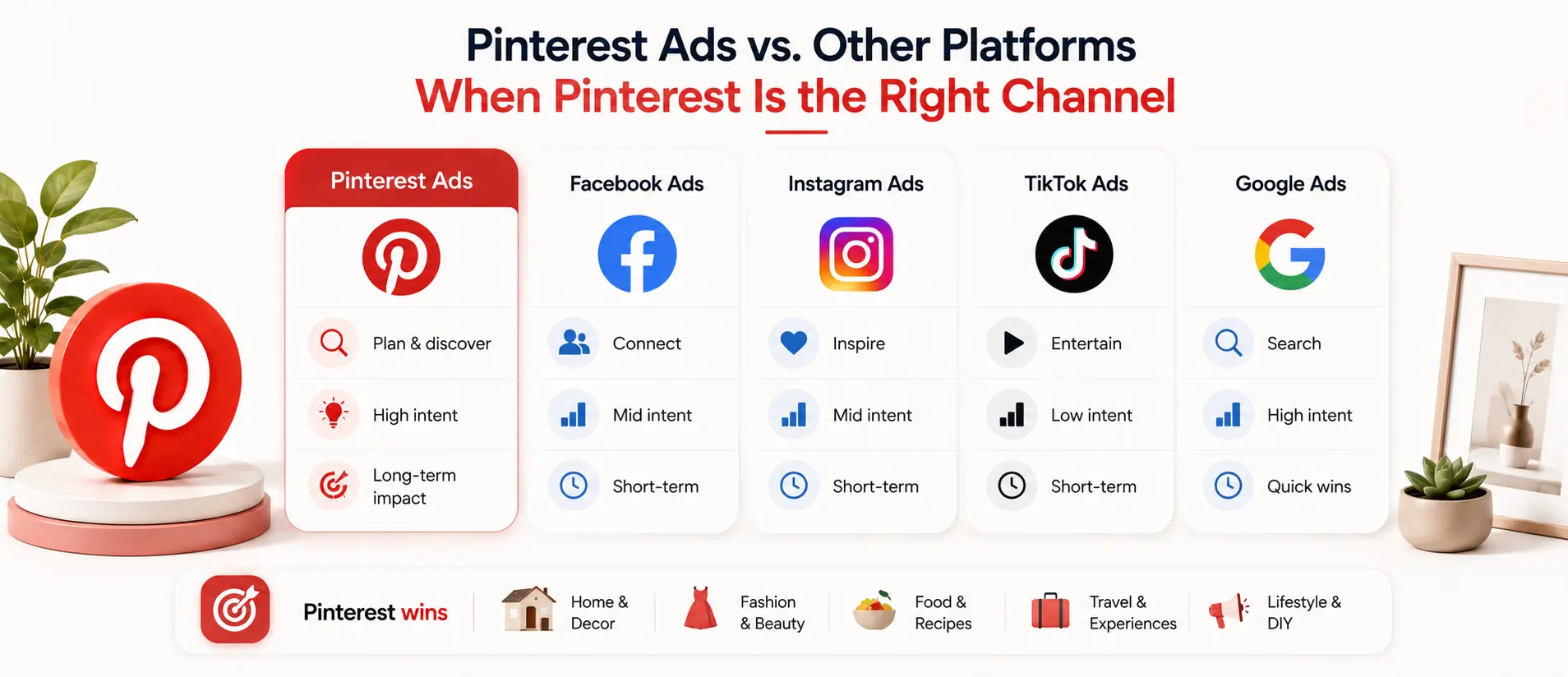
Every brand considering a Pinterest advertising agency partnership eventually asks the same question: Shouldan this budget come from Meta, or is this incremental spend?
The honest answer depends entirely on category and customer journey, but there are clear signals that indicate Pinterest deserves a dedicated, not borrowed, budget.
Pinterest’s average cost-per-click typically runs lower than Instagram for comparable targeting and audience size, and CPMs are consistently lower than Meta and TikTok across most categories — a structural advantage that exists because advertiser competition for Pinterest’s inventory remains significantly lower relative to its audience quality and intent. This is, candidly, the platform’s most underappreciated characteristic. Marketers have collectively underinvested in Pinterest relative to its actual performance potential, which means the brands moving budget there now are capturing efficiency that will compress as more advertisers catch up to what the data has been showing for several years.
The organic ROI comparison is similarly compelling. The average ROI of organic Pinterest marketing runs at 2.7x — higher than organic Facebook at 1.4x, though lower than organic SEO at 3.8x. This places Pinterest in a unique strategic position: it performs more like a search and content channel than a traditional paid social platform, which is exactly why agencies that apply pure social media tactics to Pinterest consistently underperform those that apply a hybrid SEO-plus-paid-media approach.
The category fit matters as much as the platform-level metrics. Pinterest is exceptionally effective for visually-driven, planning-stage purchase categories — home, fashion, beauty, food, weddings, DIY, and parenting. It is less effective, though not without value, for impulse-driven categories, B2B with long enterprise sales cycles outside the design and creative software space, and categories where visual inspiration plays a minimal role in the purchase decision.
The practical budget allocation framework most performance marketing agencies use in 2026 treats Pinterest as a dedicated line item — not a Meta budget overflow — sized according to category fit. For home, fashion, beauty, and wedding-adjacent D2C brands, Pinterest commonly represents 15 to 30% of total paid social budget, growing as performance data validates the channel. For brands outside Pinterest’s strongest categories, a smaller test budget of 5 to 10% of paid social spend is appropriate to validate fit before scaling further.
Choosing the Right Pinterest Advertising Agency — What to Actually Evaluate
The Pinterest advertising agency landscape includes everyone from boutique specialists who manage nothing but Pinterest accounts to large full-service agencies offering Pinterest as one line item among dozens of services. The right fit depends on your scale and category, but several evaluation criteria matter regardless of agency size.
Platform-native thinking, not repurposed social strategy. Ask directly how the agency’s Pinterest strategy differs from their Instagram strategy for the same client. If the answer involves resizing the same creative assets and adjusting captions, that agency does not understand the platform’s search-first logic. A genuinely capable Pinterest team builds keyword research, board architecture, and content calendars specifically around Pinterest search behavior.
Demonstrated catalog and shopping ad expertise for ecommerce clients. If you sell physical products, the agency’s experience with Pinterest’s API for shopping, dynamic retargeting setup, and catalog feed optimization is the single highest-leverage technical capability they need. Ask for specific examples of catalog ad performance improvements they have driven for comparable clients.
A measurement framework beyond impressions and pin saves. Pin views are the Pinterest version of vanity metrics — nice to look at, largely meaningless for revenue decisions. The metrics that actually matter are saves, outbound clicks, and the conversion rate of the landing page each pin sends traffic to. An agency’s reporting should connect Pinterest activity directly to revenue outcomes through proper UTM tracking and conversion API implementation, not stop at engagement metrics.
Patience built into the strategy and the contract terms. Pinterest’s organic content takes 3 to 6 months to demonstrate meaningful traction, and even paid campaigns benefit from a testing period before scaling decisions are made. An agency promising dramatic results within the first 30 days either does not understand the platform or is setting unrealistic expectations to close the contract.
Category-specific case studies, not generic social media portfolios. A Pinterest advertising agency with documented results in your specific vertical — home decor, fashion, wedding, beauty, food — brings pattern recognition that a generalist cannot replicate. Ask for the specific metrics: cost per acquisition trends, ROAS by campaign type, and organic-to-paid performance lift.
At DQOT Solutions, we build Pinterest advertising programs that treat the platform as the search-and-discovery engine it actually is — combining Pinterest SEO foundations, format-specific creative strategy, catalog and shopping ad infrastructure, and AI-powered optimization into a connected system measured against revenue, not impressions.
Frequently Asked Questions
A Pinterest advertising agency manages the full strategy and execution of a brand’s Pinterest presence — combining Pinterest SEO and keyword research, organic pin and board optimization, paid campaign management across multiple ad formats, catalog and shopping ad integration for ecommerce brands, creative production specifically built for Pinterest’s vertical format, conversion tracking and analytics, and ongoing optimization based on performance data. Unlike a general social media agency, a specialized Pinterest agency builds campaigns around the platform’s search-first behavior rather than treating it as a passive scrolling platform.
For brands in home decor, fashion, beauty, food, wedding, DIY, and parenting categories, Pinterest advertising is consistently one of the most efficient paid acquisition channels available. Pinterest reported $1.008 billion in revenue for Q1 2026, up 18% year over year, with 631 million monthly active users. Pinterest users are seven times more likely to say the platform influenced their purchase decisions compared to other social platforms, and CPMs typically run lower than Meta and TikTok due to comparatively lower advertiser competition relative to audience quality.
Pinterest functions as a visual search engine with social features, while Meta and Instagram function as interruption-based social discovery platforms. On Pinterest, users arrive with active purchase intent — searching for specific ideas, products, or solutions — while Meta and Instagram users are primarily seeking entertainment and connection. This means Pinterest campaigns are built around keyword research and search relevance, similar to SEO, while Meta campaigns are built around interest-based targeting and creative interruption. Pinterest pins also have significantly longer lifespans, often driving traffic for 6 to 12 months compared to 24 to 48 hours of peak relevance on other social platforms.
Pinterest’s primary ad formats include standard image pins, video pins, carousel ads, collection ads, idea pin ads for long-form vertical video content, shopping and catalog ads with product tagging, quiz ads, and Premiere Spotlight placements for major brand campaigns. Video and idea pins receive increasing algorithmic favor in 2026, with watch time becoming a more significant optimization metric. Performance+ campaigns use Pinterest’s automated AI bidding and targeting to optimize delivery across the platform’s full inventory.
Pinterest’s average cost-per-click typically runs lower than comparable Instagram targeting, and CPMs are generally lower than Meta and TikTok across most categories, largely because advertiser demand has not yet caught up to the platform’s actual audience quality and purchase intent. Specific costs vary significantly by category competitiveness, targeting precision, and bidding strategy. Advertisers using Pinterest’s API for shopping catalog ads see approximately 35% lower cost per acquisition compared to standard shopping ad formats, making catalog integration a particularly cost-efficient entry point for ecommerce brands.
Pinterest paid campaigns can begin generating traffic and conversions within the first 1 to 2 weeks, though meaningful optimization typically requires a 30-day testing period to identify which pins, audiences, and formats perform best for a specific brand. Pinterest’s organic SEO foundation takes longer to mature — typically 3 to 6 months for meaningful organic traffic growth — but this organic groundwork directly improves paid campaign efficiency once established. The platform’s unique durability means well-performing pins continue generating traffic for 6 to 12 months after initial publication, creating a compounding return that most paid social channels do not offer.
Home decor, fashion, beauty, food, weddings, DIY, and parenting categories represent Pinterest’s strongest commercial performance, driven by the platform’s planning-stage, visually-driven search behavior. Service businesses,, including photographers, interior designers, event planners, and coaches also perform well using education-focused video and idea pin content to build trust and authority. Categories with lower visual inspiration relevance or shorter consideration cycles — most impulse purchases and traditional enterprise B2B — see comparatively limited returns from Pinterest relative to other channels.
DQOT Solutions builds Pinterest advertising programs around the platform’s actual behavior as a visual search and shopping engine — not as a repurposed social media checkbox. Our team delivers Pinterest SEO and keyword strategy, format-specific creative production including AI-accelerated video content, catalog and shopping ad integration for ecommerce clients, AI-powered campaign optimization using Pinterest’s native tools, and revenue-focused reporting that connects pin performance directly to conversion outcomes. We treat Pinterest as a dedicated channel with its own strategic logic, not a Meta budget afterthought.
Pinterest Is the Search Engine Most Brands Forgot to Optimize For
While most marketing budgets continue chasing attention on platforms where users are actively trying to avoid advertising, 631 million people are opening Pinterest every month with a specific intention: to find something they plan to buy.
That gap — between where marketing dollars are concentrated and where genuine purchase intent actually lives — is the opportunity a specialized Pinterest advertising agency exists to close. Not through louder creative or bigger budgets, but through understanding that this platform rewards relevance, patience, and search-native strategy in ways that interruption-based advertising fundamentally does not.
The brands building real Pinterest advertising programs in 2026 — combining SEO foundations, format-specific creative, catalog integration, and AI-powered optimization — are capturing efficiency that the broader market has not yet priced into its budget allocation. That window narrows every quarter as Pinterest’s advertiser revenue growth accelerates and more brands recognize what the data has been showing for years.
The question is not whether your customers are on Pinterest. For most visually-driven categories, they already are. The question is whether your brand shows up when they search.
Ready to build a Pinterest advertising program that turns search intent into measurable revenue?