

Here’s something that happened recently at a mid-sized personal injury firm in Chicago.
Their marketing director ran an experiment. She took their existing content production workflow — brief to published article — and documented every step. Writer briefing. Research. First draft. Legal review. Compliance check. Edit. SEO optimisation. Publication. The whole process took, on average, eleven working days and cost roughly $800 per piece including writer fees, editor time, and compliance review.
Then she implemented an AI-assisted workflow. The same process — brief, draft, legal review, compliance, edit, SEO, publish — took three days and cost $200 per piece.
Same compliance standards. Same quality bar. Same legal accuracy review by a qualified attorney. Four times faster. One quarter of the cost.
That firm is now publishing four times more content than its competitors. It’s appearing in Google AI Overviews for terms its competitors haven’t even thought to target. Its attorneys are being cited by ChatGPT and Perplexity when people ask legal questions in their practice areas. And it’s generating 60% more qualified client enquiries than it was eighteen months ago.
This isn’t a startup. This isn’t a BigLaw firm with a hundred-person marketing department. This is a 12-attorney firm that made a deliberate decision to take AI marketing seriously before most of its competitors did.
That window — the window where early adoption creates disproportionate competitive advantage — is still open in legal marketing. But it’s closing.
This guide tells you exactly what to do with it.
Table of Contents
The Reality of Legal Marketing in 2026 — And Why Most Law Firms Are Getting Left Behind
Let’s start with an honest assessment of where the legal marketing landscape actually stands.
Legal services is one of the most competitive digital marketing environments in existence. “Personal injury lawyer [city]” and “criminal defense attorney [city]” are among the most expensive Google Ads keywords in any market — routinely $50-$200+ per click in major US cities. Family law, immigration, corporate law, and employment law terms follow similar patterns. The competition for organic search visibility is equally fierce.
In this environment, the law firms that were already winning before AI were the ones who had invested significantly in SEO, content marketing, and paid advertising over years. They had authority. They had backlinks. They had content libraries. They had established Google Business Profiles with hundreds of reviews.
Here’s what AI has done to that dynamic: it has dramatically lowered the cost of creating the content and digital signals that build authority, while simultaneously raising the ceiling on what a well-resourced firm can produce.

A law firm that used to publish two blog posts per month can now publish twenty — without increasing headcount, without sacrificing quality, and with better SEO optimisation on each piece than their human-only workflow was producing.
The firms that understand this and act on it are not just keeping pace. They’re pulling ahead at a rate that their less tech-forward competitors will find very difficult to close.
AI reduces law firm marketing costs by up to 40% while simultaneously improving the quality, volume, and strategic sophistication of marketing output. That’s not a vendor claim. That’s what firms implementing AI marketing properly are consistently reporting across USA, UK, Australia, Canada, India, and other major legal markets.
The question isn’t whether AI belongs in law firm marketing. It does. The question is whether your firm is going to adopt it thoughtfully — with strategy, compliance awareness, and genuine understanding of where AI helps and where human expertise remains non-negotiable — or whether you’re going to watch competitors do it first.
What Is AI Marketing for Law Firms — And How Does It Actually Work?
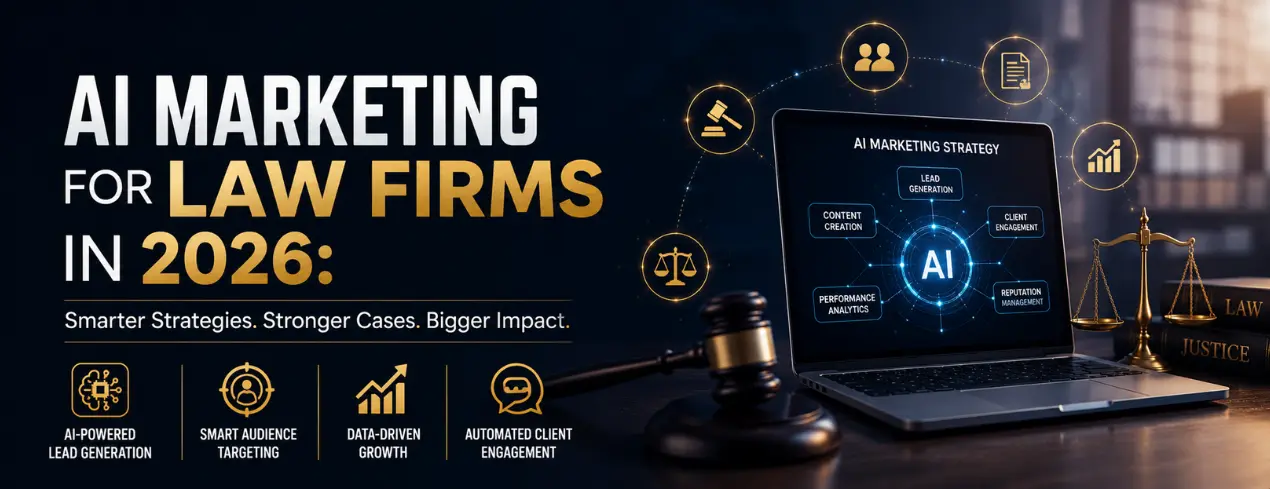
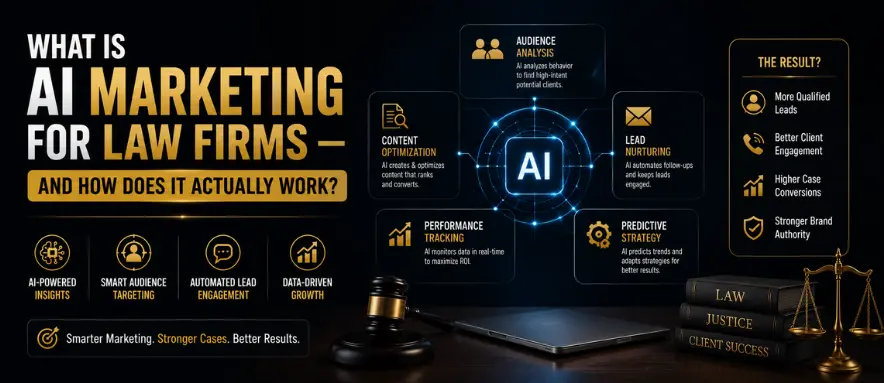
AI marketing for law firms is the application of artificial intelligence tools and automation to the full range of marketing functions that law firms engage in — content creation, SEO, paid advertising, lead generation, client communication, reputation management, and analytics.
It’s important to understand what this is and what it isn’t, because the hype around AI in legal marketing sometimes obscures practical reality.
What AI marketing for law firms IS:
It’s using tools like ChatGPT, Claude, Gemini, Perplexity, Jasper, and specialised legal marketing AI to produce first drafts of blog posts, website content, email sequences, and ad copy significantly faster than human-only workflows.
It’s using AI-powered SEO platforms to identify keyword opportunities, analyse competitor content gaps, generate optimised content briefs, and track ranking performance with more granularity than manual analysis allows.
It’s deploying AI chatbots and intake automation on your firm’s website to capture and qualify leads at any hour, not just when your receptionist is at their desk.
It’s using AI analytics to understand which marketing activities are generating the clients who actually retain and pay, not just the enquiries that consume intake time without converting.
It’s building AI marketing agents that automate repetitive workflows — review request sequences, lead follow-up emails, content publishing schedules — so your team’s time is directed toward work that requires genuine human judgment.
What AI marketing for law firms IS NOT:
It’s not producing legal content that skips compliance review. Every piece of AI-generated content that goes on a law firm’s website requires attorney review for accuracy and bar association compliance. AI speeds the production. It doesn’t eliminate the oversight.
It’s not replacing attorneys with robots who write legal advice. The legal analysis, the strategic counsel, the courtroom advocacy — none of that is touched by AI marketing.
It’s not a magic switch. Law firms that implement AI tools without strategic thinking about their target practice areas, their ideal client profile, and their competitive positioning don’t get good results. AI amplifies strategy. It doesn’t replace it.
Generative Engine Optimisation (GEO) for Law Firms — The Most Important New Marketing Concept of 2026
This is the section that most law firm marketing guides aren’t covering yet — which means it’s the section most worth reading carefully.
Search behaviour is changing faster than at any point since mobile overtook desktop. The emergence of AI-powered search — Google AI Overviews, ChatGPT search, Perplexity, Microsoft Copilot, Gemini — means that a growing percentage of people looking for legal help are getting their first answers from AI systems, not from clicking through to websites.
When someone types “what should I do if I’ve been in a car accident that wasn’t my fault” into Google in 2026, they’re increasingly seeing an AI-generated answer at the top of the page before they see any law firm’s website. When someone asks ChatGPT “how do I find a good immigration lawyer in [city],” the AI gives them a direct answer — sometimes with specific firm recommendations, always with a framework that shapes how they think about their options before they’ve contacted anyone.
For law firms, this creates two equally important challenges:
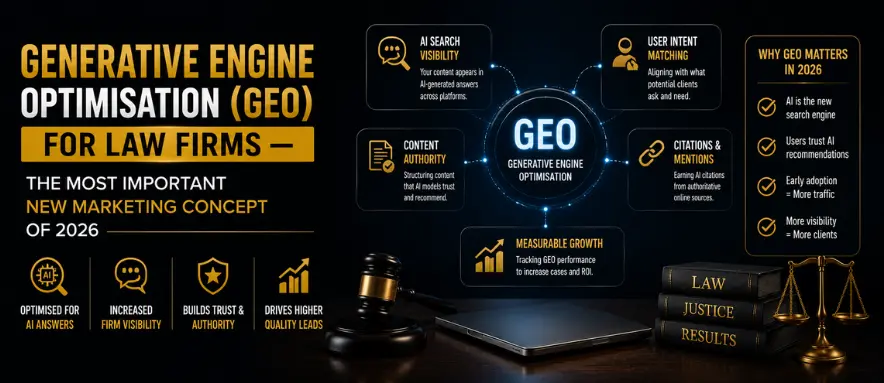
One: you need to be the firm that AI systems recommend, reference, and cite.
Two: the content you produce needs to be the content that AI systems trust enough to cite.
This is Generative Engine Optimisation — GEO for law firms. It’s the practice of structuring, writing, and publishing content in ways that make it trustworthy, citable, and surfaceable by AI search systems, not just by traditional Google algorithms.
How LLM SEO for Law Firms Actually Works
E-E-A-T signals amplified — Google’s Experience, Expertise, Authoritativeness, and Trustworthiness framework has always mattered for legal content. AI systems use similar signals, but they weight them differently. Content written by identifiable attorneys with verifiable credentials, citing specific statutes, case law, and authoritative sources, is dramatically more likely to be cited by AI systems than generic content that could have been written by anyone.
Structured, direct answers to specific questions — AI systems prefer content that directly answers specific questions. “What is the statute of limitations for personal injury claims in Texas?” with a direct, accurate, properly cited answer performs better in AI search than a 2,000-word blog post that eventually gets to the answer in paragraph eleven.
Perplexity optimisation for legal websites — Perplexity’s AI search is heavily weighted toward content that demonstrates specific expertise and cites verifiable sources. Law firm content that references case law, regulatory bodies, specific legislation, and official legal sources gets cited by Perplexity at higher rates than content that generalises.
Gemini visibility for law firms — Google’s Gemini AI surfaces legal content based on authority signals that align closely with traditional SEO factors, plus content freshness and specificity. Regular publication of genuinely expert content on specific legal topics in specific jurisdictions builds Gemini visibility over time.
ChatGPT law firm marketing — getting your firm mentioned in ChatGPT responses requires a combination of strong general web presence (ChatGPT’s training data weights authoritative, frequently-cited content), structured directory listings on platforms ChatGPT references, and content that directly addresses the questions your potential clients are asking AI systems.
The legal marketing teams who understand GEO right now are building their firms’ authority in the AI search ecosystem while their competitors are still focused exclusively on traditional Google ranking. The compound advantage of this early investment will be significant.
AI-Powered Law Firm SEO — The Practical Implementation
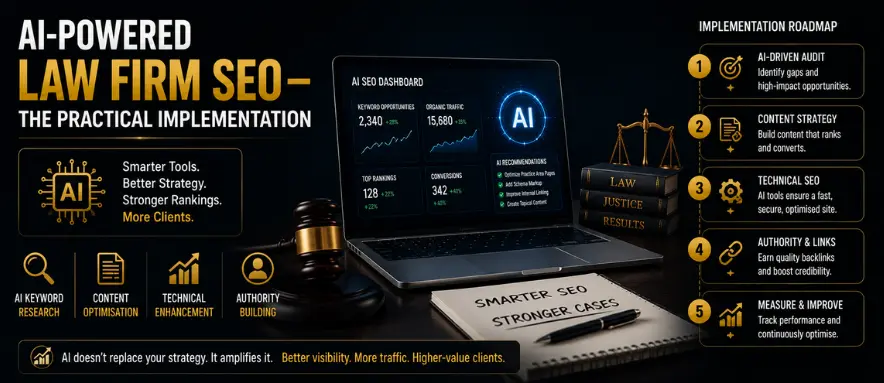
Traditional SEO for law firms has always been the highest-return long-term marketing investment available. AI doesn’t change that. It makes it faster, more sophisticated, and more accessible to firms that previously couldn’t compete with the content production capacity of larger competitors.
Generative AI for Law Firm SEO — The Workflow
Keyword research and opportunity identification — AI-powered SEO tools can identify keyword clusters, question-based queries, local modifier combinations, and semantic keyword groups at a scale and speed that manual keyword research cannot match. For law firms, this means identifying the specific searches your ideal clients make at every stage of their legal journey — from “do I need a lawyer for…” to “best [practice area] attorney [city]” to “how much does a [type of case] lawyer cost.”
Content gap analysis — AI tools can analyse your competitors’ content footprints and identify specific topics they rank for that you don’t. For a personal injury firm competing against established players, knowing exactly which content pieces are driving their visibility — and producing better versions of them — is a direct SEO growth path.
Content creation at scale — generative AI for law firm SEO means producing the volume of expert content that builds authority, without the cost and timeline constraints of purely human-written content. The AI drafts. The attorney reviews for accuracy and compliance. The SEO specialist optimises. The content goes live. Three days instead of eleven.
Local SEO for law firms — law firm local SEO remains the highest-priority SEO objective for most practices. Appearing in the local pack for “[practice area] attorney [city]” searches is the most direct route to high-intent local client enquiries. AI tools assist with:
- Google Business Profile optimisation and posting schedules
- Local citation building and consistency management
- Review generation and response workflows
- Hyperlocal content targeting specific courts, jurisdictions, and geographic areas
Technical SEO with AI assistance — AI tools can audit technical SEO factors (page speed, structured data, internal linking structure, crawlability) and generate specific implementation recommendations faster than manual audits.
An experienced SEO agency that understands both the technical SEO requirements and the specific compliance landscape of legal marketing can implement all of this in a way that builds genuine, sustainable search visibility.
Google Ads for Law Firms — AI-Optimised Paid Search
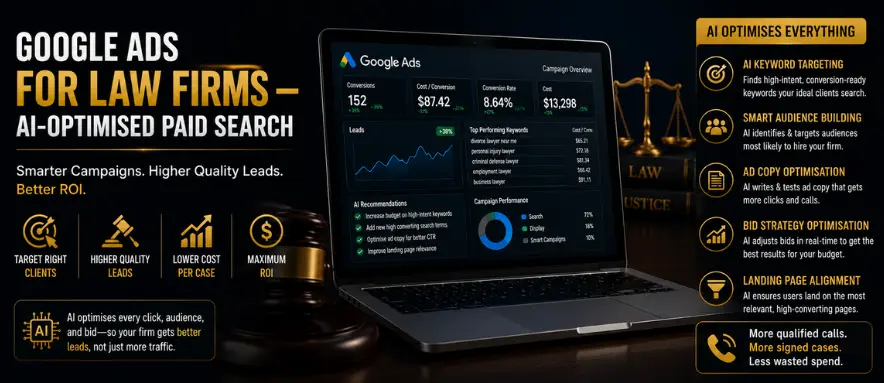
Legal paid search is simultaneously the most expensive and the highest-converting paid advertising category in most markets. A qualified personal injury lead worth $10,000-$100,000+ in contingency fees justifies a $100-$200 cost per click in a way that most industries cannot.
AI has transformed how law firm Google Ads campaigns are managed — both in terms of Google’s own AI-driven campaign products and in terms of the external AI tools that help marketing teams manage campaigns more effectively.
How AI Elevates Law Firm Google Ads
Smart Bidding for legal keywords — Google’s AI-driven Smart Bidding strategies use machine learning to set bids in real time based on the probability that a given search will result in a conversion. For law firms with properly configured conversion tracking (call tracking, form submissions, chat initiations), Smart Bidding can significantly improve cost per qualified lead compared to manual bidding.
Responsive Search Ads with AI testing — RSAs allow Google’s AI to test multiple headline and description combinations, serving the combinations that perform best to different audience segments. For law firms, this means systematic creative testing at a scale that manual ad management can’t achieve.
AI-powered keyword research for law firm PPC — identifying the specific intent-rich, practice-area-specific keywords that generate qualified leads (not just clicks) requires AI-assisted analysis of search term data, competitor bidding patterns, and conversion correlation.
Negative keyword management — law firm search campaigns are plagued by irrelevant searches: people looking for legal forms, law school information, legal TV shows, and academic research. AI-powered negative keyword tools continuously identify and exclude these searches, reducing wasted spend that commonly accounts for 20-35% of law firm PPC budgets.
Call tracking and AI attribution — most law firm leads come through phone calls, not form submissions. AI-powered call tracking and attribution systems identify which keywords, ads, and campaigns generate calls that convert to consultations and retained clients — closing the attribution gap that makes most law firm marketing measurement inaccurate.
A dedicated Google Ads management company with legal industry experience understands the specific compliance requirements, the practice-area-specific keyword economics, and the conversion tracking configurations that make law firm paid search genuinely profitable rather than just expensive.
Meta Ads for Law Firms — Building the Pipeline Before People Know They Need You
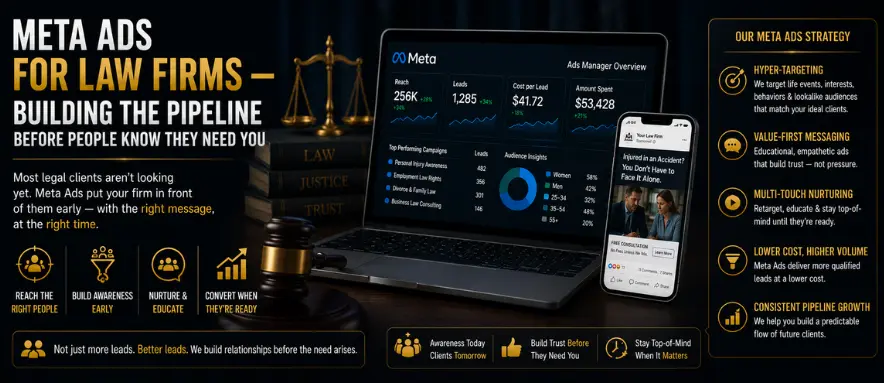
Most law firm marketing is reactive — reaching people who are already searching for legal help. Meta Ads create a different kind of opportunity: building awareness and trust with your ideal client demographic before they’re in a legal situation, so that when they are, your firm is already in their consideration set.
This is particularly valuable for practice areas with predictable demographic correlations:
Family law — targeting married adults in certain age brackets, homeowners in specific geographic areas. People who aren’t currently thinking about divorce but whose demographic profile makes them statistically likely future family law clients.
Estate planning — targeting adults over 50, high household income brackets, property owners. Building awareness of your estate planning services with an audience that needs them but may not be actively searching yet.
Immigration law — targeting specific nationality communities, new residents, working visa holders. Highly specific demographic and interest targeting that reaches the right people before a visa issue becomes urgent.
Employment law — targeting professionals in specific industries, senior employees, recent job changes. People who may face employment legal issues without yet knowing they have a case.
Personal injury — retargeting people who have visited your website, reaching audiences similar to your existing clients, building brand recognition in geographic areas where your firm operates.
Meta Ads for law firms also work powerfully for retargeting — reaching people who have visited your website, watched your videos, or engaged with your social content, keeping your firm top of mind through the consideration period that precedes a legal engagement.
Facebook and Instagram for law firm brand building — regular, high-value content on social platforms builds the authority and familiarity that makes a potential client choose your firm over an unknown competitor when the moment arrives. Attorney profiles, case results (where ethically and legally appropriate), community involvement, and educational content all serve this function.
AI Content Marketing for Attorneys — The Compliant Content Machine
Legal content marketing is uniquely challenging because it sits at the intersection of SEO requirements (which favour specific, comprehensive, authority-building content) and bar association advertising rules (which vary by jurisdiction but generally require that content doesn’t constitute legal advice, isn’t misleading, and meets specific disclosure requirements).
This is where many law firms hesitate on AI content: “Can AI produce content that’s compliant?”
The honest answer is: AI produces content that requires attorney review for compliance, just as human-written content does. The AI draft is faster and cheaper. The compliance review is the same. The output, when the process is properly managed, is compliant — because a qualified attorney has reviewed it.
How AI Content Marketing for Law Firms Works in Practice
Practice area blog content — AI tools can produce comprehensive, well-researched first drafts of blog posts on specific legal topics in specific jurisdictions. “What to do after a slip and fall accident in New York,” “Understanding child custody arrangements in England and Wales,” “Navigating commercial lease disputes in New South Wales.” These drafts require attorney review for accuracy and compliance, but the production process is dramatically faster than starting from scratch.
FAQ pages and structured content — AI excels at generating structured FAQ content that answers the specific questions potential clients ask. These pages rank in Google’s featured snippets and are cited by AI search systems — building organic visibility while serving genuine informational value.
Attorney bio and profile content — AI-assisted writing helps attorneys articulate their experience, credentials, and approach in language that resonates with potential clients while reflecting genuine professional standing.
Case study and result content — where jurisdictional rules permit the discussion of case results, AI can help structure and write compelling case study content that demonstrates your firm’s track record. Compliance review ensures result descriptions meet local bar requirements.
Email nurture sequences — AI-generated email sequences for leads who have enquired but not yet retained. Educational, trust-building content that maintains relationship through the consideration period. These sequences, properly managed, significantly improve enquiry-to-retainer conversion rates.
ChatGPT prompts for law firm content — the quality of AI-generated legal content depends heavily on the quality of the prompts used to generate it. Experienced legal marketing professionals have developed specific prompt frameworks for different content types — blog posts, FAQ pages, email sequences, ad copy — that consistently produce high-quality first drafts.
AI Chatbots and Lead Generation for Law Firms
Every law firm loses potential clients outside business hours. A potential client with an urgent legal question at 10pm on a Friday — a DUI arrest, a domestic violence situation, a served divorce notice — needs response. If your website offers nothing but a contact form and a promise that someone will call them during business hours, many of them will have called a competitor by Monday morning.
AI chatbots for law firms solve this problem. A properly configured AI intake chatbot can:
Qualify leads instantly — asking the specific questions that determine whether an enquiry is within your practice areas, in your jurisdiction, and within the scope of cases you take. Filtering out time-wasters before they reach your intake team.
Capture urgency signals — identifying when an enquiry involves a legal emergency that requires immediate response versus a matter that can be scheduled. Routing urgent cases to on-call staff while scheduling routine enquiries.
Collect detailed intake information — gathering the case details that your intake team would otherwise collect in an initial phone call. Names, dates, incident details, existing legal representation, insurance information. Reducing the time investment required per consultation.
Provide immediate informational value — answering general questions about your firm, your practice areas, your fee structures, and your process. Managing expectations before the first human contact. Reducing intake calls that are really just information requests.
Initiate follow-up sequences — automatically triggering email and SMS follow-up sequences for leads who engage but don’t immediately book a consultation. Keeping your firm in the conversation during the consideration period.
AI for attorney lead generation — the combination of AI chatbot intake, automated follow-up sequences, and AI-powered lead scoring creates a lead generation system that operates continuously without human intervention until a lead meets the qualification threshold for direct attorney or intake staff contact.
Custom AI marketing agents built specifically for law firm intake and lead nurturing workflows deliver significantly better results than generic chatbot tools because they’re configured for the specific practice areas, intake criteria, jurisdiction constraints, and conversion goals of the individual firm.
Law Firm Reputation Management with AI
In legal services, reputation isn’t just a marketing asset. It’s the product. Potential clients making decisions about who will represent them in some of the most consequential situations of their lives — a criminal charge, a divorce, a personal injury claim, an immigration matter — are making deep trust decisions. Your reputation across digital channels is the primary signal they use.
AI-Powered Review Generation and Reputation Management
Automated review request sequences — AI-managed post-matter review requests, triggered at optimal timing (usually shortly after matter resolution), sent through the client’s preferred communication channel (email, SMS, WhatsApp), with personalised messaging that reflects the specific matter type. Firms implementing systematic AI-managed review requests consistently generate 3-5x more Google reviews than those relying on manual or ad hoc requests.
Review monitoring and response — AI tools that monitor review mentions across Google, Yelp, Avvo, Martindale-Hubbell, Justia, and other legal directories, alert the marketing team to new reviews, and draft response language for attorney approval. Ensuring every review — positive and negative — receives a professional, considered response.
Search result reputation management — AI-assisted content strategies that ensure the search results for your firm’s name, your attorneys’ names, and your practice area keywords are dominated by positive, accurate, authoritative content. For firms dealing with legacy negative coverage, AI-supported content production at scale accelerates the process of building positive content that pushes negative results down.
Social proof optimisation — AI tools that identify which testimonials, case results, and awards generate the most trust signals with potential clients in specific practice areas, and ensure those elements are prominently featured across digital touchpoints.
AI Marketing Automation for Legal Service
The operational efficiency gains from AI marketing automation are significant for law firms at every scale — from solo practitioners to national firms.
What AI Marketing Automation Does for Law Firms
Automated intake and qualification workflows — from first website visit to booked consultation, AI automation can manage the entire intake journey without human intervention for routine enquiries. Lead capture, qualification, information collection, appointment scheduling, confirmation sequences, and pre-consultation preparation materials — all automated.
Nurture sequences for long consideration cycles — some legal matters have long decision-making cycles. Estate planning. Business structuring. Immigration planning. Potential clients who research for weeks or months before selecting an attorney can be nurtured with automated educational content sequences that maintain your firm’s presence and authority through that period.
Cross-sell and upsell automation — existing clients who may benefit from additional legal services. A family law client whose divorce revealed estate planning needs. A business formation client whose growth now requires employment law counsel. AI automation can identify these opportunities and trigger relevant outreach without manual case-by-case analysis.
Referral network management — automated communication sequences for referral sources (other attorneys, financial advisors, accountants, therapists). Regular, value-add touchpoints that maintain relationships without requiring continuous manual relationship management.
Performance reporting automation — AI-generated weekly and monthly marketing performance reports that synthesise data from multiple platforms (Google Analytics, Google Ads, Meta Ads, CRM, call tracking) into clear, actionable insight. Replacing hours of manual report building with automated intelligence.
Agentic AI development for law firms — building custom AI agents configured for specific legal marketing workflows — is the frontier of this space. Firms investing in custom agentic AI infrastructure now are building operational advantages that off-the-shelf tools will take years to replicate.
YouTube and Video Marketing for Law Firms
Video content is the highest-trust content format available to law firms — and the most underused by the profession.
A three-minute video of an attorney explaining what happens in the first 30 days of a personal injury case builds more trust than any written testimonial, any star rating, any award badge. Potential clients who watch an attorney on video before their first consultation arrive with a sense of familiarity and trust that dramatically improves consultation conversion rates.
YouTube marketing for law firms is also one of the most cost-effective long-term marketing investments available. YouTube videos rank in Google search results. They’re cited by AI search systems. They build the kind of authority that compounds over time. A video published today generates views and trust signals for years.
Content formats that work for law firm YouTube:
“What to do if…” videos — “What to do if you’ve been in a car accident,” “What to do if you’ve been served divorce papers,” “What to do if you’re arrested.” These are searches with high intent and high video consumption. Direct, practical, attorney-delivered answers.
Process explanation videos — “What to expect from a personal injury case,” “How the divorce process works in [state/country],” “Understanding the immigration visa application timeline.” Reducing client anxiety about the legal process builds trust and improves client retention.
FAQ videos — answering the specific questions potential clients ask, on camera. These rank for both YouTube search and Google video results.
Attorney introduction videos — genuine personality introductions that go beyond credentials. Why did this attorney choose this practice area? What do they care about in their clients’ outcomes? What makes them different? These videos are the digital equivalent of the first human impression.
AI video creation for legal content — AI video creation tools can produce high-quality explainer videos, case overview animations, and branded content at a fraction of traditional video production costs. For law firms wanting YouTube and social video presence without full production budgets, AI video is a genuine pathway to competitive content production.
Practice Area-Specific AI Marketing Strategies
Different practice areas have different marketing dynamics. Here’s how AI marketing applies to the highest-volume legal practice areas across the markets we serve.
Personal Injury Law Firm Marketing
High competition, high value, high urgency. The potential client who has just been in an accident or suffered an injury needs to find representation quickly. Google Ads and Local Services Ads are the primary paid channels. Local SEO for location-specific injury terms is the primary organic channel. AI assists with content production at scale, automated intake, and lead nurturing for prospects who don’t immediately retain.
AI content focus: “What to do after [type of accident]” guides for every relevant accident type and location. Jurisdiction-specific statute of limitations content. Insurance claim guidance. Attorney fee explanation content. These topics have high search volume and direct relevance to the moment of need.
Family Law Marketing
Longer consideration cycle, high emotional stakes, referral-heavy. Meta Ads for demographic targeting of the at-risk family law audience. Strong local SEO for “[city] divorce attorney,” “[city] custody lawyer.” AI-powered content addressing the emotional journey of family law matters, not just the procedural aspects, builds the trust that this practice area requires.
Immigration Law Marketing
Community-specific, multilingual, referral-driven. AI translation and localisation tools allow law firms to produce content and communications in the specific languages of their target communities. Meta Ads targeting specific nationality communities. YouTube content addressing immigration concerns in community-specific languages.
Criminal Defence Marketing
Urgency-driven, trust-critical, local. When someone needs a criminal defence attorney, they typically need one now. Google Ads and Local Services Ads are the primary channels. Website conversion optimisation — prominently featured phone numbers, live chat, 24/7 intake — is critical. AI chatbots that capture urgent enquiries outside business hours are particularly high-value for criminal defence firms.
Corporate Law and Business Law Marketing
Longer sales cycles, relationship-driven, LinkedIn-centric. LinkedIn marketing for corporate law firms deserves its own strategy. AI-powered thought leadership content — articles, commentary on regulatory developments, business law guides — builds the professional authority that generates referrals and direct corporate client enquiries.
Estate Planning Marketing
Long-term audience building, demographic targeting, educational content. Meta Ads targeting older homeowners. YouTube and blog content addressing estate planning questions that people research over time. Email nurture sequences for leads who enquired but haven’t yet scheduled a consultation.
Social Media Management for Law Firms
Social media for law firms is often done badly — either over-promotional in a way that audiences ignore, or so cautious about bar association rules that it communicates nothing of value. The middle path is genuinely useful, genuinely human content that builds trust and authority without making claims that violate professional conduct rules.
LinkedIn for law firms — the highest-priority social platform for corporate, employment, immigration, and business law firms. Thought leadership articles, regulatory commentary, attorney insights, and firm news. LinkedIn’s professional audience matches the client profile for many business-facing practice areas.
Instagram for law firms — visual brand building, attorney personality content, community involvement, case milestone celebrations (where ethically appropriate). Particularly relevant for consumer-facing practice areas — personal injury, family law, immigration.
Facebook — community presence, educational content, local event involvement. Facebook’s older demographic aligns well with many legal service audiences. Local community group participation (appropriately) generates organic referral traffic.
Social media management for law firms requires understanding both social media strategy and legal advertising compliance. Every jurisdiction has specific rules about what attorneys can say on social media, what testimonials they can feature, and what results they can reference. Professional management navigates this while maintaining a consistent, trust-building presence.
The Global Picture — AI Legal Marketing by Market
USA — the world’s most competitive legal marketing market. Legal Google Ads are the most expensive in any industry. Local Services Ads (Google Guaranteed) are available for specific practice areas and carry enormous trust signals. State bar advertising rules vary significantly — AI content must be reviewed against jurisdiction-specific requirements.
UK — Solicitors Regulation Authority (SRA) rules govern legal marketing. Strong local SEO opportunity in regional markets outside London. Legal Services Board regulated environment requires compliance awareness in content marketing. LinkedIn strong for corporate and commercial firms.
India — Bar Council of India rules significantly restrict advertising by advocates. However, educational content, informational blog posts, and firm website presence are permissible and increasingly important. India’s digital-first legal research behaviour means firms with strong informational content presence are capturing client discovery that competitors miss.
Australia — State law society rules govern solicitor advertising. Competitive local SEO market in Sydney, Melbourne, and Brisbane. Strong Google Ads market, particularly for personal injury (compensation law) and family law. Legal content marketing is well-established and competitive.
Canada — Provincial law society rules apply. Strong Google Ads market. Local SEO particularly effective in Ontario, BC, and Alberta markets. French-language content important for Quebec-based firms.
New Zealand — NZ Law Society rules. Smaller market means strong local SEO can dominate relatively quickly. Google Ads competition lower than Australian or UK markets.
Netherlands — Nederlandse Orde van Advocaten rules. Dutch-language content essential. Growing digital-first legal research behaviour makes SEO and content marketing increasingly valuable.
France — Conseil National des Barreaux governs. French legal marketing has traditionally been word-of-mouth and referral-heavy, but younger client demographics are increasingly using online search to find legal help. Early-mover digital marketing advantage available.
Malta — small market, strong English and Maltese language presence important. EU law expertise is a significant differentiator in international client acquisition.
Brazil — OAB (Brazilian Bar Association) rules apply, with specific restrictions on attorney advertising. Educational content, information legal guides, and thought leadership are the primary permissible digital marketing activities. Growing digital legal research behaviour makes content marketing investment increasingly valuable.
Is AI-Generated Legal Content Compliant With Bar Association Rules?
This question comes up in every conversation about AI marketing for law firms. The answer is nuanced and important.
Bar association rules govern the content of legal marketing, not the tools used to produce it. A misleading ad is a violation whether it was written by a human or generated by AI. An accurate, properly disclaimed educational article is compliant whether it was written by an attorney at midnight or drafted by Claude and reviewed by an attorney the next morning.
The compliance requirements are the same. The review process is the same. What changes is the speed and cost of the drafting phase.
Key compliance considerations for AI-generated legal content:
No specific legal advice — content must be framed as general legal information, not specific advice for specific situations. This is true regardless of whether AI or humans produce it.
Result and testimonial rules — most jurisdictions have specific rules about referencing past case results and client testimonials. These rules apply to AI-generated content exactly as they apply to human-written content. Attorney review must check these elements specifically.
Specialisation and certification claims — in many jurisdictions, attorneys can only claim specialisation in areas where they hold recognised certifications. AI content that implies specialisation must be reviewed against these rules.
Disclaimer requirements — many jurisdictions require specific disclosures on legal marketing content (e.g., “Prior results do not guarantee similar outcomes”). These must be consistently applied to all AI-generated content.
The practical solution — AI drafts, attorney reviews for accuracy and compliance, legal marketing specialist checks for jurisdiction-specific rules. This three-step process produces compliant content faster and cheaper than any purely human workflow.
Frequently Asked Questions: AI Marketing for Law Firms
AI marketing for law firms is the application of artificial intelligence tools to content creation, SEO, paid advertising, lead generation, intake automation, reputation management, and marketing analytics. It works by using AI to automate high-volume, repeatable marketing tasks — producing content faster, optimising ads more precisely, capturing leads more consistently — while human oversight handles strategy, compliance review, and the relationship-building elements that AI cannot replicate.
Through a combination of AI-optimised content that ranks for the searches potential clients make, Google Ads and Meta Ads managed with AI optimisation tools, AI chatbots that capture and qualify website enquiries 24/7, automated follow-up sequences for leads that don’t immediately convert, and review generation automation that builds the social proof that influences client selection decisions.
AI-generated content must meet the same compliance requirements as human-written content. The drafting tool doesn’t determine compliance — the content does. Law firms using AI for content production should maintain an attorney review step for every piece of content, with specific compliance checking against the applicable jurisdiction’s advertising rules.
For keyword research and content strategy: Semrush AI, Ahrefs, Clearscope. For content production: Claude, ChatGPT, Jasper. For technical SEO: Screaming Frog with AI analysis, Surfer SEO. For GEO and AI search visibility: creating well-structured, authoritative content that AI systems cite requires human expertise combined with AI drafting tools.
GEO for law firms involves producing content that AI search systems trust and cite — content written by identified attorneys, citing specific statutes and sources, structured with direct answers to specific questions, published on authoritative domains. Appearing in AI Overviews and ChatGPT answers requires the same authority signals as traditional SEO, plus specific structural and formatting approaches that AI systems prefer.
AI-assisted legal marketing typically costs 30-40% less than equivalent traditional marketing for the same output volume. A law firm spending $5,000/month on a traditional content marketing programme might achieve equivalent output for $3,000-$3,500 with AI-assisted workflows. Paid advertising costs (Google Ads, Meta Ads) are separate and depend on practice area and market competitiveness.
No — but it changes what a legal marketing agency does. Strategy, compliance oversight, creative direction, platform management, and relationship management remain human functions. AI handles volume, speed, and data processing. The best legal marketing agencies in 2026 are those that have integrated AI deeply into their workflows, passing the efficiency gains to clients in the form of better outputs at lower costs. A digital marketing company with both AI capability and legal marketing experience combines both requirements.
What Working With an AI-Enabled Legal Marketing Agency Looks Like
For law firms ready to implement AI marketing properly, here’s what a structured engagement looks like:
Discovery and audit — current digital presence assessment, practice area competitive analysis, keyword opportunity identification, content gap analysis, paid media audit, and conversion path review.
Strategy development — practice area prioritisation, target client persona definition, channel strategy, content calendar, GEO optimisation plan, and paid media strategy.
AI infrastructure setup — implementing the AI tools, automation workflows, chatbot configuration, CRM integration, review management system, and reporting infrastructure.
Execution — SEO and content production, Google Ads management, Meta Ads campaigns, YouTube content, social media management, and reputation management — all AI-augmented, all with compliance review.
Ongoing optimisation — monthly performance review, strategy adjustment based on data, content expansion, and AI tool evolution as new capabilities emerge.
The law firms that get the most from this engagement are the ones that treat it as a genuine strategic partnership — providing access to their practice area priorities, their ideal client profiles, their case result history (where ethically appropriate), and their firm’s genuine competitive differentiators. The more real information goes in, the better the AI-augmented output that comes out.
Final Word: The Law Firms That Will Win the Next Five Years Are Building Their AI Marketing Foundation Right Now
Legal marketing has always rewarded early movers. The firms that invested in websites when most attorneys thought the internet was irrelevant now have domain authority that took fifteen years to build. The firms that started Google Ads before legal keywords became expensive locked in cost-per-acquisition economics that their late-arriving competitors can never replicate.
AI marketing is the current version of that same story.
The firms implementing AI marketing properly in 2026 — building GEO-optimised content that gets cited by ChatGPT and Perplexity, deploying AI intake automation that captures leads at midnight on Sundays, generating four times more SEO content at a fraction of the cost — are building advantages that will compound for years.
The technical gap between early adopters and late adopters in AI marketing will close eventually. But the authority signals — the content library, the review volume, the backlink profile, the AI search citations — that the early movers build while the gap is open will not be easily replicated.
The window is open. The question is whether you walk through it.