
Here’s a situation every childcare director has lived through.
A parent finds your center online at 9pm on a Tuesday. Their current daycare just announced it’s closing. They need a new place — urgently. They visit your website, read your About page, look at your photos, and click the contact form. They fill it out. They hit submit. And then they wait.
By Wednesday morning when your front desk gets in and sees the inquiry, that parent has already had a call from two other centers who had their inquiry forms connected to automated follow-up systems. By the time you call them back at 10am, they’ve already scheduled tours with your competitors.
That inquiry — that family — is gone. Not because your center wasn’t right for them. Not because your program wasn’t better. Because the response was slow in a world where parents expect instant acknowledgment.
This scenario plays out dozens of times every month at childcare centers that haven’t implemented inquiry automation. And it’s just one of the ways that AI marketing for child care is changing who wins the enrollment game in 2026.
The childcare centers staying full right now — with waitlists stretching months ahead — aren’t necessarily the biggest or the most established. They’re the ones who have built digital systems that work around the clock to find the right parents, communicate trust, capture inquiries instantly, and nurture undecided families until they’re ready to enroll.
This guide shows you exactly how they’re doing it.
Table of Contents
The Childcare Enrollment Challenge in 2026 — Why Marketing Has Never Mattered More
Let’s start with the context, because the environment childcare centers are marketing in has shifted significantly over the last several years.
In most markets, parents are choosing childcare earlier — researching options six to twelve months before they actually need a place. The decision-making process starts online, with Google searches, reviews, social media browsing, and website research. By the time a parent calls you, they’ve typically already shortlisted two or three centers and formed a preliminary impression of each based on their digital presence alone.
In the USA, the UK, Australia, Canada, India, and across Europe, the same pattern holds: the centers that win the most desirable enrollments — the families who will stay for years and become your best referral sources — are the ones who look credible, trustworthy, and professional in every digital touchpoint long before a parent ever walks through the door.
At the same time, the childcare sector in most markets is experiencing twin pressures: increasing competition (more daycare options, more home-based childcare, more corporate childcare benefits for working parents) and rising operational costs that make every unfilled seat a real financial impact.
In this environment, marketing isn’t a nice-to-have. It’s operational necessity. And AI-powered marketing is giving forward-thinking childcare businesses the ability to compete — and win — without adding significant headcount or budget.
Local SEO for Daycares — Being Found When Parents Are Searching
When a parent in your neighbourhood opens Google and types “daycare near me,” “childcare center [suburb],” or “preschool [city],” what happens? Does your center appear in the top three results with your star rating, photos, and contact details prominently displayed? Or do you appear somewhere on page two, below three competitors who have invested in local SEO?
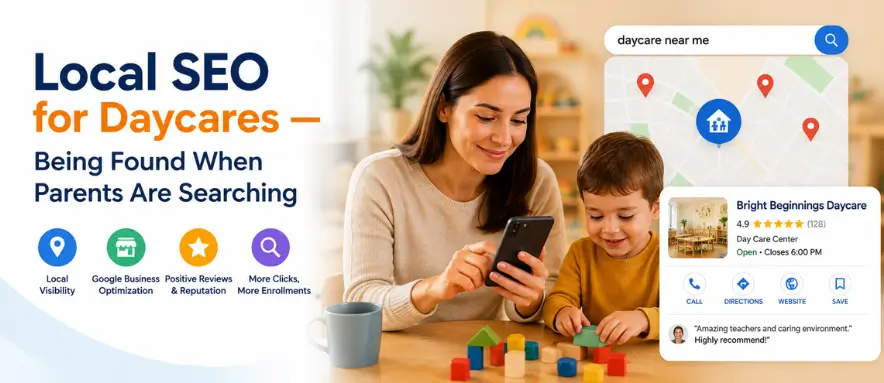
Local SEO for daycare centers is the foundation of every other marketing effort. If parents can’t find you in search, the quality of your program, the warmth of your staff, and the beauty of your facilities are invisible.
Google Business Profile — The Most Critical Free Tool for Childcare Centers
Your Google Business Profile is what appears in the local pack — those three businesses with the map that show up at the top of local search results. For parents searching for childcare, this is often the first thing they see before they visit any website. Getting it right is non-negotiable.
Category setup — “Child Care Agency,” “Day Care Center,” “Preschool,” “Nursery School” — choose the most accurate primary category and add relevant secondary categories for all the age groups and program types you offer.
Complete, keyword-rich description — write your GBP description for parents first, but include natural mentions of your program types (infant care, toddler care, preschool, after-school), your location references (neighborhood, nearby landmarks, areas you serve), and key trust signals (years established, qualified staff ratios, curriculum approach, safety certifications).
Photos that build trust immediately — parents choosing childcare are making an emotionally loaded decision. Photos of your actual facility — the play areas, the classrooms, the outdoor space, the meals — build trust that no marketing copy can replicate. Post new photos consistently, showing the real, lived environment of your center. Never use stock photos as your primary gallery. AI image tools can help you enhance photo quality, but authenticity is paramount.
Review generation — the single highest-ROI activity — childcare center reviews are read more carefully than almost any other local business review category. Parents are making decisions about their children. A center with 150 reviews averaging 4.8 stars will win inquiries over a center with 15 reviews averaging 5.0, every single time, because volume signals confidence. AI-automated review request systems, sent via SMS or email to parents immediately after enrollment confirmation or positive milestone moments, consistently generate 3-5x more reviews than centers relying on occasional manual requests.
Regular GBP posts — weekly posts showing program activities, upcoming events, staff spotlights, and seasonal curriculum content keep your profile active (which Google rewards with better ranking) and give browsing parents additional trust-building touchpoints.
On-Page SEO for Childcare Websites
Individual program pages — don’t list all your programs on a single page. Create individual pages for each age group and program: infant care, toddler program, preschool program, after-school care, holiday programs, summer camp. Each page targets the specific search terms parents use when looking for those specific services.
Location-specific content — if you serve multiple neighborhoods or suburbs, location pages that speak directly to parents in each area outperform generic regional content significantly. “Daycare in [Suburb A]” and “Preschool near [Landmark B]” pages capture hyper-local searches that your homepage never will.
Parent FAQ content — what do parents actually ask when they’re researching childcare? Fees, staff qualifications, curriculum philosophy, daily routines, food and allergy policies, safety procedures, sick child policies, holiday closures. Comprehensive FAQ pages answer these questions while capturing the search traffic of parents who type those exact questions into Google.
AI SEO for daycare business — AI-powered SEO tools like Surfer SEO, Clearscope, and Semrush’s AI features can analyse what content is performing for competing childcare centers in your market and identify the specific topics and keyword patterns your website is missing. This content gap analysis, which would take an experienced SEO specialist days to conduct manually, can be produced in hours with AI tools — and acted on systematically.
An SEO agency with experience in local service businesses and childcare-specific keyword research can build the complete local SEO foundation that keeps your center visible in search, month after month, year after year.
Building a Childcare Website That Converts Parent Visitors Into Enrolled Families
Your website is having conversations with parents at all hours of the day and night. What is it saying? Does it build trust, answer concerns, and make it easy to take the next step? Or does it leave parents with unanswered questions and a vague sense that they should keep looking?
A high-converting childcare website does one thing above everything else: it makes parents feel safe before they’ve ever met you in person.
What a Trust-Building Childcare Website Includes
A headline that speaks to the parent’s actual concern — not “Welcome to Sunshine Nursery” (says nothing, trusted by no one). Instead: “Safe, Nurturing, Ofsted-Outstanding Childcare in [City] — Places Available from [Age].” Or: “NAEYC-Accredited Preschool Serving Families in [Suburb] Since 2008.” Specifics build trust. Generics don’t.
Transparent safety information front and centre — parents want to know: who is with my child, what are their qualifications, what security does your facility have, how do you handle emergencies, what is your safeguarding policy? Childcare centers that answer these questions proactively — with a dedicated safety page, staff qualification listings, and clear security descriptions — convert at significantly higher rates than those who bury this information or omit it entirely.
Genuine staff profiles with photos and qualifications — “Meet our team” pages with real photos, real names, qualification details, and brief personal notes (“Ms. Sarah has worked in early childhood education for 12 years and has two children of her own”) are among the highest-performing trust-building elements on childcare websites. Parents aren’t just choosing a facility. They’re choosing the people who will care for their child daily.
Curriculum and daily routine transparency — what does a typical day look like? What learning philosophy do you follow? How are meals handled? What outdoor time do children get? Parents who understand your program deeply before visiting convert at higher rates and stay longer because the reality matches their expectations.
Video tour of the facility — a 2-3 minute video walkthrough of your center is one of the most powerful conversion elements a childcare website can have. Parents who can see the actual environment their child would be in — the colours, the resources, the space, the atmosphere — are significantly more likely to book a tour than those who’ve only seen static photos.
Pricing transparency (or a clear pricing request process) — childcare pricing is the question every parent wants answered before calling. Centers that provide clear pricing information (or a clear explanation of how pricing is structured and how to get a quote) reduce friction in the inquiry process. AI chatbots can handle pricing inquiries at any hour, providing range guidance and capturing contact details for follow-up.
Social proof throughout — Google review stars displayed at the top of the homepage. Testimonial quotes from current parents with first names and suburb. Accreditations and quality ratings prominently featured. Enrollment numbers or years established as credibility signals. Parents who are comparing three centers online will choose the one that looks and feels most trustworthy in every signal.
AI-Powered Parent Inquiry Automation — Never Lose a Lead Again
This is where AI marketing for child care creates its most immediate, measurable impact.
Studies of childcare enrollment patterns consistently show the same finding: the first center to respond to a parent inquiry converts at dramatically higher rates. Parents researching childcare are often making multiple simultaneous inquiries. The center that responds within five minutes — with a warm, personalised acknowledgment and a clear next step — wins the attention and begins building the relationship that leads to enrollment.
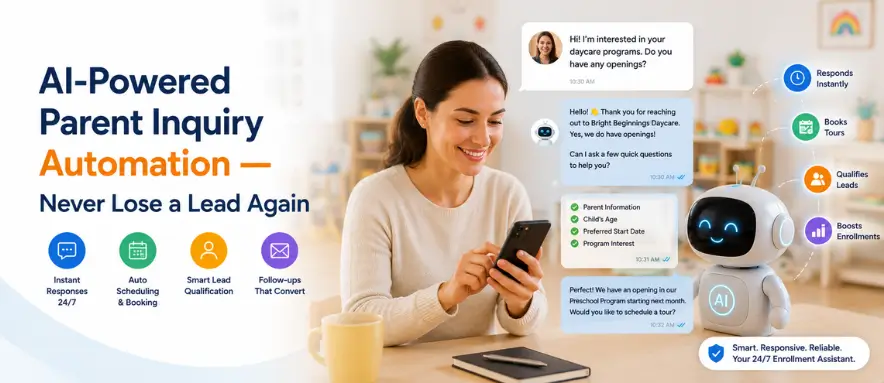
Five minutes. At any hour. On any day.
No human intake team can guarantee this. A well-configured AI system can.
What AI Inquiry Automation Looks Like for a Childcare Center
Immediate acknowledgment — the moment a parent submits a contact form, emails, or initiates a chat, they receive an immediate automated response. Not a generic “thank you for your message” — a personalised acknowledgment that references the specific program they enquired about, provides initial information relevant to their inquiry, and sets a clear expectation for when they’ll hear from a real person.
“Hi [Name], thank you for your interest in our toddler program at [Center Name]. We know finding the right childcare is one of the most important decisions you’ll make, and we’re here to help. I’ll have [Center Director’s name] reach out to you within the hour during business hours. In the meantime, you might find our [Toddler Program page] helpful — it covers our daily routine, curriculum approach, and team qualifications. If you have any immediate questions, our chat is open 24/7.”
That message takes 45 seconds to read. It builds trust. It manages expectations. It provides value. And it was sent automatically, immediately, without any human involvement.
AI chatbot for childcare inquiries — a properly configured AI chatbot on your website can handle the full range of initial parent inquiries: availability questions, pricing guidance, program descriptions, staff qualification information, facility features, enrollment process explanations, and tour scheduling. It captures contact details for every inquiry, qualifies the lead (what age is the child? what start date are you looking at? what program are you interested in?), and routes urgent or high-intent inquiries to your staff immediately.
Automated waitlist management — for centers at capacity, an AI-managed waitlist system keeps interested families engaged through the waiting period. Regular updates on waitlist position, relevant content about your program, and first-notification when a place becomes available prevent the waitlist from going cold. The childcare centers with the shortest time-to-enrollment after a place opens are those with actively nurtured waitlists.
Multi-step nurture sequences — not every parent who inquires is ready to enroll immediately. Some are researching months in advance. AI-automated email and SMS nurture sequences — delivering relevant content about your program, seasonal updates, parent resources, and periodic soft calls-to-action — maintain your center’s presence through the consideration period. The family who inquired in January and starts receiving genuinely helpful content about early childhood development and school readiness through February and March is primed to enroll when a place opens in April.
Tour scheduling automation — AI-integrated calendar booking means parents can schedule a tour at any time, from any device, without waiting for your office to open. Automated confirmation, reminder sequences (48 hours before, day of), and pre-tour information packages maximise show rates and arrive quality for booked tours.
Custom AI marketing agents built specifically for childcare enrollment workflows — configured with your program details, your fee structures, your availability calendar, and your specific inquiry qualification criteria — deliver significantly better results than generic chatbot tools because they speak in your center’s specific voice and with your specific information.
Google Ads for Childcare Centers — Targeted Enrollment Campaigns
When a parent types “childcare near me” or “daycare [suburb]” into Google, they want help now. Google Ads for childcare centers puts your facility at the top of those results, in front of the highest-intent parents, at the exact moment they’re making their decision.
Hyper-local targeting is the defining characteristic of effective childcare Google Ads. Parents choose childcare within a very specific geographic radius of their home or workplace — typically 2-5 miles in urban areas, somewhat larger in rural and suburban settings. A childcare center advertising to the entire city is wasting a large portion of its budget on parents who will never realistically enroll because of distance.
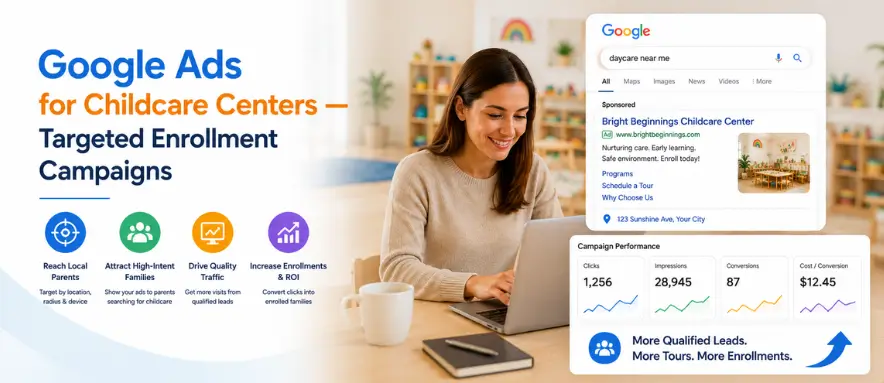
What Effective Childcare Google Ads Looks Like
Precise radius targeting — your ads should show only to parents within your realistic service radius. Overlapping radius targeting centred on your facility and the major residential areas and workplaces in your catchment generates the highest-quality clicks.
Age-group and program-specific ad groups — separate campaigns for infant enrollment, toddler program, preschool enrollment, after-school care, and holiday programs. Each campaign has its own keywords, its own ad copy, and its own landing page. A parent searching for “infant daycare” and a parent searching for “preschool near me” have different needs — they should see different ads and land on different pages.
Enrollment-period campaign timing — childcare enrollment follows predictable seasonal patterns. September new intake. January new intake after school terms. Summer program enrollment in spring. Campaign budgets should scale with enrollment season demand, not run at flat spend year-round.
Call extensions and call-only ads — many parents prefer to call rather than fill out a form, particularly for urgent childcare needs. Call extensions put your phone number directly in the ad. Call-only campaigns are specifically formatted for mobile searchers and display a large, easy-to-tap phone number rather than a website link.
Local Services Ads for childcare — in the USA and UK specifically, Google’s Local Services Ads product is increasingly available for childcare providers. The “Google Screened” or “Google Guaranteed” badge that appears on these ads is a significant trust signal for an industry where parental trust is the primary purchase driver.
A Google Ads management company that understands enrollment cycles, childcare-specific conversion tracking, and the geographic dynamics of childcare marketing will generate significantly better cost-per-enrollment than a generalist agency applying standard ecommerce or service business frameworks to a childcare context.
Social Media Marketing for Childcare Centers — Building Trust Where Parents Live Online
Parents of young children are among the most active social media demographics in existence. The Facebook groups and Instagram accounts they follow for parenting content, local recommendations, and community connections are where your childcare center’s reputation is built and shared — whether you’re actively managing it or not.
The centers that win the social media trust game are the ones that show parents what it actually feels like to have their child in their care — through consistent, warm, genuine content that communicates safety, love, learning, and joy.
AI Social Media for Childcare Centers — What to Post and Why
Daily life and activity content — with appropriate parental consent, photos and short videos of children engaged in learning activities, play, creative projects, and outdoor time are the highest-performing content type for childcare social media. They demonstrate the environment, the engagement of staff, and the quality of the program in a way that no written content can match. AI tools can help generate captions, hashtag sets, and content descriptions for these photos quickly and consistently.
Safety and procedure content — posts that explain your safety protocols, emergency procedures, access security, and safeguarding policies build parental confidence. “Did you know that all of our staff complete enhanced DBS/background checks every two years?” “Here’s how our secure entry system works.” These posts address the anxieties that parents have but may not voice during a tour.
Staff spotlight content — introducing individual staff members — their qualifications, their experience, their approach to early childhood education — humanises your center and builds the personal connections that lead parents to say “I want my child with that person.”
Curriculum and learning moment content — showing specific learning activities with brief explanations of their developmental purpose (“This sensory play activity supports fine motor development and language acquisition as children describe what they’re experiencing”) demonstrates educational intentionality and builds trust with parents who care about their child’s development, not just their supervision.
Parent testimonial and review content — sharing parent testimonials (with permission), celebrating enrollment milestones, and featuring families who have been with you for years creates powerful social proof. The parent who sees “The Johnson family has been with us since 2019 — we’re so proud to watch little Aiden growing up with us” is far more likely to trust your center than one who sees only promotional posts.
Seasonal and community engagement content — festival celebrations, community events, charity involvement, seasonal activities. This content keeps your profile active and relevant while demonstrating that your center is embedded in the local community.
ChatGPT content for childcare website and social media — AI tools can generate content calendars, caption drafts, blog post outlines, and social media copy for childcare centers significantly faster than human-only workflows. The AI draft is edited by someone who knows your center, your voice, and your families — but the blank page problem is solved.
Professional social media management for childcare centers handles the full content cycle — planning, drafting, scheduling, community management, and performance analysis — consistently and professionally, so your social presence works for you even during the school holidays and staff-intensive periods when marketing is the last thing anyone has time to think about.
Meta Ads for Childcare Centers — Reaching the Right Parents Before They’re Searching
Google Ads reaches parents who are actively searching. Meta Ads reach the parents who will need childcare in three months, six months, or next year — before they’ve started searching.
This proactive reach is particularly valuable for childcare centers because the planning timeline for childcare decisions is long. Many parents begin researching options during pregnancy or while their child is still an infant. Building awareness and trust with these parents early — before they’re in comparison-shopping mode — creates a pre-sold audience who already feel familiar with your center when they finally need to make a decision.
Meta Ads for childcare marketing work exceptionally well for:
Demographic targeting of new and expectant parents — Facebook and Instagram’s targeting capabilities allow childcare centers to reach parents within their geographic area based on parenting status, child age ranges, household demographics, and interests. New parent communities, parenting page followers, and baby product purchasers are all reachable audiences.
Local parent community targeting — Facebook’s location targeting combined with interest-based targeting around local parenting groups, schools, and community pages concentrates ad spend on the exact parents who live and work in your service area.
Video ad formats — short facility tour videos, staff introduction clips, and activity showcase videos perform strongly on Meta for childcare. Parents stop scrolling for content that shows happy children in safe, engaging environments. A 30-60 second facility tour ad delivers more trust-building information than any static ad format.
Retargeting website visitors — parents who have visited your website but haven’t yet inquired are your warmest potential audience. Retargeting ads that follow them across Facebook and Instagram with testimonial content, specific program highlights, or enrollment deadline reminders keep your center top of mind through the consideration period.
Lead generation ads — Meta’s native lead generation ad format (where the inquiry form is built into the ad itself, without requiring a website visit) reduces friction dramatically for mobile users. A parent can submit their contact details and basic inquiry information in three taps, without ever leaving their Facebook feed.
Email Marketing for Daycares — Nurturing Parents From Inquiry to Enrollment
Email marketing for daycares has the highest ROI of any childcare marketing channel — and most childcare centers are using it either minimally or not at all.
Your email list is the most valuable marketing asset your center owns. It contains your current families (who are your best referral source), your past inquiries (who may be ready to enroll now or know someone who is), and your waitlist (who need consistent nurturing to remain committed through the waiting period).
The Childcare Email Marketing Calendar
Inquiry confirmation sequence (Days 1-14 post-inquiry): Day 1: Immediate acknowledgment + program overview Day 3: Detailed curriculum and daily routine information Day 7: Staff team introduction content + safety overview Day 10: Parent testimonials and community highlights Day 14: Soft tour invitation if not yet booked
Waitlist nurture sequence (Monthly): Monthly program update including current children’s activities and achievements (anonymised/consented) Seasonal curriculum content relevant to child development Parent resource articles — age-appropriate activities, developmental milestones, school readiness tips Waitlist position update and estimated availability timeline Referral invitation — “Know a family who needs childcare? Share our details and both families receive a joining fee waiver”
Current family communication: Weekly newsletter — program highlights, upcoming events, parent reminders Seasonal enrollment reminders for additional services — holiday programs, summer camp, extended hours Annual re-enrollment confirmation Referral programme reminders
Re-engagement sequences: For inquiry contacts who went cold — “Has your childcare situation changed? We wanted to let you know places are now available in our [program] for [month].”
AI email marketing for daycares automates all of these sequences while personalising content based on the child’s age, the program of interest, and the inquiry timeline. What would require a full-time administrator to manage manually runs automatically, 24/7, with consistent tone and timing that human workflows can never fully replicate.
YouTube and Video Marketing for Childcare Centers
Video is the highest-trust content format available to childcare centers — and the format that parents respond to most powerfully when making enrollment decisions.
A three-minute facility tour video communicates more about the safety, warmth, and quality of your center than three hours of reading website content. Parents watching that video are mentally placing their child in that environment. They’re assessing the space, the staff interactions they can see, the resources available, the atmosphere.
YouTube marketing for childcare centers builds a permanent library of trust-building content that works around the clock:
Virtual facility tours — a complete walkthrough of your center, with warm narration that explains each area, its safety features, and its purpose for children’s development. These videos rank on YouTube search (“daycare near [city],” “preschool tour [suburb]”) and are embedded on your website where they dramatically improve conversion rates.
Meet the team videos — short individual introductions from each staff member. Qualifications, years of experience, what they love about working with children, their educational philosophy. Parents who have “met” your staff through video arrive at tours feeling they already know your team.
Curriculum explainer videos — what learning approach do you follow? Montessori? Reggio Emilia? Play-based learning? An early childhood education specialist explaining your curriculum philosophy in accessible, engaging terms builds enrollment-driving credibility with education-focused parents.
Day in the life content — an anonymised, consented “day in the life” video showing a typical program day — morning arrival, activities, meals, outdoor time, rest, afternoon activities — sets realistic expectations and builds trust with parents who want to understand exactly what their child’s experience will be.
Parent testimonial videos — a 60-90 second video of a genuine, articulate parent talking about their experience with your center is the most persuasive piece of marketing content you can produce. These videos should feature parents speaking authentically — not reading from a script — about what made them choose your center, what their child loves, and what has surprised them.
AI video creation for childcare — AI video creation tools can produce high-quality explainer animations, program overview videos, and branded content that supplement filmed content at a fraction of traditional production costs. For centers that want professional video content without full production budgets, AI video opens this channel to businesses of every size.
AI Marketing Automation for Childcare — The Complete System
Bringing all the AI marketing elements together into a coordinated system is where childcare centers achieve the most significant competitive advantages.
The AI-Powered Childcare Enrollment System
Top of funnel — awareness: Local SEO ensuring visibility in “childcare near me” and “daycare [suburb]” searches. Google Ads appearing at the top of results for high-intent enrollment searches. Meta Ads building awareness with parents in the demographic and geographic target profile. YouTube content building trust and familiarity with the center before a parent has ever contacted you.
Middle of funnel — consideration: Website content that builds trust, answers concerns, and makes the center feel safe and credible. AI chatbot capturing inquiries at any hour, answering initial questions, and qualifying leads. Automated email sequences delivering trust-building content through the consideration period. Retargeting ads maintaining presence with parents who have visited the website but haven’t yet inquired.
Bottom of funnel — decision: Automated tour scheduling making it frictionless to book a visit. Pre-tour information sequences that prepare parents and maximise tour show rates. Post-tour follow-up sequences that address remaining concerns and move undecided families toward enrollment. AI-managed enrollment documentation workflows that reduce friction in the paperwork process.
Retention and referral: Current family communication keeping existing families engaged, informed, and connected. Review generation automation building the social proof that supports top-of-funnel visibility. Referral programme management turning happy families into active advocates. Re-enrollment automation ensuring families stay through transitions between programs.
For childcare centers ready to implement the complete AI marketing system, agentic AI development services can build custom automation infrastructure configured for the specific workflows, communication preferences, and enrollment processes of individual centers — far beyond what generic marketing tools can deliver.
Reputation Management for Childcare Centers — The Trust That Fills Seats
In childcare, reputation isn’t just a marketing asset. It’s the primary product. Parents aren’t buying a commodity service. They’re making a deeply personal decision about who will care for their child for eight to ten hours a day. The trust they place in a childcare center is profound — and it’s built and maintained through every review, every social media post, every response to a concern, and every interaction with the community.
Systematic review generation — AI-automated review request systems, sent via SMS or email at optimal moments (enrollment confirmation, six-month anniversary, after positive feedback interactions), generate consistent review volume that builds the social proof foundation that keeps your center visible and credible in search.
Monitoring and response — AI tools that monitor Google, Daycare.com, Yelp, Care.com, Mumsnet (UK), and other platforms for mentions and new reviews, alerting your team and drafting response language for approval. Responding to every review — positive and negative — within 24 hours signals responsiveness and care that reinforces parent trust.
Crisis communication readiness — childcare centers are uniquely vulnerable to reputation challenges. A single complaint, a regulatory visit, an incident that gets misrepresented online. Having pre-agreed communication protocols and response frameworks ready before any challenge occurs allows for calm, professional, trust-preserving responses rather than reactive communications made under pressure.
Search result management — ensuring that when a parent searches your center’s name, the results are dominated by positive, accurate, authoritative content. AI-assisted content production builds the positive content library that shapes search results over time.
Childcare Digital Marketing by Country — What Works Where
India — the formal childcare and preschool sector is growing rapidly in urban India, driven by dual-income households and increasing awareness of early childhood education. Google Ads are increasingly competitive in major cities. Local SEO is a significant opportunity in Tier 2 cities where digital competition is lower. WhatsApp automation is essential — Indian parents heavily prefer WhatsApp for initial inquiries and ongoing communication. Instagram is the primary social platform for building aspirational preschool brand positioning.
USA — highly competitive market with significant per-center investment in digital marketing. Local Services Ads are available for childcare in many states. State licensing and accreditation (NAEYC, state quality ratings) are significant trust signals in content marketing. Childcare costs are a primary concern — transparent pricing content performs strongly.
UK — Ofsted rating is the dominant trust signal. Any childcare center with Outstanding or Good rating should prominently feature this in every digital touchpoint. Free childcare entitlement hours (15/30 hours for eligible families) create specific inquiry peaks that digital marketing campaigns should be timed to capture. Mumsnet and local Facebook parenting groups are significant referral and reputation channels.
Australia — Child Care Subsidy (CCS) is a primary decision factor for Australian families. Content and advertising that clearly explains CCS eligibility and net costs after subsidy generates significantly higher conversion than content that only mentions headline fees. Australian childcare centers should target “approved provider” and “registered childcare” in local SEO content.
Canada — provincial government childcare funding programmes vary significantly. In provinces with subsidised childcare (Quebec, British Columbia’s $10/day programme), pricing and subsidy eligibility are primary content priorities. English and French language content important for Quebec-based centres.
New Zealand — 20 Hours ECE entitlement for 3-5 year olds is the primary government support programme. Local SEO and Google Ads are the primary digital channels. Community-based marketing through school and playgroup networks supplements digital.
Netherlands — kinderopvang (childcare) market. Dutch-language content essential. Government childcare subsidy system means pricing transparency about net parental contribution is important. Facebook and Instagram strong for parent community engagement.
France — crèche and école maternelle system creates specific marketing opportunities around the segments not served by public provision. French-language content required. Social media engagement in local parenting communities.
Malta — small, tight-knit market where personal recommendation and community reputation are highly influential. Facebook groups are the primary word-of-mouth platform. Local SEO can achieve strong results quickly given lower competition.
Brazil — rapidly growing private childcare market, particularly in urban centres. WhatsApp essential for parent communication. Instagram strong for visual trust-building content. Meta Ads effective for local parent audience targeting.
Frequently Asked Questions: AI Marketing for Child Care
AI marketing helps daycares get more enrollments by ensuring they’re visible in local search (local SEO and Google Ads), by capturing and responding to every parent inquiry instantly (AI chatbots and automation), by nurturing undecided families through the consideration period (automated email sequences), and by building the trust and social proof that parents need before choosing a childcare center (reputation management, review generation, content marketing). The combined effect is more inquiries, better conversion from inquiry to tour, better conversion from tour to enrollment, and lower cost per enrolled family.
For content creation: ChatGPT and Claude for caption drafts, content calendar planning, and blog post generation. For scheduling: Hootsuite, Buffer, or Later with AI features. For image enhancement: Adobe Firefly for improving photo quality while maintaining authenticity. For video: AI video tools like Runway or Canva’s AI video features for promotional content. The most effective approach combines AI drafting tools with human review to ensure content sounds genuine and is appropriate for the sensitivity of the childcare context.
The most effective approach is an AI chatbot on your website that immediately engages every new inquiry, combined with an email and SMS automation platform (like HubSpot, ActiveCampaign, or Mailchimp) configured with a multi-step inquiry nurture sequence. The sequence should acknowledge immediately, provide relevant program information over the first week, invite a tour at the right moment, and continue with lighter-touch content through the consideration period. Custom AI marketing agents can manage this entire workflow automatically.
Yes — with an important caveat. AI tools can produce high-quality first drafts of trust-building content: safety policy explanations, curriculum descriptions, staff qualification overviews, FAQ pages, and parent-focused blog posts. But this content requires human review — by someone who actually knows your center, your staff, and your families — before publication. The AI draft is faster and often more comprehensive than a human first draft. The human review ensures it’s accurate, warm, and authentic to your specific center’s voice.
AI-powered local SEO tools help daycares appear in Google Maps by systematically optimising every element that influences the local pack ranking: Google Business Profile completeness and activity, review volume and quality, website content relevance for local search terms, citation consistency across directories, and the geographic targeting signals in your website structure. AI tools can audit all of these factors, identify specific gaps, and generate the content and optimisation actions needed to improve ranking — at a pace and scale that manual local SEO work can’t match.
Final Word: The Childcare Centers That Will Win in 2026 Are Already Building Their Digital Systems
Here’s the honest truth about childcare marketing in 2026.
The centers that have their seats filled and their waitlists growing aren’t necessarily the most qualified educators, the most beautifully designed facilities, or the most experienced operators. They’re the ones who show up at every digital touchpoint a parent uses during their decision-making journey — in Google search results, in Instagram feeds, in review platforms, in automated email inboxes, in instant chatbot responses at 10pm on a Tuesday.
Your program quality is why families stay. Your digital marketing is why they find you in the first place, choose you over the competitor down the road, and tell their friends about you.
Every day a seat sits empty is revenue that can’t be recovered. Every inquiry that doesn’t get an immediate response is a family that may have enrolled. Every parent who can’t find you online is a family who chose someone else, not because they were better, but because they were more visible.
AI marketing for child care doesn’t replace the warmth, the care, and the genuine commitment to children’s development that makes a great childcare center. It makes sure that those qualities are visible to every parent who’s looking.
Talk to DQOT Solutions about AI marketing for your childcare center →