
A D2C founder in Andheri is staring at her Meta Ads dashboard at 11pm.
Three months ago, her ROAS was 3.8x. She was scaling confidently, adding budget every week, watching revenue follow. Last month it dropped to 2.4x. This month it is sitting at 1.7x and still falling. Her CAC has nearly doubled. Her best-performing ad creative from six months ago — the one she has been running on repeat — has completely died. She has tried new audiences. She has tried new copy. Nothing is working.
She is not running her ads poorly. She is running an outdated playbook in a market that has moved.
India’s digital advertising market reached ₹49,000 crore in FY2025. Over 900 million Indians are online. The ecommerce and D2C ecosystem has expanded dramatically, meaning more brands than ever are competing for the same Meta audiences, the same Google keywords, and the same consumer attention. CPCs are rising. Creative fatigue is faster than it has ever been. And the performance marketing agencies that are growing their clients in this environment are doing something fundamentally different from what worked in 2021 and 2022.
This is the complete 2026 guide to performance marketing agencies in India — what the best ones actually do, why UGC ads have become the highest-ROI creative format in the market, and how to evaluate whether an agency partner will fix your ROAS problem or just manage your declining metrics with more sophisticated language
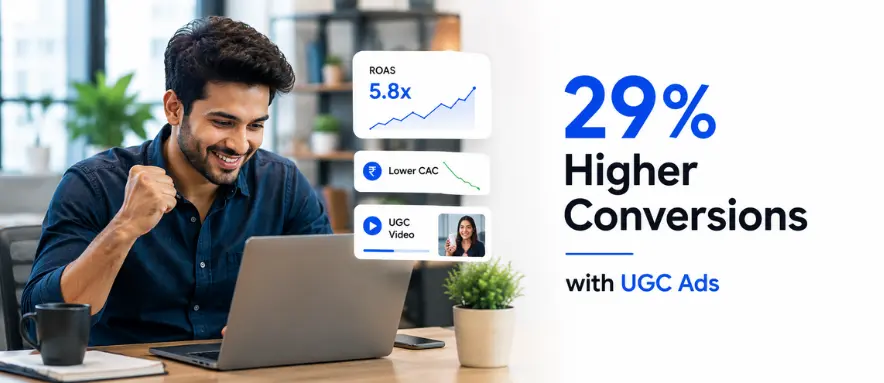
Table of Contents
What Performance Marketing Actually Means in 2026 — And Why Most Brands Get It Wrong
But this clean definition creates a dangerous misconception. Brands hear “performance marketing” and assume it means running Google Ads and Meta Ads until the money runs out and checking whether the ROAS looks acceptable. That is not performance marketing. That is paid media with a reporting layer.
The performance marketing agencies actually delivering results in 2026 understand a more complete picture.
Revenue does not come from one channel. It comes from how channels work together. A Meta ad that generates awareness, a Google Search ad that captures the resulting branded query, a landing page that converts the visit, an email automation that recovers the abandoned cart, and a WhatsApp follow-up that closes the hesitant buyer — these are not separate campaigns. They are one revenue system. Optimizing Meta in isolation while the landing page is broken, the email automation is generic, and the Google brand campaign is underfunded is performance marketing theater. The dashboard looks active. The revenue does not reflect it.
The brands seeing consistent ROAS improvement in India’s current advertising environment have made three specific structural changes.
First, they have moved from last-click attribution to multi-touch attribution models that give credit to the channels that actually influenced the purchase — not just the final click. India’s digital ad spend trajectory demands granular, real-time attribution across all touchpoints. When a performance marketing agency cannot explain exactly how they track which creative, which platform, or which audience drove each conversion, they are not managing performance. They are managing reporting.
Second, they have shifted significant creative budget toward UGC — user-generated content — because the data on UGC ad performance is now undeniable. More on this in the next section.
Third, they have built first-party data infrastructure — email lists, WhatsApp subscriber bases, loyalty program memberships — as the foundation of a marketing system that does not depend entirely on Meta’s targeting precision or Google’s keyword inventory. Cookie tracking is disappearing, and the brands building their own customer databases are building the most durable competitive advantage available in Indian performance marketing right now.
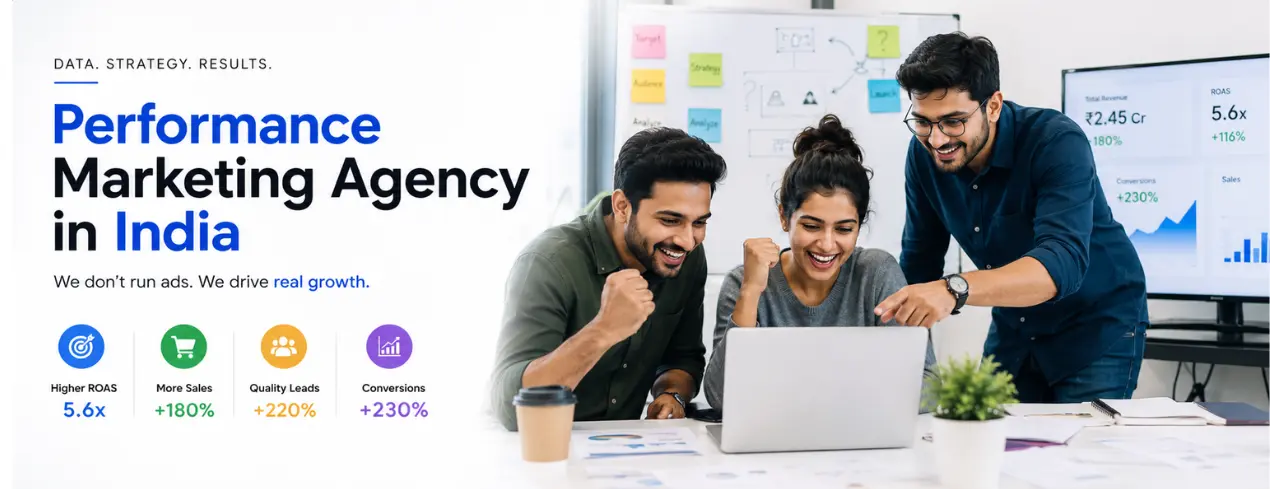
A genuine performance marketing agency in India in 2026 is not a vendor that runs your ads. It is a growth partner that builds the complete revenue system — creative, paid media, landing pages, attribution, retention — and manages it as a connected whole rather than a set of siloed channel reports.

UGC Ads — The Highest-ROI Creative Format in Indian Performance Marketing Right Now
If there is one creative format that has definitively separated the performance marketing agencies growing their clients from the ones managing their decline, it is UGC ads — user-generated content advertising.
Campaigns blending UGC with paid distribution achieve 29% higher conversion rates and 4x CTR boosts compared to traditional polished brand creative. Indian video affiliates using UGC formats average 6 to 10% conversion rates — almost double those of traditional display ads. These are not optimistic estimates from a UGC-selling agency. They are observed outcomes across real campaigns at scale.
Why does UGC outperform traditional creative so consistently in the Indian market specifically?
The trust gap in India between branded advertising and personal recommendation is enormous. Indian consumers — particularly the 25 to 45 year old D2C buyer who is the most commercially valuable audience segment for most performance marketing campaigns — respond to content that feels real more than content that looks expensive. A 60-second Meta Reel of an actual customer unboxing a skincare product, talking through what they noticed after two weeks of use, showing their skin in natural lighting without studio correction, consistently outperforms a beautifully shot brand video with the same product because it does not look like advertising. It looks like what their friend sent them.
This authenticity premium is compounded by Meta’s advertising environment specifically. The scroll speed and ad saturation on Instagram and Facebook in 2026 means polished, produced creative is identified as an ad within the first half-second and scrolled past by a majority of users. UGC content — which looks native to the social environment it appears in, because it was created for that environment — holds attention longer, generates more complete video views, and converts at higher rates at equivalent or lower CPMs.
The practical architecture of a high-performing UGC ads program for an Indian D2C or ecommerce brand works across three layers.
Creator sourcing and briefing. The best UGC for Indian performance marketing is not found on global creator marketplaces that source Western creators producing content that feels culturally misaligned with Indian audiences. It is found in India-specific creator networks — micro and nano influencers with 5,000 to 80,000 engaged Indian followers who speak the language of the product’s target customer, whether that is urban professional English, conversational Hindi, or regional Tamil, Telugu, or Kannada. The brief must give the creator real product experience — they need to actually use what they are talking about — and clear performance objectives without scripting their natural voice out of the content.
Volume and variation testing. The fundamental principle of UGC ads at scale is that you do not know which creator, which hook, which format, or which length will break out until you test at volume. A performance marketing agency running UGC campaigns needs a systematic creative testing framework — producing 8 to 15 UGC variants per campaign, testing hooks, formats (unboxing vs. review vs. transformation), and creator profiles, identifying the 2 to 3 winners that produce significantly better cost-per-purchase, and scaling budget behind them while refreshing creative inventory before fatigue sets in.
Paid distribution behind organic UGC signals. The most efficient UGC ad strategy identifies organic content that is already generating above-average engagement — saves, shares, comments, and profile visits — and whitelists or boosts that content as paid advertising. Meta’s algorithm already knows this content resonates with real audiences before a single paid rupee is spent behind it. Putting paid distribution behind pre-validated organic performers consistently outperforms creating fresh paid creative from scratch.
UGC ad creation and performance marketing services for Indian brands in 2026 are most effective when the creative and media-buying functions are genuinely integrated — the team designing the UGC brief understands what the media buyer needs to optimize, and the media buyer understands what creative signals indicate a UGC variant is worth scaling. Separating these functions into a creative team and a media team that communicate monthly is consistently the structural reason that UGC programs underperform their potential even when the individual pieces are solid.
The Full Performance Marketing Stack — Channel by Channel
Let me walk through what a complete performance marketing stack looks like for an Indian brand in 2026 — how each channel contributes to the overall revenue system and where agencies consistently create or destroy value.
Google Ads: Capture What Demand Already Exists
Google Ads management in performance marketing serves a fundamentally different function than Meta or social advertising. Google captures demand that already exists — someone searching “buy wireless earbuds under ₹3000” or “best protein powder for beginners” has already decided to purchase and is in the final comparison phase. Getting your brand in front of that query, with a compelling ad and a landing page that converts, delivers the highest-intent traffic available in paid media.
Performance Max campaigns — Google’s AI-driven cross-channel format — have become increasingly important in 2026, dynamically allocating budget across Search, Shopping, Display, YouTube, and Gmail based on real-time conversion signal optimization. PMax campaigns require excellent creative assets, a well-structured product feed for ecommerce brands, and a performance marketing team that understands how to set conversion goals that reflect actual business value rather than proxy metrics like page visits or session duration.
Google Shopping is where most ecommerce and D2C performance marketing investment belongs if the brand sells physical products — shopping ads with high-quality product imagery, competitive pricing, and strong review signals consistently deliver lower cost-per-purchase than comparable brand search campaigns for most product categories.
Meta Ads: Create and Capture Demand Through the Funnel
Meta Ads management for Indian performance marketing in 2026 operates through three campaign layers running simultaneously.
Top-of-funnel awareness campaigns — using UGC video content, interest and behavioral targeting, and broad audience reach — introduce products to audiences that did not know they needed them. Middle-of-funnel consideration campaigns — using carousel formats, social proof content, and benefit-led creative — nurture people who have visited the website or engaged with previous content. Bottom-of-funnel conversion campaigns — using dynamic product ads, retargeting specific product viewers, and urgency-based offers — close the buyers who are nearly ready to purchase.
The critical discipline in Meta performance marketing is maintaining all three layers simultaneously, not collapsing into pure bottom-of-funnel retargeting when ROAS pressure increases. Retargeting-only Meta strategies deplete the warm audience pool quickly, producing a temporary ROAS spike followed by audience saturation and severe performance degradation — exactly the pattern that D2C founders describe when they say their performance “fell off a cliff” after a period of strong returns.
Advantage+ Shopping Campaigns — Meta’s AI-optimized shopping format — are producing compelling results for ecommerce brands in India that have strong product catalogs and clean pixel data. Running Advantage+ alongside traditional manual campaigns, with an experienced agency managing budget allocation between them based on real performance data, consistently outperforms either approach run in isolation.
YouTube Ads: The Trust-Building Performance Channel
YouTube marketing is the most underinvested performance channel for Indian D2C and ecommerce brands relative to its actual conversion contribution. YouTube’s consideration-stage value — reaching consumers who are actively researching products through how-to videos, unboxing content, and category education — is substantially underrepresented in most performance marketing attribution models because it rarely appears as the last click before a conversion.
But YouTube view-through conversions — purchases made by people who watched a YouTube ad before eventually converting through a different channel — demonstrate that YouTube plays a significant role in the path to purchase for high-consideration products in India. Performance marketing agencies with genuinely holistic attribution measurement rather than last-click dependency consistently allocate more to YouTube and see overall funnel improvement as a result.
SEO: The Long-Term Performance Layer
SEO services are not typically classified as performance marketing — but a complete performance marketing agency in India understands that organic search traffic is the most cost-efficient conversion traffic available, and that investing in content-driven organic visibility alongside paid media is the difference between a marketing strategy that requires constant paid reinvestment to sustain revenue and one that builds compounding organic leverage alongside paid growth.
Product category pages, buying guides, comparison content, and brand search capture through SEO reduce the portion of customer acquisition cost that depends on paid media — improving blended MER (Marketing Efficiency Ratio) over any sustained time horizon. Performance marketing and SEO are not competing priorities. They are complementary systems that share the same conversion objective.
AI in Performance Marketing — How Intelligent Systems Are Changing the Game
Performance marketing in India for 2026 is on the brink of revolutionary change, shaped by advances in AI, dramatic growth of retail media networks, and a decisive shift towards first-party data and privacy-driven strategies.
The AI layer in performance marketing operates across four specific, measurable functions.
Creative intelligence and automated testing. AI marketing automation systems now analyze creative performance signals — hook completion rates, view-through rates, comment sentiment, conversion probability — and identify which creative elements are driving performance versus which are creating drag. Rather than waiting for a campaign to run for two weeks before evaluating creative performance, AI-powered creative analysis surfaces early signals within 48 to 72 hours that predict which variants will perform at scale. This dramatically accelerates the creative testing cycle and reduces wasted spend on underperforming creative.
Predictive bidding and budget allocation. Manual bid management at the campaign level is increasingly a commodity function — the platforms’ own AI bidding systems (Google’s Smart Bidding, Meta’s Advantage+ audience optimization) outperform manual CPC and CPM strategies in most campaign contexts. The value-add of a sophisticated agentic AI performance marketing system is one layer above this — portfolio-level budget allocation across channels, campaigns, and audience segments based on predicted marginal ROAS, adjusting spend dynamically as performance signals shift throughout a campaign flight.
First-party data activation. As third-party cookies phase out, the brands with clean, structured first-party data — email lists, WhatsApp subscriber bases, loyalty program memberships, CRM records — have a material performance marketing advantage over those whose targeting depends entirely on platform-provided audience signals. AI systems that enrich first-party customer data with behavioral predictions — identifying which existing customers are most likely to repurchase, which lapsed customers are most likely to reactivate, and which segments of the customer base are most likely to respond to specific offer types — enable a precision in performance marketing that platform-provided targeting alone cannot replicate.
GEO and AEO optimization for performance marketing discovery. Indian business decision-makers — founders, CMOs, and marketing leads searching for performance marketing agencies in India — are increasingly beginning their agency evaluation process not on Google but through AI tools. Asking ChatGPT or Perplexity “best performance marketing agency in Mumbai for D2C brands” is becoming as common as a Google search for the same query. AI search visibility optimization for performance marketing agencies — and for brands that want to capture AI-driven discovery in their own categories — requires content architecture that AI tools can parse, trust, and confidently recommend.
AI video creation is also transforming the UGC production bottleneck. Producing 12 to 15 UGC ad variants per month through traditional creator sourcing takes 3 to 4 weeks and significant coordination. AI-assisted UGC production — generating video scripts, creating variation in hooks and CTAs, and producing platform-native vertical video content from existing brand and product assets — compresses that timeline to 3 to 4 days, enabling creative velocity that the current Indian performance marketing environment genuinely demands.
Performance Marketing Agency Mumbai — The Specific Market Context
Mumbai deserves specific attention in any guide to performance marketing agencies in India because the city’s business ecosystem creates a distinct set of performance marketing challenges and opportunities that are not replicated anywhere else in the country.
Mumbai is India’s commercial engine. From FMCG giants in Andheri to fintech startups in BKC, every business here competes for the same thing: attention that converts. India’s digital advertising market reached ₹49,000 crore in FY2025, growing at strong double-digit rates — and a disproportionate share of that spend is concentrated in Mumbai across FMCG, fashion, food and beverage, financial services, and consumer tech categories.
This concentration means two things. First, performance marketing costs in Mumbai’s primary categories are among the highest in India — CPCs for competitive search terms, CPMs for premium Instagram audiences, and influencer rates for Mumbai-based creators are all materially higher than equivalent campaigns run for secondary city markets. Second, the performance marketing talent density in Mumbai — experienced media buyers, skilled creative strategists, data analysts who understand attribution — is the highest in India, which means the gap between a good performance marketing agency in Mumbai and a mediocre one is wider in terms of actual capability, not just reputation.
Performance marketing retainers for Mumbai clients typically range from ₹25,000 per month for early-stage businesses with limited ad spend under management, to ₹2,50,000 and above for established brands with significant monthly media budgets requiring multi-channel management, dedicated UGC creative production, and sophisticated attribution reporting.
The questions that determine whether a performance marketing agency in Mumbai is genuinely capable or merely well-positioned are specific and worth asking directly. How do they handle creative fatigue? What is their UGC production cadence? How do they measure incrementality rather than last-click ROAS? What first-party data strategy do they recommend for a brand in your category? The specificity of the answers to these four questions tells you more than any case study presentation.
Choosing the Right Performance Marketing Agency in India — The Evaluation Framework
The Indian performance marketing agency landscape in 2026 is saturated with competent-sounding options and very few genuinely differentiated capabilities. Here is the evaluation framework that actually separates agencies that will improve your business from agencies that will manage your current trajectory with more sophisticated reporting.
Creative infrastructure, not just media buying. A performance marketing agency that cannot produce UGC ads, does not have a structured creator briefing and testing framework, and relies entirely on a brand’s internal creative team for ad assets is a media buying service, not a performance marketing agency. In 2026, where creative velocity is the primary ROAS lever across Meta and increasingly on Google and YouTube, the agency’s creative production capability is at least as important as its paid media expertise. Ask specifically: how many UGC variants do they produce per month for comparable clients? What is their creative testing framework? How quickly do they identify and replace fatiguing creative?
Attribution beyond last click. Any agency presenting only last-click ROAS in their monthly reports is hiding the actual complexity of how performance marketing drives revenue. Ask how they measure view-through conversions on YouTube. Ask how they account for Meta’s contribution to Google brand search volume. Ask how they would structure incrementality testing to determine whether their paid spend is genuinely driving additional revenue or capturing demand that would have converted organically. The sophistication of the attribution conversation is a direct predictor of campaign quality.
First-party data strategy. An agency that does not proactively recommend email list building, WhatsApp subscriber acquisition, and CRM enrichment as part of the performance marketing strategy is leaving a significant and growing competitive advantage unbuilt. The brands in India that will be able to maintain performance marketing efficiency through the ongoing erosion of third-party targeting are the ones building first-party data assets now, and the agency that does not prioritize this is not thinking about your brand’s 2027 marketing environment.
Transparent, business-level reporting. ROAS by campaign is not enough. The performance marketing reporting that actually supports business decisions includes blended MER across all channels, contribution margin per acquisition rather than just cost per acquisition, LTV-to-CAC ratio trends, creative performance intelligence that informs the next testing cycle, and a clear attribution of which channel mix changes are producing the results versus which are incidental. If a prospective agency’s reporting sample does not include these metrics, their optimization decisions are correspondingly less informed.
AI and automation capability. Agencies that are not deploying AI tools for creative testing intelligence, predictive audience management, and automated performance alert systems are operating at a structural efficiency disadvantage versus agencies that are. This does not mean using AI as a marketing buzzword — it means specifically deploying machine learning-assisted creative analysis, AI bidding strategies at the portfolio level, and predictive CLV modeling for audience targeting. Ask which specific AI tools and systems are integrated into their campaign management workflow.
At DQOT Solutions, we build performance marketing systems that combine paid media management across Google, Meta, and YouTube with UGC creative production, AI-powered optimization, first-party data strategy, and attribution infrastructure — all measured against the business metrics that actually determine whether a marketing investment is working.
Frequently Asked Questions
Performance marketing is a results-based advertising model where brands pay specifically for measurable actions — clicks, leads, app installs, or sales — rather than for exposure, impressions, or reach. Unlike traditional digital marketing that may measure success through brand awareness metrics, performance marketing agencies track every rupee of ad spend against a specific conversion event, making campaigns fully accountable and continuously optimizable. In India’s current advertising environment, the best performance marketing companies combine paid media management across Google, Meta, and YouTube with UGC creative production, full-funnel strategy, and attribution systems that measure revenue impact rather than channel metrics in isolation.
UGC ads — user-generated content advertisements — are marketing videos or images created by real customers, creators, or micro-influencers rather than produced by professional studio teams. They perform significantly better than traditional brand creative in India’s current paid media environment for three specific reasons. They bypass the scroll-past reflex that polished advertising increasingly triggers in high-saturation platforms like Meta and Instagram. They generate trust through authenticity — a real person describing real product experience resonates more deeply with Indian consumers than a branded spokesperson. And they enable creative velocity — a brand can produce and test 12 to 15 UGC variants for the cost of a single studio production, dramatically accelerating the creative testing that performance improvement requires. Campaigns combining UGC with paid distribution achieve 29% higher conversion rates and 4x CTR boosts compared to traditional creative.
Performance marketing agency pricing in India varies significantly based on service scope, channels under management, and creative production requirements. Ongoing performance marketing retainers typically start around ₹25,000 per month for early-stage businesses and can reach ₹2,50,000 or more per month for established brands with significant monthly ad spend requiring multi-channel management, dedicated UGC production, and sophisticated attribution reporting. Agency management fees are typically charged separately from media spend — the ad budget itself is paid directly to the platforms. Many agencies charge a percentage of ad spend under management, commonly 10 to 20% of media budget, with minimum monthly retainer floors.
ROAS — Return on Ad Spend — measures the revenue generated for every rupee spent on advertising. It is declining for many Indian brands in 2026 for several compounding reasons. Meta’s targeting precision has degraded following iOS privacy changes, reducing the efficiency of audience-based paid social campaigns. Ad platform CPMs and CPCs have risen significantly as more Indian brands compete for the same digital inventory. Creative fatigue is accelerating — audiences see the same ad more quickly in a high-volume advertising environment, and creative that worked for 6 months in 2021 fatigues in 6 weeks in 2026. And many brands are running pure bottom-of-funnel retargeting strategies that deplete warm audience pools without replenishing them through top-of-funnel awareness. Performance marketing agencies genuinely solving ROAS problems in 2026 address all four of these factors simultaneously — not just optimize bids within a declining structural environment.
The most sophisticated performance marketing companies in India measure campaign success across a hierarchy of metrics. Blended MER — total revenue divided by total marketing spend across all channels — provides the most accurate picture of overall marketing efficiency without the distortions of last-click attribution. Contribution margin per acquisition accounts for COGS, shipping, and returns to reveal whether the business is actually profitable at a given CAC. LTV-to-CAC ratio measures whether the customer acquired is worth more over their lifetime than it cost to acquire them — the fundamental health check for any performance marketing program. Repeat purchase rate and 90-day reorder rates assess whether the acquired customers are genuinely high-quality. An agency reporting only channel-level ROAS without these business-level metrics is providing performance theater rather than performance intelligence.
Performance marketing agencies across Mumbai, Delhi, and Bangalore differ primarily in category depth and cultural context rather than fundamental capability. Mumbai-based agencies typically have the deepest expertise in FMCG, fashion, financial services, and consumer tech — reflecting the city’s commercial ecosystem. Delhi and Gurgaon agencies often have stronger B2B and government-adjacent sector experience. Bangalore agencies frequently have deeper SaaS, edtech, and startup ecosystem knowledge. The choice between city-based agencies matters less for digital-native channels like Meta and Google — where campaigns are managed remotely — and more for services requiring local team presence, creator networks, or sector-specific relationships. For most ecommerce and D2C performance marketing needs, agency capability and relevant sector experience matters more than geographic location.
Google Ads campaigns targeting high-intent purchase queries can begin generating conversions within 7 to 14 days of launch when landing pages are properly optimized. Meta campaigns targeting cold audiences typically require 30 to 60 days for meaningful optimization, as Meta’s algorithm needs sufficient conversion data to train its delivery model. UGC creative testing requires a systematic 30 to 45 day testing cycle to identify which variants produce significantly better cost-per-purchase before scaling budget behind winners. SEO layered alongside paid media shows meaningful organic traffic growth within 4 to 6 months. Full-funnel performance systems — where paid acquisition, landing page optimization, email automation, and retention sequences work together — typically demonstrate the strongest improvement in blended MER at the 90-day mark and compound from there.
DQOT Solutions provides complete performance marketing services for Indian brands — including Google Ads management across Search, Shopping, and Performance Max; Meta Ads management combining UGC creative production with full-funnel campaign architecture; YouTube marketing for consideration-stage brand building and product demonstration; social media management and UGC creator strategy; SEO for organic performance alongside paid media; AI-powered marketing automation for lead nurture and customer retention; agentic AI systems for predictive campaign optimization; and AI video creation for UGC ad content at scale. We measure every engagement against business-level metrics — contribution margin, LTV-to-CAC ratio, and blended MER — not channel-level vanity metrics.
Your ROAS Problem Is Solvable — But Not With Yesterday’s Playbook
India’s digital advertising market is ₹49,000 crore and growing. The competition for Indian consumers’ attention has never been fiercer — or more systematically beatable by the brands that understand what the current environment actually rewards.
It rewards creative velocity. The brand testing 15 UGC variants per month consistently outperforms the brand running 3 evergreen creative assets. It rewards full-funnel thinking. The brand managing awareness, consideration, and conversion simultaneously outperforms the brand that retargets until its warm audience is exhausted. It rewards first-party data. The brand building its email list, WhatsApp subscriber base, and CRM while running paid media is building resilience that third-party-dependent brands cannot match. And it rewards attribution honesty — understanding which channels are genuinely driving incremental revenue versus which are capturing intent that would have converted anyway.
The performance marketing agencies in India that are delivering genuine results in 2026 are not running more ads. They are running smarter systems — where UGC creative, paid media, AI optimization, and retention marketing work together as a connected revenue engine rather than a collection of independently managed campaigns.
That system is buildable. The question is who you build it with.
Ready to build a performance marketing system in India that fixes your ROAS and builds sustainable growth?
Talk to the DQOT Solutions performance marketing team today →