


There is a couple in your city right now planning their wedding. They have a venue. They have a dress. They have a date. And tonight, one of them opens Google and types “wedding photographer [your city].”
The search results load in 0.4 seconds. Three names appear in the local map pack at the top of the page. Below that, five more websites appear in the organic results. The couple clicks the first result, spends 90 seconds on the portfolio, reads three reviews, and sends an inquiry at 9:23pm.
Your name was not in those results. Not because your work is not as good as the photographer who got the booking. Not because your prices are wrong. But because your website is not optimized to show up when the right client goes looking.
SEO for photographers is how you fix that. Permanently.
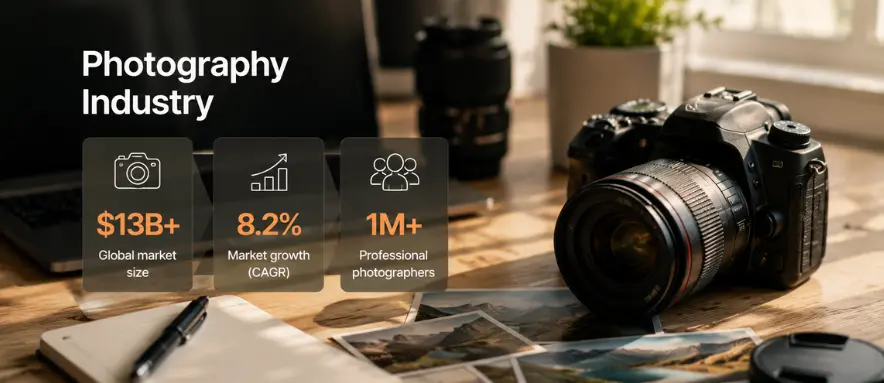
The US photography industry is worth $16.2 billion in 2026, with 255,000 businesses competing for clients who are increasingly making their decisions through Google search. A local search for “wedding photographer near me” converts to a booking inquiry at rates five to ten times higher than any non-local search term. And 76% of photography searches now happen on mobile devices — meaning clients are searching in real time, ready to act, comparing the top three results and choosing before they reach their second coffee.
This is the complete SEO guide for photographers in 2026 — covering keywords, local SEO, image optimization, blog content, technical foundations, and the AI search visibility that is becoming the next major booking channel for photographers who move early.
Table of Contents
Why Most Photography Websites Are Invisible — And How SEO Changes That
Here is the uncomfortable truth about most photography websites.
They are built to impress, not to be found.
A stunning Showit template with a moody hero image and an editorial font tells the photographer’s story beautifully. But if the page title is “Home” and the only text on the page is “Welcome — I’m [Name] and I love capturing moments,” Google has no idea who you are, what you do, or where you do it. The search engine reads your site and categorizes it as a generic creative website with no discernible specialty or location. You rank for nothing. You are found by no one except the people who already know your name.
The photographers with consistently full booking calendars understand one fundamental principle: SEO is not about stuffing keywords into your website. It is about clearly communicating — to both Google and the humans behind the searches — exactly what you offer, for whom, and where. When that communication is done correctly, the right clients find you at the exact moment they are ready to hire.
Here is what the modern photography client journey looks like before they ever contact you. They search a location-specific query — “family photographer Austin” or “newborn photographer near me” or “wedding photographer Charleston venue name.” They scan the top three local map pack results and evaluate based on rating, review count, and profile completeness. They click one or two websites and form an impression within eight seconds. They read two or three reviews looking for their specific situation. They check the portfolio for their style match. And if everything aligns, they submit an inquiry.
Your SEO strategy determines whether you are visible during those first two steps — the local search and the map pack — and whether your website converts the visitor once they arrive. Getting both right is what fills a photography calendar with ideal clients rather than random inquiries that never convert.
The good news: most photographers are doing this poorly. Which means the competitive gap between photographers with strong SEO foundations and those without one is wide and winnable with consistent, targeted effort.
Keyword Research for Photographers — Finding the Terms That Actually Book

The biggest keyword mistake photographers make is trying to rank for terms that are impossible to win.
Type “wedding photographer” into Google. You will see results from major media publications, photography directories, Pinterest boards, and photographers with decade-long domains and thousands of backlinks. You are not ranking for that term as a solo photographer or small studio, regardless of how well you optimize. And even if you did rank for it, the conversion rate on a non-location-specific search is terrible — the person searching has not decided on a city yet, let alone a photographer.
The keywords that build a photography business are specific, local, and intent-driven. They are the searches that people make when they have already narrowed their decision to a location and are actively comparing photographers to hire.
Here is how to structure keyword targeting for your photography website.
Your homepage should target one primary location-specific keyword. The formula for most photographers is straightforward: [photography type] photographer [city]. “Austin wedding photographer.” “Charlotte newborn photographer.” “Nashville brand photographer.” This is the most commercially valuable page on your website and the most competitive keyword in your local market. The homepage carries the most domain authority, so it has the best chance of competing for your primary commercial term.
Every specialty you offer needs its own dedicated service page with its own keyword. A photographer who shoots weddings, engagements, elopements, and portrait sessions should not have one “Services” page listing all four. They should have four pages — each targeting a specific search query. “Austin elopement photographer.” “Austin engagement photographer.” “Austin family portrait photographer.” Each page targets a different client at a different intent stage and competes in a different keyword landscape. This is how one photography website ranks for dozens of relevant search terms rather than one or two.
Long-tail keywords are where photographers actually win search. A local search like “wedding photographer Lincoln Park Chicago” has lower volume, manageable competition from photographers in your actual service area, and conversion rates that are 5 to 10 times higher because the person is actively looking for someone they can hire. The more specific the keyword, the closer the searcher is to booking, and the less competition you face. “Luxury wedding photographer Savannah outdoor venue” is easier to rank for and converts at a higher rate than “wedding photographer Savannah” — because the searcher who types that full phrase knows what they want and is comparing their final options.
Venue keywords are the most underutilized opportunity in wedding photography SEO. Writing a blog post titled “Weddings at [Venue Name] — What to Expect from Your Photos” targets a keyword with almost zero competition while putting you directly in front of couples who are researching that specific venue. Do one for every venue you have shot at. Couples searching a specific venue name are deep in the planning process and ready to book vendors. If your name shows up when they search that venue, you have captured a highly qualified lead at near-zero cost.
Informational keywords build authority and catch clients early in the journey. “What to wear for family photos” is one of the best-performing informational keywords in portrait photography SEO — it gets searched constantly, it is relatively easy to rank for, and everyone searching it is clearly in the process of booking a family portrait session. “How much does wedding photography cost” captures a buyer at the research stage who will remember the photographer whose blog answered their question honestly and helpfully. These keywords feed the top of your inquiry funnel with people who are not ready to book today but will be in 30 to 90 days.
Keyword research and SEO strategy for photographers is not about volume. It is about intent alignment — matching your content to the specific moment in the client journey when someone is most likely to hire you.
Local SEO for Photographers — Dominating the Map Pack in Your Market
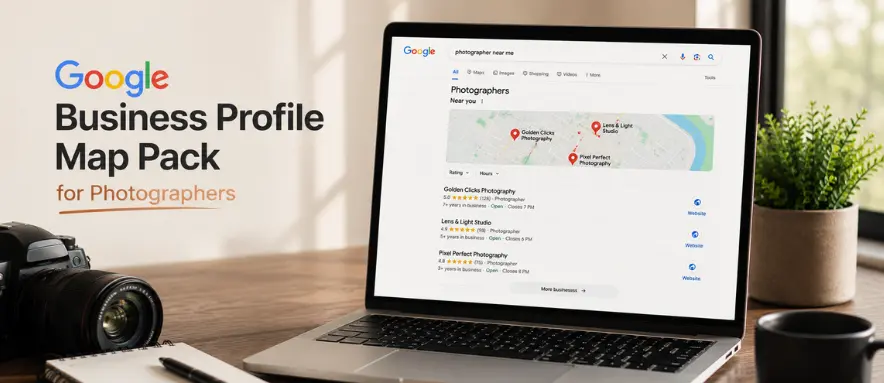
For photographers, local SEO is not one component of a broader digital strategy. It is the strategy. Because almost every photography client — wedding, portrait, commercial, or specialty — is searching for someone in a specific geographic area. They want a local photographer, with local knowledge of venues and locations, who is available on their dates.
The Google Business Profile is your most powerful local SEO asset. More than your website for local search. More than your social media. When a potential client searches for a photographer in your area, the three businesses in the map pack they see before any organic results are determined almost entirely by Google Business Profile quality, review volume, and relevance signals. Winning that map pack position for your primary keyword is the single highest-leverage action in photography local SEO.
A fully optimized photographer Google Business Profile in 2026 includes: a complete business description with your specialty and location mentioned naturally within the first two sentences; every relevant service category selected from Google’s options; detailed services listed including specific photography types and session details; your full service area specified if you travel; at minimum 50 photos and portfolio images — because practices with 100+ photos see dramatically higher engagement than those with fewer; weekly posts on your GBP covering recent sessions, blog links, and seasonal promotions; and a Q&A section seeded with the questions your clients ask most — “Do you travel to destinations?” “Do you offer payment plans?” “How far in advance should I book?” These questions and answers appear directly in search and influence whether a client clicks through to your website.
Reviews are the ranking currency of local photography SEO. A photographer with 120 Google reviews averaging 4.8 stars will consistently outrank a photographer with 25 reviews — even with an inferior website — in the local map pack for competitive searches. The most effective review generation system for photographers is to ask at the peak of client excitement: the moment they receive their gallery and react with genuine emotion is the moment they are most likely to write a detailed, specific review. A text message with a direct Google review link sent within 24 hours of gallery delivery generates significantly higher response rates than asking at the end of the session or weeks later.
Location pages extend your local SEO reach beyond your primary city. If you serve multiple neighborhoods, suburbs, or nearby cities, creating a genuinely useful location page for each — mentioning specific venues, parks, neighborhoods, and local context that a real resident would recognize — allows you to rank for location-qualified searches across your full service area. Generic pages with only the city name swapped in do not rank. Pages that demonstrate genuine knowledge of a specific location do.
Image SEO — The Photography-Specific Ranking Factor Everyone Misses
Here is the single biggest technical mistake photographers make with their websites: they upload gallery images at full resolution.
A raw gallery file from a modern camera can be 20 to 40 megabytes. A portfolio page with 25 of these images can take 45 seconds to load on a mobile connection. And since 76% of photography searches happen on mobile, your page speed is your conversion rate. Google’s ranking algorithms include Core Web Vitals — measuring speed, visual stability, and responsiveness — as direct ranking signals. A beautiful portfolio that loads slowly ranks poorly and loses clients before they ever see your best work.
Image SEO for photographers works across five dimensions, all of which matter for both rankings and conversions.
File size compression is the first and highest-impact fix. Every image you upload to your photography website should be compressed before upload — targeting 100 to 200 kilobytes per image for web display while maintaining visual quality. Tools like Squoosh, ShortPixel, and TinyPNG compress files without visible quality loss. A portfolio that loads in 1.5 seconds converts dramatically better than one that loads in 5 seconds, and ranks noticeably better in Google’s results.
File naming is where most photographers leave easy keyword opportunities. An image saved as IMG_2847.jpg tells Google nothing. An image saved as “austin-wedding-photographer-ceremony-outdoor.jpg” tells Google exactly what the image shows, who took it, and where. Rename every image before uploading with descriptive, keyword-rich file names that describe the subject, location, and photography type.
Alt text is the written description of your image that appears when an image cannot load and that search engines use to understand and index visual content. Every single image on your photography website should have alt text. Not “image 1” or left blank — descriptive, specific alt text like “outdoor wedding ceremony at Barr Mansion Austin by [Your Name] Photography.” Alt text is also how your images appear in Google Image Search, which is a meaningful source of discovery traffic for photographers.
Image file format matters for speed. WebP format delivers equivalent visual quality to JPEG at 25 to 34% smaller file size. Converting your portfolio images to WebP format before uploading improves page load speed without any perceptible quality difference.
Structured data for images — using schema markup to tell Google what your images depict — improves the likelihood of your photos appearing in rich results, Google Images, and visual search features. For photographers, this is an often-overlooked ranking advantage that few competitors are implementing.
Blog Content Strategy — How Writing Fills Your Calendar
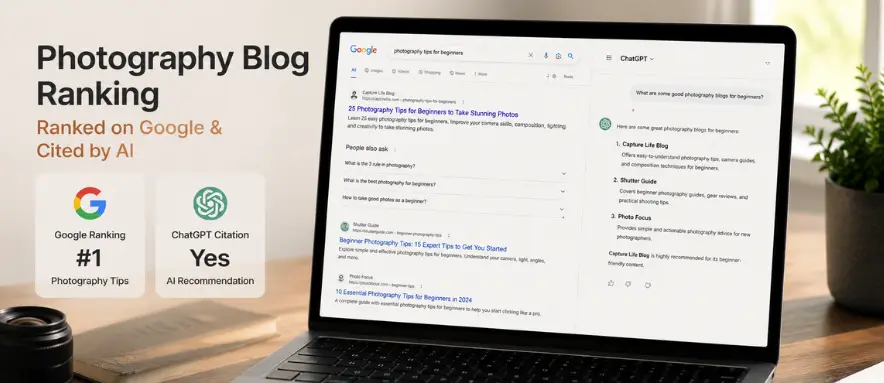
The photographers who consistently appear at the top of Google for competitive local search terms are not doing it through technical SEO wizardry alone. They are doing it through content.
Every page you publish is another opportunity to rank for a different search query. A photographer with 50 pages of useful, targeted content will almost always outrank one with a five-page portfolio site — even if the portfolio is more stunning. Google rewards websites that demonstrate comprehensive expertise across a topic. A photography website that covers wedding planning, local venues, portrait tips, and seasonal guides signals to Google that this is an authoritative resource for photography-related searches in its area.
Here is the blog content strategy that works for photographers in 2026 — organized by content type and intended search intent.
Venue and location features are the highest-converting blog format for wedding and portrait photographers. Writing a genuine, experience-based guide to a specific wedding venue — covering lighting conditions at different times of day, the best spots on the property, what couples should know about the timeline, and what makes it unique — targets a low-competition keyword that couples searching that venue will find. A photographer who has published 30 venue feature posts has 30 additional pages competing for 30 different searches, each one reaching a couple who is specifically planning at that location.
“What to expect” and preparation guides capture clients during the research phase before they book. “What to wear for family photos” is consistently one of the most-searched informational queries in portrait photography. “How to prepare for your newborn session” helps parents who are already in the process of booking. “What to ask a wedding photographer at your consultation” reaches couples who are actively comparing photographers. Each of these blog posts captures a reader at a specific moment in their journey and introduces your name at a time when trust is being built.
Cost and pricing transparency is one of the most avoided blog topics in photography — and one of the most searched by potential clients. “How much does wedding photography cost” receives substantial consistent search volume. Photographers who publish honest, helpful guides to photography pricing in their market — explaining what variables affect cost, what clients should expect in different budget ranges, and what is included in their specific packages — build extraordinary trust with clients who are making significant financial decisions.
Local area guides position you as a photographer with genuine local knowledge. “Best outdoor portrait locations in [city]” or “top wedding venues in [region] for intimate ceremonies” creates content that serves both local couples and travel clients seeking a photographer who knows the area deeply. These pages also naturally attract local backlinks from wedding blogs, venue websites, and regional directories.
Publishing one genuinely useful, well-researched blog post per week is more effective than daily thin posts or quarterly updates. Google rewards consistency and depth over frequency. A 1,500-word venue guide with real images from that location, specific details that only someone who has shot there would know, and naturally integrated location-specific keywords outperforms any generic SEO content strategy.
GEO and AI Search — The Next Booking Channel for Photographers
Here is a scenario playing out right now that most photographers are not aware of.
A couple planning their wedding opens Perplexity and asks: “Who are the best wedding photographers in [your city] for an outdoor ceremony?” The AI generates a synthesized answer, citing specific photographers and linking to their websites. One of those photographers has their name in the first two sentences of the response. They receive five new inquiries that week from people who never visited Google Search at all.
That photographer is not necessarily the most experienced or the most talented in the market. They are simply the one whose website content was structured clearly enough for an AI model to parse, trust, and recommend.
GEO — Generative Engine Optimization — for photographers is becoming a measurable traffic source in 2026 as AI tools like ChatGPT, Perplexity, and Gemini become primary research platforms for couples, brands, and individuals seeking creative services. The way to appear in these AI-generated recommendations is the same as the way to demonstrate trustworthiness to any intelligent reader: clear, specific, authoritative content that directly answers real questions.
Google now generates AI-powered summaries at the top of many search results. For photographers, that means your proof of real-world work has to be obvious on-page. Photography websites that structure their content with clear headings, FAQ sections with direct question-and-answer formats, specific geographic mentions, and citations of real venues, real dates, and real client outcomes earn the trust signals that AI models use to select sources for citations.
The practical steps for photography GEO optimization in 2026 are not complicated. Add a comprehensive FAQ page to your website answering the most common questions clients ask — what you charge, what is included, how far in advance to book, whether you travel, what your style is. Use structured FAQ schema markup so search engines and AI tools can parse your answers directly. Mention specific venues, neighborhoods, and local landmarks throughout your content — geographic specificity is a strong signal for AI recommendation systems trying to match a local query to a local source. Cite and link to authoritative sources when you reference facts — venue websites, local wedding directories, style guides — because external link authority is a trust signal for AI models.
AI-powered SEO and content strategy for photographers is becoming a competitive differentiator in saturated local markets. The photographers who build GEO-optimized content architectures now are establishing recommendation visibility in AI search that will compound in value as AI-driven discovery continues to grow as a booking channel.
Technical SEO for Photography Websites — The Foundations That Make Everything Else Work
A photography website with exceptional content, a full Google Business Profile, and a strong local review presence still loses clients if the technical foundations are broken.
Here is the technical photography SEO checklist for 2026 — the non-negotiable elements that determine whether your content can rank at all.
Page speed and Core Web Vitals are Google ranking signals, not optional performance metrics. A photography website should load in under three seconds on mobile. The primary culprits for slow photography websites are uncompressed images, bloated website builder themes, and gallery plugins that load unnecessary scripts. Run your site through Google’s PageSpeed Insights to identify specific issues. Compress images before upload. Use lazy loading for gallery pages so images only load as they scroll into view.
Mobile optimization is essential since 76% of photography searches happen on mobile devices. Test your website on a real phone — not just your desktop browser’s mobile preview. Navigation should be simple, portfolio images should load crisply on a 4G connection, and the booking or contact button should be visible without scrolling.
Website platform matters for SEO capability. Showit, Squarespace, WordPress, and Pixieset each have different SEO strengths and limitations. Showit with WordPress blog integration offers the most SEO flexibility. Squarespace has good default SEO foundations. Pixieset’s free sites have limited SEO capability. Whatever platform you use, ensure you can control page titles, meta descriptions, image alt text, URL structure, and schema markup.
URL structure should be clean and descriptive. A page at yoursite.com/wedding-photographer-austin ranks better than one at yoursite.com/page3?id=842. Every service page, location page, and blog post should have a clean, keyword-descriptive URL.
Internal linking connects your pages so both visitors and search engines can navigate your content logically. Every blog post about a wedding venue should link to your wedding photography service page. Every portfolio gallery should link to its corresponding service page. Your service pages should link to relevant blog content. This interconnected structure distributes page authority across your site and helps Google understand the topical relationships between your content.
Sitemap submission tells Google which pages to crawl and index. Submit your sitemap through Google Search Console and monitor which pages are being indexed. Many photography websites have hundreds of gallery pages that should not be indexed — this wastes crawl budget and dilutes domain authority.
Measuring Photography SEO Success — The Metrics That Matter
The only SEO metric that matters for a photography business is inquiries. Not rankings. Not traffic. Inquiries from the right clients who convert into bookings.
With that as the foundation, here is how to track whether your photography SEO is working.
Google Search Console shows exactly which search queries are driving traffic to your site, which pages are ranking, and how your click-through rates compare to competitors in similar positions. This is free and essential. Set it up on day one, before any SEO work begins, so you have baseline data to measure improvement against.
Google Analytics — GA4 specifically — shows how visitors from organic search behave on your website. Do they visit the portfolio and then the contact page? Do they bounce immediately? Do they spend time reading your blog posts? The behavioral data tells you which pages are working and which ones need attention.
Local ranking tracking shows where your Google Business Profile and website appear in map pack results for your target keywords across different locations in your city. Tools like BrightLocal or Whitespark track these positions over time.
New patient volume through organic search is the ultimate measure. Most booking management tools — HoneyBook, Dubsado, Táve — allow you to ask clients how they found you. Systematically tracking “organic search” or “Google” responses over 12 months gives you a clear picture of whether your SEO investment is translating to revenue.
Local SEO improvements typically show movement in 60 to 90 days. Competitive organic keyword rankings for primary terms like “wedding photographer [city]” can take 6 to 12 months in established markets with photographers who have strong backlink profiles. The investment is durable — rankings earned through SEO continue to deliver bookings without ongoing ad spend, unlike paid campaigns that stop the moment the budget is paused.
Your full SEO strategy and ongoing management should be evaluated quarterly against a clear set of targets: percentage of new inquiries from organic search, ranking position improvements for primary keywords, Google Business Profile performance, and review velocity.
Building Your Complete Photography SEO System
Let me bring all of this together as a connected system rather than a checklist of separate tactics.
Your photography SEO system has five layers that work together.
The keyword foundation determines every other content and optimization decision. Start by identifying your primary commercial keyword (your specialty + your city), your secondary service keywords (each specialty type or location you serve), your informational content keywords (the questions your clients ask at every stage of their journey), and your image search keywords (descriptive terms for your visual content).
The local visibility layer ensures you appear when the right clients search. Google Business Profile optimization, review generation system, local citation consistency, and location page content work together to win the map pack positions that capture the most ready-to-book clients.
The website optimization layer ensures that when clients reach your site, it loads fast, communicates clearly, and converts effectively. Technical SEO foundations (speed, mobile, structure), on-page optimization (titles, headings, meta descriptions, alt text), and internal linking work together here.
The content authority layer builds your topical authority and catches clients at every stage of their journey. Venue features, preparation guides, local area content, pricing guides, and informational posts each serve a specific search intent and bring a different type of client into your discovery funnel.
The AI visibility layer — GEO and AEO optimization — structures your content to appear in AI-generated search results and recommendations as this channel grows in importance. FAQ schema, geographic specificity, direct question-and-answer content formats, and authoritative external citations all contribute here.
The digital marketing and SEO infrastructure that connects these five layers is not built in a weekend. It is built over 6 to 12 months of consistent effort — keyword-optimized service pages, venue blog posts published regularly, Google Business Profile updated weekly, reviews generated systematically after every session.
But the compounding returns are extraordinary. A photographer who builds this system in 2026 is building organic traffic that delivers qualified inquiries in 2027, 2028, and beyond — without paying for each one. Every ad campaign stops when the budget pauses. Every SEO investment continues to work.
Frequently Asked Questions
SEO for photographers is the practice of optimizing a photography website and online presence so that it appears in Google search results when potential clients search for photography services in your area. It matters because the US photography industry has 255,000 businesses competing for clients who are overwhelmingly making their decisions through online search. A photographer who ranks in the top three local search results for their specialty and location receives a consistent flow of qualified, ready-to-book inquiries at no per-click cost — unlike paid advertising that stops the moment the budget pauses.
The most commercially valuable photography SEO keywords follow a consistent pattern: specialty plus location. “Wedding photographer [city],” “newborn photographer near me,” “headshot photographer [city],” and “[city] family photographer” are the primary commercial keywords. Beyond these, venue-specific keywords, informational queries like “what to wear for family photos” and “how much does wedding photography cost,” and style-specific long-tail terms like “luxury elopement photographer” are the next tier. Local, specific, intent-driven keywords consistently outperform broad terms for booking conversion.
Local SEO improvements — particularly Google Business Profile optimization and review generation — typically show meaningful results within 60 to 90 days. Website ranking improvements for competitive location-plus-specialty keywords take 4 to 6 months for smaller markets and 6 to 12 months for competitive major city markets with established competitors who have strong backlink profiles. Blog content and informational posts begin generating traffic within 1 to 3 months depending on competition. The most important thing to understand about photography SEO is that its returns are durable — rankings built over 6 months continue delivering inquiries for years without additional investment.
The Google Business Profile is the single most important local SEO factor for photographers. It determines whether you appear in the three-listing map pack that appears at the top of local search results — the position that captures the majority of clicks and inquiries for local photography searches. Within the GBP, review volume and rating are the dominant ranking and conversion factors. A photographer with 150 reviews averaging 4.8 stars will outrank competitors with fewer, lower-rated reviews in most market conditions regardless of website quality.
Photography image SEO works across five elements. First, compress images before uploading — target 100 to 200 kilobytes per web-display image to ensure fast page loading. Second, rename image files with descriptive keywords before uploading — “austin-wedding-photographer-ceremony-outdoor.jpg” rather than “IMG_2847.jpg.” Third, add descriptive alt text to every image describing the subject, location, and context. Fourth, convert images to WebP format where possible for smaller file sizes at equivalent visual quality. Fifth, implement image schema markup to help search engines understand and index your visual content accurately.
The highest-performing photography blog content for SEO falls into four categories. Venue features — detailed, experience-based guides to specific venues you have shot at, targeting couples researching that venue. Preparation guides — “what to wear for family photos,” “how to prepare for your newborn session” — capturing clients in the research phase before booking. Pricing and cost guides — honest, transparent explanations of photography pricing in your market that build trust with budget-conscious clients. Local area guides — best portrait locations, top wedding venues, and neighborhood guides that position you as a photographer with genuine local knowledge and attract local backlinks.
GEO — Generative Engine Optimization — is the practice of structuring your photography website content so that AI answer engines like ChatGPT, Perplexity, and Google’s AI Overviews select your work as a credible, citable source when generating answers about photography. When a couple asks an AI tool “who are the best wedding photographers in [city],” the photographers who get recommended are those with clear FAQ sections, geographic specificity throughout their content, direct question-and-answer formatting, and authoritative external citations. As AI-driven discovery becomes a growing booking channel for creative services, GEO optimization is transitioning from optional to essential for photographers competing in digital-first markets.
Photography SEO investment varies significantly based on your market competitiveness, how much you do yourself versus outsourcing, and your timeline goals. DIY with tools like Yoast Premium, Semrush, or Google’s free tools starts from around $100 to $300 per year in tool costs, with your time as the primary investment. Boutique photography SEO specialists and agencies typically charge $500 to $2,500 per month for active management including content creation, technical optimization, and link building. The appropriate investment is always measured against the value of a single booking — a wedding photography booking worth $3,000 to $10,000 justifies significant monthly SEO investment if it delivers even two or three additional bookings per year through organic search.
The Booking Calendar You Want Is Built on Search Results You Do Not Have Yet
Your images stop people mid-scroll. Your style is unmistakable. Your clients love working with you.
None of that generates inquiries if the right people cannot find you when they go looking.
The US photography industry is worth $16.2 billion. The global wedding photography market alone is projected to reach $27.36 billion in 2026. The demand for exceptional photographers is real and growing — driven by couples who rank photography as their top wedding budget priority, by brands that need consistent visual content, and by families who want genuine, artistic documentation of their lives.
The photographers capturing that demand are not necessarily the most talented in their markets. They are the ones who show up on page one of Google when someone searches with intent to hire. They are the ones with 200 reviews and a fully optimized Google Business Profile. They are the ones whose blog posts answer the questions their dream clients are asking at midnight. They are the ones whose names are appearing in AI-generated recommendations as a new discovery channel grows.
SEO for photographers is not a marketing trick or a technical afterthought. It is the infrastructure that connects your creative work to the clients who need it — consistently, compoundingly, without paying for every single click.
Build the infrastructure. The bookings follow.
Ready to build a photography SEO system that delivers consistent inquiries from your ideal clients?