
Someone in your city woke up this morning with a neck that has been locked up for three days. They have tried ibuprofen, ice, heat, and two nights of sleeping on the couch. Nothing is working. They pick up their phone at 7:42am and type “chiropractor near me” into Google.
Three clinics appear in the local map pack. Yours might be one of them — or it might not. The patient calls the first result with at least 50 reviews and a 4.8 star rating. They book an appointment for 10am. The clinic with 9 reviews and no website description gets nothing.
That moment happens dozens of times every single day in your local area. Patients with back pain, neck pain, sciatica, sports injuries, and post-accident trauma are actively searching for exactly what you do. The chiropractors with full schedules are not necessarily better clinicians. They are simply the ones who show up — clearly, credibly, and in the right place — when a patient goes looking.
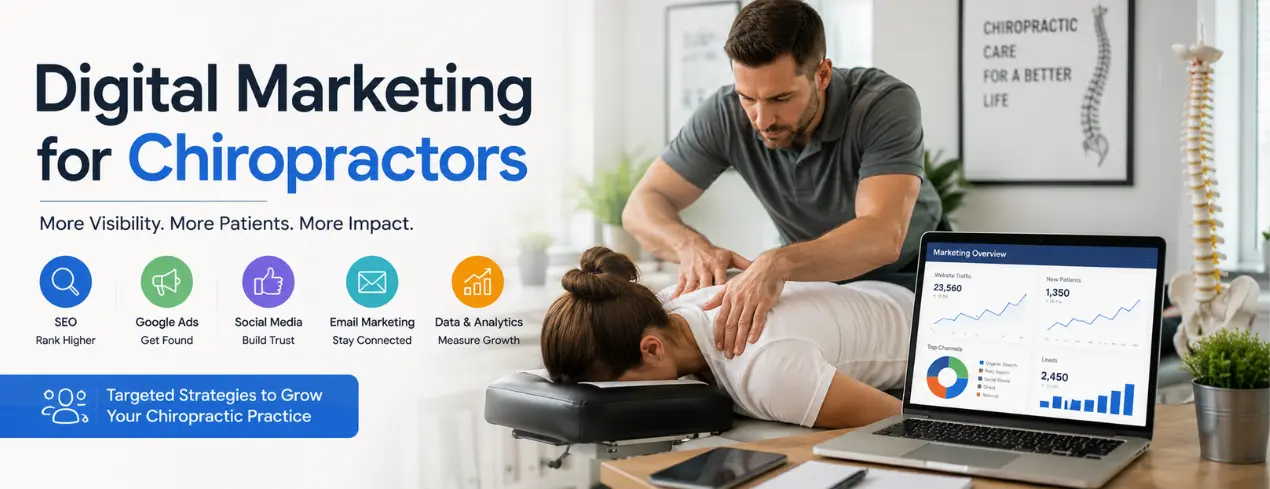
Digital marketing for chiropractors in 2026 is not about going viral on TikTok or spending a fortune on advertising. It is about building the digital infrastructure that ensures your clinic is the obvious choice when someone in pain needs help right now.
This is the complete playbook.
Table of Contents
The Opportunity — And Why Most Chiropractic Clinics Miss It
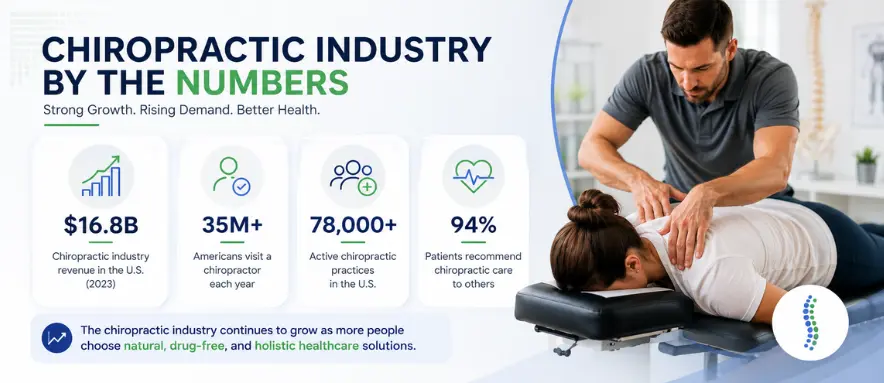
The numbers tell a remarkable story about the chiropractic profession in 2026.
The global chiropractic market is valued at $21.91 billion in 2026, growing toward $44.95 billion by 2035 at a CAGR of 8.2%. In the United States alone, the chiropractors industry is worth $21.9 billion with 65,297 businesses operating nationwide. More than 35 million Americans visit a chiropractor every year. Back pain accounts for 55% of those visits, and neck pain makes up another 14%. Chiropractic adjustments are administered over 1 million times daily in the US. Three in four patients — 77% — describe chiropractic care as very effective.
Demand has never been higher. Opioid concerns are pushing patients toward drug-free pain management in record numbers. Over 60% of primary care physicians now recommend chiropractic treatments for musculoskeletal issues, up from 42% in 2015. Platforms like TikTok and YouTube have connected chiropractic clinics with younger generations who actively seek out adjustment videos and wellness content.
So why are so many chiropractic practices running at 60 to 70% capacity?
Because finding a chiropractor and choosing one are two completely different actions — and most clinics have not invested in the digital infrastructure that converts the first into the second.
Here is what the modern patient journey actually looks like before they book an appointment. They search “chiropractor near me” or “back pain clinic [city]” — and they evaluate the first three results in the local map pack based on star rating, review volume, and the quality of your Google Business Profile description. They click through to your website and decide in eight seconds whether you look credible and whether they can book online. They check your Google reviews and read three or four of them — looking for someone who had the same condition they have. They might check your Instagram or TikTok, watch a short video, and make a judgment about whether you seem knowledgeable and approachable. By the time they call, the decision is already 80% made.
If your clinic fails at any one of those steps — invisible in local search, low review count, outdated website, no online booking, no social proof — a patient who needed your help goes to a competitor. Not because the competitor is a better chiropractor. Because they made it easier to say yes.
The most effective chiropractic marketing advice is not more advertising spend. It is building the digital foundations that make every other marketing channel more effective. Let us go through them one by one.
The Foundation: Local SEO and Google Business Profile
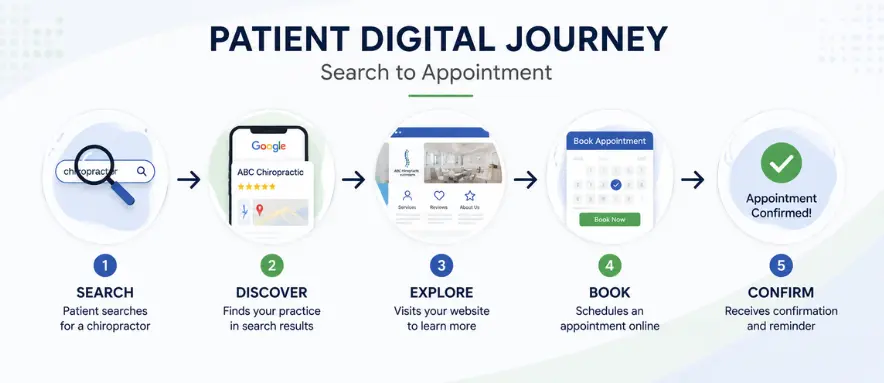
For a chiropractic practice, no marketing channel delivers a higher return on investment than local SEO — specifically, showing up in the three-listing map pack that appears at the top of Google when someone searches for a chiropractor near them.
That three-result map pack captures the majority of clicks for local healthcare searches. A clinic that appears there consistently — with strong reviews, an optimized profile, and accurate information — receives inquiry volumes that a clinic buried on page two of organic results simply cannot access, regardless of how good their website is.
Your Google Business Profile is the single most important digital asset for a chiropractic practice. It is more valuable, for local patient acquisition, than your website. Most chiropractors treat it as a directory listing — name, address, phone number, and nothing else. The practices growing fastest in 2026 treat it as a content and conversion platform.
What a properly optimized chiropractic Google Business Profile looks like in 2026: every service category listed individually (back pain, neck pain, sciatica, sports injury, prenatal chiropractic, spinal decompression, personal injury); 100 or more photos and treatment videos because practices with 100+ photos get 520% more calls than those with fewer than 10; weekly GBP posts covering educational content, clinic updates, offers, and patient outcomes; a seeded Q&A section answering the questions patients most commonly ask — “Do you accept walk-ins?” “Do you treat sciatica?” “Is chiropractic covered by insurance?” These Q&A answers appear directly in search results and influence AI-generated responses.
Reviews are the ranking currency of local chiropractic SEO. A practice with 200 verified Google reviews averaging 4.7 stars will consistently outrank a newer competitor regardless of website quality, ad spend, or social media activity. The most effective review generation systems are automated — sending a text message or email to every patient 24 hours after their appointment, with a direct link to the Google review page. The timing, the simplicity, and the automation are what make the difference between practices with 18 reviews and practices with 340.
SEO for chiropractic practices beyond the Google Business Profile requires dedicated service pages for every condition and treatment you offer. A page for back pain. A page for neck pain. A page for sciatica. A page for sports injuries. A page for prenatal chiropractic. Each page targets the specific keywords patients search when they have that condition and are looking for local care. “Chiropractor for sciatica [city]” is a buyer-intent search with clear commercial potential — and most chiropractic websites in any given city do not have dedicated, optimized pages for it.
Local SEO improvements for chiropractic practices typically show ranking movement within 60 to 90 days, with meaningful changes in 4 to 6 months. The traffic it generates does not switch off when you stop spending — which makes it the most cost-efficient patient acquisition channel available over any meaningful time horizon.
Google Ads: The Fastest Route to New Patients
Google Ads for chiropractors works because it captures patients at the exact moment of highest pain and highest intent. Someone typing “chiropractor neck pain appointment today” is not browsing. They are ready to call. Getting your clinic in front of that query, with a relevant ad and a purpose-built landing page, converts at dramatically higher rates than any top-of-funnel advertising.
A well-managed Google Ads campaign for chiropractors typically achieves a ROAS of 4x to 8x once past the initial 60 to 90-day learning phase. When you factor in patient lifetime value — a patient who visits 12 to 18 times across a care plan and refers two family members is worth $2,000 to $5,000+ in lifetime revenue — even a cost per new patient of $200 to $400 through Google Ads represents extraordinary ROI.
The critical executional difference between a chiropractic Google Ads campaign that works and one that burns budget is the landing page. Sending paid search traffic to your homepage — with its navigation menu, about page links, service listings, and a general contact form — is one of the most common and expensive mistakes in chiropractic marketing. A patient who clicked an ad for “chiropractor for back pain” needs to land on a page focused entirely on that condition: what you treat, how you treat it, what to expect, patient success stories, and a single clear call to action — either call now or book online. Conversion rates on condition-specific landing pages are consistently 2 to 3 times higher than traffic sent to a homepage.
Google Local Services Ads (LSAs) are a separate and increasingly important paid format for chiropractors. Unlike standard Google Ads, LSAs display a “Google Screened” or “Google Guaranteed” badge alongside your listing — a trust signal that significantly increases click-through and call rates for healthcare searches. LSAs operate on a pay-per-lead model rather than pay-per-click, which means you pay only when a potential patient contacts you directly, not when someone clicks. For chiropractic practices in competitive markets, running both standard Google Ads and LSAs simultaneously covers multiple placement types in the search results page.
Meta Ads and TikTok: Building the Audience That Fills Your Schedule
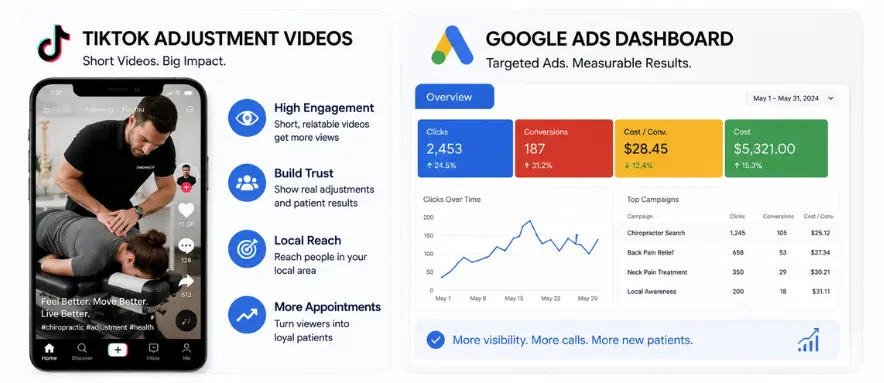
Meta Ads — Facebook and Instagram — serve a different function in chiropractic patient acquisition than Google Ads. While Google captures patients who are actively searching, Meta reaches people who are not searching yet but who are your ideal future patients.
Meta Ads for chiropractic clinics work best for two specific objectives. First, building awareness among people in your local area who fit your patient profile — adults aged 35 to 55 who work desk jobs, participate in sports, or have experienced recent physical stress — before they become acute pain patients. The consistent presence of your clinic in their feed means that when their back goes out at 7am on a Tuesday, your name is the first one they think of. Second, retargeting people who have already visited your website or engaged with your content but did not book. A patient who visited your sciatica page three times last week is a warm prospect who needs one more nudge — a testimonial video or a “first appointment 20% off” offer served in their Instagram feed.
The most effective Meta Ads creative format for chiropractic practices is video — specifically, real patient testimonials and actual adjustment footage. Chiropractic adjustment videos have been among the most organically viral healthcare content on social media for the last several years precisely because the results are viscerally satisfying and immediately understandable. A 45-second video showing a patient walking in hunched and walking out upright, narrated by the patient in their own words, consistently outperforms any produced creative in both cost per click and cost per lead.
TikTok is where the chiropractic marketing opportunity in 2026 is most underappreciated by practices and most accessible by content. Chiropractic adjustment videos have generated billions of organic views on TikTok — the satisfying cracking sounds, the visible relief on patients’ faces, the before-and-after posture comparisons. This content resonates with a 25 to 45-year-old demographic that is actively looking for non-pharmaceutical solutions to chronic pain and that has high social media engagement.
The TikTok algorithm does not require a follower base to generate reach. A new clinic can post a patient adjustment video and reach 50,000 local views within 48 hours if the content quality and hook are strong. TikTok and social media management for chiropractic clinics is not about dancing trends or challenges. It is about showing your clinical expertise in a format that 25 to 40-year-olds find immediately credible and shareable.
YouTube: The Trust Engine for Long-Term Patient Relationships
YouTube is not the fastest chiropractic marketing channel. It is the most durable one.
A chiropractic practice that consistently publishes educational video content on YouTube — explaining conditions, demonstrating treatment approaches, answering the questions patients are afraid to ask, and sharing genuine patient outcome stories — builds a level of pre-consultation trust that no other marketing channel can replicate at the same cost.
A patient who has watched 8 of your YouTube videos before their first appointment is not a new patient in the traditional sense. They already know your clinical approach, your communication style, and your values. They have made the trust decision before they walked through the door. Your consultation becomes a confirmation, not a sales process. These patients accept care plans more readily, comply with treatment protocols more consistently, and refer at significantly higher rates than patients acquired through pure paid advertising.
YouTube marketing for chiropractic practices content strategy for 2026 focuses on three content types. Condition education — clear, accurate explanations of what sciatica actually is, what causes text neck, why disc herniation responds to manipulation — builds authority and ranks for informational searches. Treatment demonstration videos — showing the adjustment process, explaining what a spinal decompression session involves, demystifying what first-time patients should expect — reduce anxiety and objection before patients have articulated those objections. Patient journey content — real stories from real patients with real conditions — is the social proof that closes the gap between consideration and commitment.
YouTube videos also rank in Google Search. A well-optimized video titled “What causes sciatica and how does a chiropractor treat it” can appear in both YouTube search results and Google video carousels for patients researching the condition — delivering qualified, high-intent traffic from both platforms from a single piece of content.
The AI Layer — Automation, GEO, and the New Patient Discovery Landscape
The chiropractic marketing landscape has shifted more fundamentally in the last 18 months than in the previous decade. And the practices that understand what is actually changing — not just surface-level trends but structural changes in how patients discover and evaluate healthcare providers — are the ones gaining durable competitive advantages right now.
The structural change is this: patients are beginning their healthcare provider research in AI tools, not just Google.
Someone with chronic lower back pain asking Perplexity “what type of chiropractor is best for herniated disc treatment” is not performing a keyword search. They are having a research conversation. The AI answers that appear in response — the providers and practices that get cited — come from clinics with structured, authoritative, entity-rich content that AI models can parse and confidently recommend.
GEO — Generative Engine Optimization — for chiropractic practices is the practice of structuring your website content, FAQ sections, condition pages, and blog articles so that AI answer engines (ChatGPT, Perplexity, Gemini) select your practice as a citable, trustworthy source when generating healthcare answers. This means clear definition boxes for clinical terms, comprehensive FAQ sections with direct answers to common patient questions, structured data markup, geographic specificity in your content, and external citations from authoritative health sources. The practices investing in this now are building AI search visibility that will compound as AI-driven discovery becomes the primary research mode for healthcare decisions.
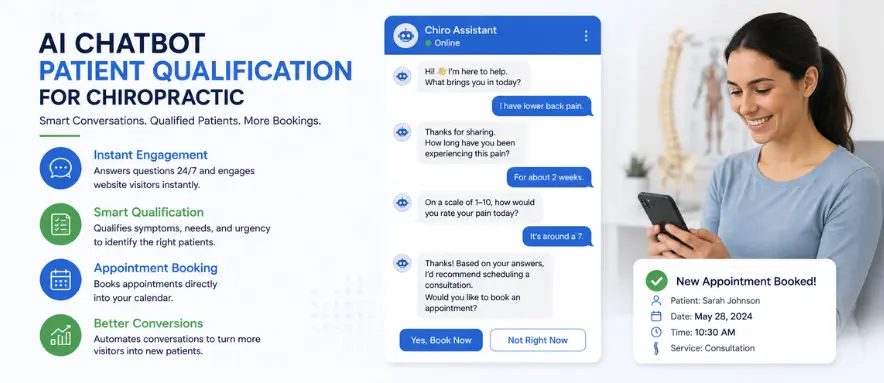
AI marketing automation for chiropractic clinics delivers immediate, measurable impact in the patient acquisition funnel through automated lead response. A patient who submits a contact form or clicks “Book Now” on your website at 9pm on a Sunday expects acknowledgment before they go to sleep — not a call Monday morning. An AI-powered intake system responds within 90 seconds with a personalized message, condition-specific information, and a self-service booking link. It qualifies the patient’s condition, treatment history, and insurance coverage. It confirms the appointment and sends automated reminders at 24 hours and 2 hours before the session. And it follows up with a review request 24 hours after the visit.
This level of responsiveness and consistency is not achievable manually at any practice volume. Agentic AI systems for healthcare practices handle the entire top-of-funnel patient experience — from first contact to confirmed appointment — without a receptionist being involved until the patient walks through the door.
AI video creation for chiropractic practices is removing the production bottleneck that prevents consistent video marketing. A practice that needs 12 educational video pieces per month for TikTok, Instagram, and YouTube previously faced three choices: hire a videographer, carve time out of clinical hours, or publish inconsistently. AI video tools trained on your existing content, patient testimonials, and clinical frameworks generate professional-quality short-form video content in hours rather than days — enabling the content velocity that social media algorithms reward.
Reputation Management — The Silent Conversion Factor
Every new patient your Google Ads, Meta Ads, and SEO bring to your website will do the same thing before they book: they will read your reviews.
Not all of them. Three or four of the most recent ones, and the ones that appear most relevant to their situation. If those reviews are specific, recent, and describe outcomes that match what the patient is looking for — their decision to book accelerates dramatically. If the reviews are generic, sparse, or old, the conversion stops there.
Chiropractic reputation management in 2026 is a systematic practice, not a passive hope. The most effective approach combines automated review solicitation with an active review response strategy. Every patient, after every visit, should receive a request for feedback through the channel they are most likely to use — SMS for most patients, email for those who prefer it. The request should be simple, warm, and direct. The link should take them to Google with one tap, not navigate through multiple steps.
Responding to every review — positive and negative — signals professionalism and engagement to both patients and Google’s ranking algorithm. A clinic that responds to every review within 48 hours demonstrates active management that builds trust with prospective patients reading the responses as much as the reviews themselves.
Online reputation extends beyond Google. Yelp, Healthgrades, Zocdoc, and Facebook all factor into how patients evaluate chiropractic practices before booking. Consistent information, active profiles, and reviewed listings across these platforms compound the trust signals that drive appointment conversion.
Email Marketing and Patient Retention — The Revenue You Are Leaving Behind
New patient acquisition is expensive. Patient retention is not.
The most profitable chiropractic practices in 2026 understand patient lifetime value as the primary financial metric of their marketing system. A patient who comes in for acute back pain, responds well to a 12-visit care plan, transitions to monthly maintenance visits, and refers two family members is worth $4,000 to $8,000 over their patient relationship lifetime. The cost of acquiring and retaining that patient through a well-designed digital marketing system is a fraction of that value.
Email marketing for chiropractic practices serves three functions in the patient retention cycle. First, it keeps inactive patients engaged between visits with genuinely useful health content — ergonomic desk setup guides, stretching routines for office workers, nutrition and inflammation information — that positions your clinic as a health partner rather than just an acute care provider. Second, it reactivates patients who have not visited in 90+ days with personalized outreach referencing their previous condition and offering a check-in appointment. Third, it drives referrals through systematic referral asks and occasional patient appreciation events.
An automated email sequence for chiropractic practices does not require a dedicated marketing person. A quarterly content calendar, a monthly patient newsletter, and automated reactivation sequences for lapsed patients can be entirely systematized — running in the background while you focus on clinical care.
What a High-Performing Chiropractic Digital Marketing System Looks Like
Let me put the complete system together so you can see how each element connects.
A new patient discovers your practice through one of four channels: they searched “chiropractor near me” and found your Google Business Profile ranked in the top three of the map pack; they saw a Meta Ad retargeting them after they visited a back pain resource article on your website; they watched a TikTok adjustment video that appeared on their for-you page; or they heard about you from a patient who was asked by your automated review and referral system.
They visit your website and find a fast-loading, mobile-optimized page with a clear description of the conditions you treat, genuine patient testimonials, photos of your clinic and team, online booking prominently featured, and a Google rating of 4.8 stars with 200+ reviews visible in the header. They book through the online booking widget.
Within 90 seconds, an automated system sends them a confirmation text, a pre-appointment questionnaire, and a video introducing your clinic and what to expect on a first visit. 24 hours before the appointment, they receive a reminder. After the visit, they receive a review request, a care plan follow-up email, and entry into a post-care nurture sequence.
This system — SEO foundation, Google Ads for paid acquisition, Meta and social for awareness and retargeting, YouTube for trust building, AI automation for lead response and retention, and AI video for content at scale — is not a theoretical ideal. It is operational at practices across the US, UK, Canada, and Australia right now. The practices running it consistently see new patient volume increase by 40 to 120% within 6 to 12 months of implementation.
The metric that matters is not website traffic. It is new patient appointments per month, cost per new patient, and patient lifetime value. Everything else is a means to those ends.
At DQOT Solutions, we build these connected patient acquisition systems for chiropractic practices — designed around the specific dynamics of healthcare marketing, compliance requirements, and the patient psychology that drives chiropractic appointment decisions.
Frequently Asked Questions
Digital marketing for chiropractors is a connected system of online marketing strategies — local SEO, Google Ads, Meta Ads, TikTok and social media, YouTube, reputation management, email automation, and AI patient acquisition tools — designed to help chiropractic practices attract new patients, fill appointment slots, and retain existing patients through consistent, measurable digital visibility. It works by ensuring your clinic is found when patients search for care, is chosen based on trust signals like reviews and social proof, and is retained through automated communication that keeps patients engaged beyond a single visit.
Because the chiropractic patient journey is almost entirely digital before the first phone call. Patients with back pain, neck pain, sciatica, and sports injuries search for providers online, evaluate them through reviews and websites, and make shortlisting decisions before contacting any clinic. With 65,297 chiropractic businesses in the US alone competing for the same patients, clinics without a strong, active digital presence are invisible at the exact moment a patient is ready to book. Digital marketing ensures your clinic is the one that shows up — not a competitor.
The highest-ROI combination for chiropractic practices in 2026 is: optimized Google Business Profile with consistent review generation for local map pack visibility; condition-specific website pages with local SEO for organic search traffic; Google Ads with dedicated landing pages for immediate paid patient acquisition; Meta Ads for retargeting and awareness; TikTok and Instagram for organic reach through adjustment and educational content; YouTube for long-form patient trust building; and AI-powered automation for instant lead response and patient retention sequences. GEO and AEO optimization for AI search is rapidly becoming essential as patients begin healthcare research in ChatGPT and Perplexity.
Google Ads costs for chiropractic practices vary by location, competition level, and target conditions. CPCs for chiropractic search terms typically range from $3 to $15 per click in most US markets, with higher costs in major metros. A well-managed campaign typically achieves a ROAS of 4x to 8x once past the initial 60 to 90 day learning phase. Given that a new chiropractic patient represents $800 to $3,000 in initial care plan value and potentially $4,000 to $8,000 in lifetime value including referrals, a cost per new patient of $150 to $400 through Google Ads produces strong ROI for most practices.
TikTok’s algorithm distributes content based on viewer behavior rather than follower count, meaning a new clinic can reach thousands of local potential patients without a large following. Chiropractic adjustment videos — showing real patient treatments, posture corrections, and outcome moments — generate significant organic reach because the content is visually compelling and genuinely useful. TikTok Ads extend that reach with paid targeting to specific demographics and local geographies. The platform is particularly effective for reaching 25 to 45-year-old patients who prefer non-pharmaceutical pain management and are active on social media for health research.
GEO — Generative Engine Optimization — is the practice of structuring your website and content so that AI answer engines like ChatGPT, Perplexity, and Google Gemini select your clinic as a credible source when generating answers about chiropractic care. When a patient asks an AI tool “what is the best chiropractor for sciatica in [city]” or “does chiropractic work for text neck,” the practices that get recommended are those with structured FAQ content, clear entity definitions, geographic specificity, and authoritative health data citations. GEO for chiropractors is becoming a critical patient acquisition channel as AI-driven healthcare discovery grows.
Different channels produce results on different timelines. Google Ads can generate patient inquiries within 7 to 14 days of launch when landing pages are properly optimized. Local SEO and Google Business Profile optimization shows meaningful map pack ranking movement within 60 to 90 days. Website SEO for condition-specific pages typically takes 4 to 6 months to produce significant organic traffic. Social media and TikTok content can generate organic reach immediately if content resonates, though consistent audience building takes 3 to 6 months. AI automation for lead response improves conversion rates from existing traffic immediately upon deployment. The practices investing across all channels simultaneously see the strongest growth at 6 and 12 months.
DQOT Solutions builds complete patient acquisition systems for chiropractic practices — not generic healthcare marketing templates. We deliver local SEO and Google Business Profile optimization for map pack dominance, Google Ads management with condition-specific landing pages, Meta Ads and social media management for awareness and retargeting, YouTube marketing for long-form trust building, TikTok content strategy for organic patient reach, AI-powered marketing automation for lead response and patient retention, AI video creation for consistent content production, and GEO and AEO optimization for AI search visibility. We measure everything against new patient appointments and cost per acquisition — not impressions.
Your Schedule Does Not Fill Itself
The chiropractic profession treats more than 35 million Americans every year. The patients are there. The demand is real. The need for drug-free, non-invasive pain management has never been stronger.
The practices with full schedules and growing waitlists are not the ones with the most qualifications or the longest tenure. They are the ones that show up at every step of the digital patient journey — in the Google map pack when someone searches, on social media when someone scrolls, in the AI answer when someone asks, and in the inbox when a patient needs a reason to return.
Digital marketing for chiropractors in 2026 is not complicated. But it is systematic. It requires the right channels, the right content, the right automation, and the right measurement — all working together rather than as separate, disconnected efforts.
The patients who need you are searching right now. The question is whether they find you — or someone else.
Ready to build a chiropractic marketing system that fills your schedule with the patients who need you most?
Talk to the DQOT Solutions healthcare marketing team today →