
There is a conversation happening right now that your institute is probably not part of.
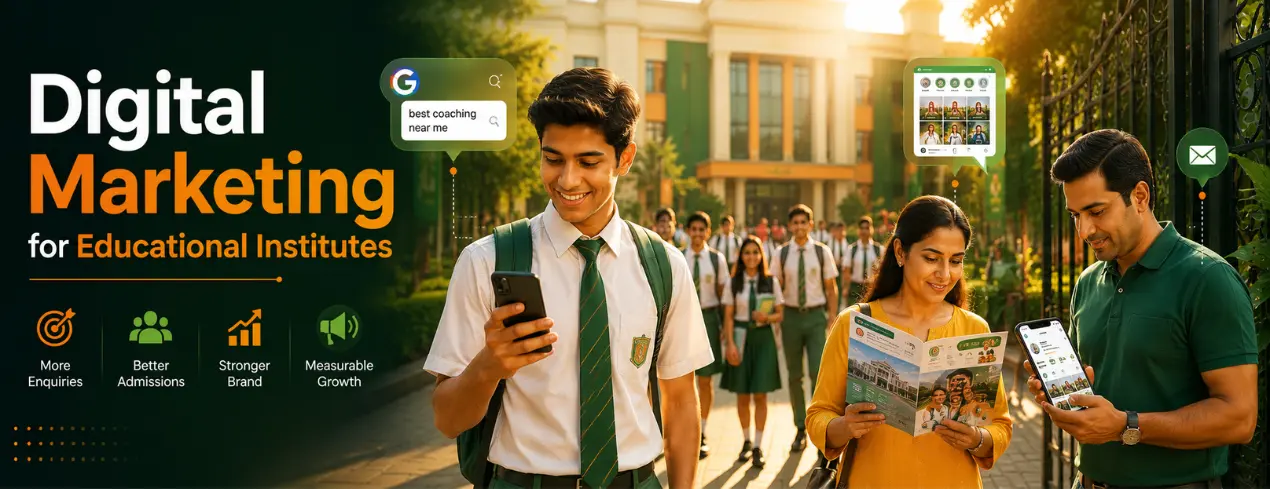
At 10:30 at night, a Class 12 student in Jaipur is sitting with her phone, comparing coaching institutes for JEE preparation. Her father is scrolling Instagram reviews of private colleges in a different tab. Her mother has asked three relatives for recommendations — but is quietly Googling on her own too.
All three of them will form an opinion about your institute before they ever call your admission office. They will visit your website. They will check your Google reviews. They will watch your Instagram reels. They will read your blog. And if they cannot find you — or worse, if what they find does not impress them — they will move on to the next institute in the search results.
This is not a future scenario. This is happening today, in every admission cycle, across every city in India.
Digital marketing for educational institutes is no longer a line item in the marketing budget. It is the entire admission strategy.
Table of Contents
The Numbers That Should Keep Every Admission Director Up at Night
Let me give you the data first.
Nearly 62% of student enrollment journeys now begin online — through Google Search, social media platforms, or directly on an institution’s website. Over 78% of prospective students research their college and course choices online before enrolling. And 47% of graduate enrollment leads now come from digital advertising or organic search alone.
Read that last number again. Nearly half of all admissions are being driven purely by online channels.
India’s digital education market is projected to grow by nearly 150% by 2026 — making this one of the most competitive digital advertising landscapes in the world.
And yet — walk into the marketing office of most schools and colleges in India today, and you will find the same tools from five years ago. A newspaper advertisement. A hoarding near the highway. A brochure designed by a local printer. A Facebook page that gets one post per month.
Meanwhile, the institute three kilometres away — with similar infrastructure, similar faculty, similar fees — is running targeted Google Ads, a YouTube channel with student testimonials, a WhatsApp broadcast to 4,000 parent contacts, and an Instagram page that gets 200 new followers every week during admission season.
Guess which institute filled 95% of its seats this year.
The Indian education sector is going through a silent but powerful transformation. What worked even three to four years ago — hoardings, newspaper ads, and word-of-mouth — is rapidly losing its impact. In 2026, admissions are no longer driven by visibility alone. They are driven by perception, positioning, and digital experience.
Here is what the student and parent decision-making process actually looks like in 2026.
A prospective student does not walk into an admission office first. They Google. Then they scroll Instagram. Then they watch YouTube videos from current students. Then they read Google reviews. Then they ask on Reddit or Quora. Then they visit the website. Then — only then — they either fill an enquiry form or call the number.
That entire journey happens before your admission team speaks to them even once.
If your institute is not present, credible, and compelling at every single one of those touchpoints, you have already lost the admission.
Digital marketing for educational institutions is not about running ads. It is about owning every stage of that digital research journey.
Why Most Institute Marketing Fails — And How to Fix It in 2026
I have spent the better part of a decade working with schools, colleges, and coaching institutes on their digital marketing. And the biggest mistake I see is always the same.
Institutes market their facilities. Students are looking for their future.
There is a fundamental disconnect between what institutions promote and what students and parents actually care about. Your AC classrooms are not the differentiator. Your faculty qualifications are not the hook. Your sports ground is not why someone will choose you over the institute down the road.
Parents do not ask “What facilities do you have?” They ask “Is this the right environment for my child?” Institutions must move from feature-based marketing to experience-based marketing.
Every piece of digital marketing content your institution creates should answer one of three questions that your target audience is actually asking:
Will my child be safe and happy here? — For schools, this is the number one parent concern. Every Instagram post, every virtual campus tour, every teacher introduction video needs to answer this emotionally before it answers it factually.
Will this help my child build a career? — For colleges and universities, placement records, industry connections, alumni networks, and internship pipelines are the real purchase triggers. Not campus beauty. Not library size.
Will I actually clear this exam here? — For coaching institutes, the only metric that matters is results. Outcomes are the primary selling point. “X students cleared NEET from our institute in 2026” is more persuasive than any brand messaging. Develop your results communication strategy explicitly.
Once you have those answers, digital marketing for schools and colleges becomes the vehicle for delivering them at scale. Here is how to build that vehicle properly.
SEO — Your 24-Hour Admission Counsellor
Search Engine Optimization is the backbone of digital marketing for educational institutions. It helps your website rank on Google when students search for queries like “school admission 2026,” “college admission marketing,” or “best coaching institute near me.” SEO brings organic traffic — users who are actively searching for what you offer. This makes the traffic highly relevant and more likely to convert. Unlike paid ads, SEO provides long-term benefits. Once your website gains authority, it continues to attract traffic without continuous spending.
But here is the SEO mistake that 90% of institutes make: they try to rank for broad, generic terms like “best college in India” or “top MBA program.” Those terms are dominated by ranking aggregators — Shiksha, CollegeDekho, Careers360 — who have domain authority built over a decade. You cannot beat them on those terms.
What you can own is the specific, intent-driven search. Program-specific long-tail queries carry strong intent and lower competition. Someone searching “part-time MBA with January intake for working professionals in Bangalore” is not browsing. They are shortlisting.
Build one dedicated, SEO-optimised landing page for every single programme you offer. A student searching “BBA admission 2026 private college Jaipur” should land on a BBA-specific page with BBA-specific placement records, fees, faculty, and an admission form — not your generic homepage. That single structural change to your website can reduce your cost per lead by 40% and double your form submission rate overnight.
A well-executed SEO agency services strategy for an educational institute focuses on three layers: course-specific pages targeting high-intent queries, local SEO for “near me” and city-specific searches, and a blog content engine that answers every question a prospective student or parent has during their research journey.
Google Ads — Filling Seats During Peak Admission Season
Organic SEO is the long game. Google Ads is the lever you pull when admission season opens and you need enquiries this week, not next semester.
The average Google Ads CPC in the education sector in India ranges from ₹30 to ₹60 for many education-related queries. Competitive keywords in MBA, engineering, or medical preparation segments can exceed ₹100 per click. That sounds expensive until you calculate what a filled seat is worth to your institution.
If your annual course fees are ₹1.5 lakh, and your Google Ads campaign delivers 200 enquiries at ₹50 per click — that is ₹10,000 in ad spend. If even 10% convert to admissions, that is 20 students generating ₹30 lakh in fees from a ₹10,000 investment. The ROAS on well-managed education Google Ads campaigns is among the highest of any industry vertical.
The key is precision. High-intent admission campaigns built around keywords that students use when they are ready to enrol — such as “best NEET coaching in Delhi,” “UPSC online classes 2026,” or “top MBA entrance coaching in Pune” — combined with geo-targeting at city and locality level, and landing page optimisation ensuring every click lands on a fast, mobile-friendly page designed to convert visitors into enquiries.
Google Ads management for educational institutes works best when campaigns are structured by programme, by city, and by admission season timing — not as a single broad campaign running all year.
Meta Ads — Reaching Parents Where They Spend Their Time
While students search on Google, parents scroll on Facebook and Instagram. These are fundamentally different audiences requiring different content and different campaign structures.
Meta Ads work well for webinar lead generation — a free 60-minute session on exam preparation, scholarship options, or career guidance generates highly qualified leads because registration itself requires genuine interest. CPL for webinar registration is typically 30 to 40% lower than direct enquiry campaigns.
For schools specifically, Facebook targeting by parents of children aged 4-17 in your city is still one of the most precise audience tools available in Indian digital marketing. Meta Ads management for educational institutes structured around parent-facing content — child safety, holistic development, teacher quality, school environment — consistently outperforms student-facing ads in the K-12 segment.
The Coaching Institute Playbook — A Market of Its Own
Coaching institutes in India operate in a category of digital marketing that is genuinely different from schools and colleges. The stakes are higher. The competition is fiercer. And the buying decision is made more emotionally than almost any other education purchase.
WhatsApp and Social Media — The Nurture Channels That Close Admissions
Getting an enquiry is not getting an admission. That gap — between inquiry received and seat confirmed — is where most institutions lose students they should have enrolled.
Here is the reality. The average coaching institute follows up on an inquiry by calling. Once. Maybe twice. And then the lead goes cold. Meanwhile, the student or parent has inquired at three other institutes, received consistent follow-up from one of them, attended a demo class that was automatically scheduled through WhatsApp, got a scholarship offer in a personalized message, and confirmed their admission — all before your team made the second call.
WhatsApp is the single most underutilized lead nurture channel in Indian education marketing.
Nearly 80.8% of Indian internet users rely on WhatsApp for everyday messaging and group communication — which means when your institute sends a WhatsApp message to a prospective student or parent, it lands in the same app they use to talk to family and friends. With a 98% open rate, WhatsApp is the most powerful follow-up and lead nurturing channel available to educational institutions in India today.
AI-powered WhatsApp marketing automation for educational institutes works like this. A student fills out an inquiry form on your website, or clicks a WhatsApp button on your Meta ad, or scans a QR code at an open house event. Within 90 seconds, they receive a personalized WhatsApp message — their name, the course they inquired about, a PDF brochure, a link to book a free demo class, and a one-tap reply option. Over the next 14 days, the automation sends follow-up messages: a student success story on day 3, an admission deadline reminder on day 7, a fee structure and scholarship details on day 10, a last-seat availability message on day 14.
No human counsellor is involved until the student clicks “Yes, I want to speak to someone.” At that point, the warmest, highest-intent leads are handed to your team. The entire top-of-funnel nurture is automated, consistent, and never misses a follow-up.
Institutions implementing WhatsApp automation alongside their lead generation campaigns report 35 to 55% higher conversion rates from inquiry to admission — from the same volume of leads.
Social Media: Building the Trust That Makes Everything Else Work
Social media management for schools and colleges is not about posting. It is about building the consistent digital presence that makes a parent or student choose you over a competitor when they finally make contact.
Think about what a parent sees when they look up your school’s Instagram page after finding you on Google. If your last post was seven months ago and shows a grainy photo of a sports day from 2023, that parent’s trust just dropped by 40%. If your feed shows regular academic achievements, student life moments, faculty features, and campus updates — with real faces and real stories — that parent’s trust goes up. And when trust goes up, conversion rates go up.
For coaching institutes specifically, content strategy on social media has a very specific structure that works.
Topper result videos — real students, real scores, real emotions — are the most shared and most converting content type in the Indian coaching market. A NEET topper video posted in May, when results come out, can generate hundreds of organic inquiries within 72 hours at zero ad spend.
Free educational content — short explanations of difficult concepts, exam tips, study strategies — positions your institute as the expert authority. A parent watching your institute’s Reels explain a JEE Physics problem clearly is building trust in your teaching quality before they ever pay a rupee.
Faculty and result credibility content — introduction videos of teachers, photos with student result certificates, live Q&A sessions — humanizes your brand and makes the decision to enroll feel less risky.
YouTube: The Long-Game Channel Nobody is Playing
YouTube marketing for coaching institutes and colleges in India is the most underutilized channel in education marketing. The competition is remarkably thin — which means the opportunity is remarkably large.
A coaching institute that consistently publishes genuinely useful free content — concept videos, previous year paper solutions, topper interview series, admission guidance videos — builds an organic audience of exactly the students they want to enroll. A student who has been watching your free JEE Chemistry videos for three months is not a cold lead when they finally inquire about admission. They already trust your teaching. The conversion cost on that inquiry is near zero.
YouTube free concept videos, topper interviews, and exam strategy content build authority and attract organic students who become paid leads. A single well-produced YouTube video on a high-search-volume topic — “How to crack JEE Main in 6 months” or “NEET 2026 biology important chapters” — can drive qualified admission inquiries for three to five years with zero ongoing budget.
AI and the Future of Education Marketing — What 2026 is Actually Delivering
The conversation about AI in education marketing has mostly been about chatbots. Which is the least interesting application of AI for educational institutes.
Here is where AI is actually changing the admission game for Indian schools, colleges, and coaching centres in 2026.
AI Lead Scoring and Prioritization
Not all leads are equal. A student who visited your coaching institute website four times, downloaded the fee structure PDF, and watched two YouTube videos about your results is ready to convert. A student who filled an inquiry form because of a discounted Meta lead ad and opened zero follow-up messages is not. Agentic AI systems can score every incoming lead by engagement behavior, source quality, response pattern, and demographic fit — surfacing the highest-intent prospects for immediate counsellor follow-up while continuing automated nurture for lower-scored leads. Institutions using AI lead scoring report 40 to 60% improvements in their inquiry-to-enrollment conversion rate without increasing lead volume.
AI-Generated Content at Scale
The average educational institute needs to produce content across Google Business Profile posts, Instagram, Facebook, YouTube Shorts, blog articles, WhatsApp broadcast messages, email newsletters, and ad creatives — simultaneously. For a marketing team of one or two people, that volume is impossible to maintain at quality. AI video creation for educational institutes and AI content generation tools allow a small team to produce 30 to 40 pieces of content per month — topper result videos, faculty introduction reels, admission reminder creatives, and educational short-form videos — without a production agency or a full creative department.
Personalized Admission Communication
Generative AI allows your admission communication to be genuinely personalized at scale. An inquiry from a student interested in your Science stream gets a WhatsApp sequence featuring science faculty, Science topper results, lab facilities, and career paths after CBSE Class 12 Science. An inquiry about Commerce gets a completely different sequence. The content matches the interest. The conversion rate reflects it.
AI Answer Engine Optimization for Education
Students and parents increasingly ask AI tools directly — “Which is the best engineering college in Rajasthan under ₹1 lakh annual fees?” or “Is [institute name] good for JEE preparation?” The AI answers that ChatGPT, Perplexity, and Gemini generate come from institutions with strong, structured, entity-rich content on their websites. Educational institutions that invest in Answer Engine Optimization (AEO) and Generative Engine Optimization (GEO) today are building visibility in AI search that will compound significantly as AI discovery becomes the primary research mode for students and parents by 2027.
The Complete Admission Funnel — How All of This Works Together
Let me put the full picture together clearly.
The admission funnel for a school, college, or coaching institute in 2026 has five stages. Every piece of digital marketing you do maps to one or more of these stages.
Stage 1 — Discovery: Student or parent becomes aware your institute exists. This happens through Google Search (SEO and Google Ads), social media (organic Instagram/Facebook), YouTube, word-of-mouth amplified by positive reviews, and local visibility (Google My Business listing). At this stage, your goal is simply to show up — clearly, credibly, and in the right search results.
Stage 2 — Evaluation: They visit your website, read your reviews, watch your videos, check your social media. This stage is won or lost on trust signals — result data, faculty credentials, campus photos, student testimonials, response speed, and review ratings on Google and Shiksha. A slow website, outdated Instagram feed, or missing review profile costs you admissions at this stage every day.
Stage 3 — Inquiry: They submit a form, click a WhatsApp button, or call. This is the moment your digital marketing converts to a human interaction. Response speed matters enormously here — institutions that respond within 5 minutes of an online inquiry convert 21 times more leads than those who respond within 30 minutes. WhatsApp automation ensures this response is instant, every time, 24 hours a day.
Stage 4 — Nurture: Most inquiries do not convert on day one. The student is comparing three to five institutes. The parent is discussing with family. Your nurture sequence — WhatsApp automation, email follow-ups, retargeting ads on Meta showing topper results and testimonials, demo class invitations — keeps your institute top-of-mind and trust-building during the 7 to 21 days between inquiry and decision.
Stage 5 — Enrollment: The counsellor call, campus visit, or demo class that closes the admission. At this stage, your digital marketing has done its job. The student or parent already trusts you. The conversion is the natural outcome of everything that came before.
A full-stack digital marketing strategy for educational institutes connects all five stages into a single, measurable system. You know exactly how many students entered at Stage 1 this month, how many reached Stage 3, what percentage moved to Stage 4, and what your Stage 5 conversion rate looks like. You optimize each stage based on data — not instinct.
Frequently Asked Questions
Digital marketing for educational institutes is a structured approach to attracting, engaging, and converting students and parents using online platforms — including SEO, Google Ads, Meta Ads, social media, WhatsApp automation, YouTube, and AI-powered lead nurturing. It ensures your school, college, or coaching centre is visible when students search, builds trust through content and reviews, and captures enquiries through optimized admission funnels. Done correctly, it is the most measurable and cost-effective way to fill seats in 2026.
Because 72% of parents research educational institutes online before visiting, and students now shortlist colleges and coaching centres entirely through Google, social media, and peer reviews — before making a single phone call. If your institution is not showing up with a strong digital presence during that research phase, you are losing admissions to competitors who are, regardless of how good your teaching or facilities actually are.
For coaching institutes, the highest-ROI combination is Google Search Ads targeting high-intent queries like “best JEE coaching in [city],” Facebook Ads targeting parents of Class 11-12 students, topper result videos on YouTube and Instagram, WhatsApp automation for instant lead follow-up, and local SEO to dominate Google Map searches. The most effective strategy for coaching institutes includes lead generation ads, high-converting landing pages, WhatsApp follow-ups, and retargeting campaigns to convert interested students into enrolled candidates.
Typical CPC in India for education-related queries runs between ₹30 and ₹60, with competitive keywords in MBA, engineering, or medical prep exceeding ₹100 per click. Starter budgets begin at ₹500 to ₹1,000 per day, scaling to ₹25,000 to ₹2,00,000 per month depending on funnel validation and institutional goals. The total digital marketing investment should be evaluated against cost per admission — a channel that costs ₹3,000 per lead and converts at 15% is delivering admissions at ₹20,000 each. If annual fees are ₹1,20,000, that is a 6x return on marketing spend.
WhatsApp automation for educational institutes enables instant, personalized follow-up on every inquiry — within 90 seconds of form submission, 24 hours a day, 7 days a week. Automated sequences deliver brochures, fee structures, result data, scholarship offers, and demo class bookings without a counsellor being involved. With a 98% open rate, WhatsApp is the most powerful follow-up and lead nurturing channel available to educational institutions in India today. Institutions using WhatsApp automation alongside lead generation report 35 to 55% higher inquiry-to-enrollment conversion rates.
For educational institutes with an existing website, targeted local SEO improvements can show ranking movement within 6 to 8 weeks. Meaningful organic inquiry traffic from content and course page SEO typically develops within 4 to 6 months. The critical point is that SEO delivers compounding, organic traffic — students and parents who are actively searching for exactly what your institution offers — without paying for each click. The long-term cost per inquiry through SEO is significantly lower than any paid channel.
YouTube is the most underutilized and highest-potential marketing channel for Indian coaching institutes in 2026. Free educational content — concept explanations, exam strategy videos, topper interviews, and result videos — builds teaching credibility and attracts organic inquiries from students who are already engaged with your content. A student who has watched 15 of your free JEE Chemistry videos is the warmest lead you will ever receive. Converting them to a paid admission costs almost nothing because the trust has been built over months of free value.
DQOT Solutions builds complete admission growth systems — not individual campaigns. We handle every stage of your admission funnel: SEO and local visibility, Google Ads and Meta Ads for lead generation, landing page design and optimization for conversion, WhatsApp automation for instant and consistent lead nurture, social media management for ongoing trust building, YouTube marketing for long-term organic authority, and AI-powered systems for lead scoring, content production, and personalization. We measure everything against one metric: admissions, not impressions.
The Bottom Line — Your Admission Season Does Not Wait
The competition for students in India is not slowing down. More private schools, new coaching centres, expanding EdTech platforms, and digitally active colleges are all competing for the same students who are making their decisions online, right now.
Most institutions will read a guide like this and nod. Some will forward it to their marketing team. A few will actually build the system.
Those few — the ones who build the connected admission funnel, the ones who invest in SEO before the season starts, the ones who automate their WhatsApp follow-up, the ones who put their topper results on YouTube instead of just the notice board — are the ones filling seats at higher enrollment rates next April while competitors are printing new flex banners and wondering what went wrong.
Digital marketing for educational institutions in India is not a future investment. It is the current requirement for every school, college, and coaching centre that wants to grow.
Ready to build a digital marketing system that fills your admission seats consistently — season after season?