
Here’s something that doesn’t get said enough in the entertainment and creator industry.
Your talent got you the audience. Your strategy will determine what you do with it.
Elvish Yadav didn’t win Bigg Boss OTT and become India’s most-subscribed Hindi creator through talent alone. There was a content strategy, a brand positioning, a merchandise play, and a social media management machine working behind the scenes. Kriti Sanon doesn’t personally reply to every brand inquiry, craft every Instagram caption, or decide which collaboration fits her public image and which one quietly damages it. There’s a team — and increasingly, a digital strategy — behind every decision.
The gap between a celebrity or influencer with 5 million followers who struggles to monetise and one with 2 million followers who commands ₹50 lakh per brand deal isn’t talent. It isn’t even luck. It’s digital strategy. It’s how they manage their presence, protect their reputation, attract the right collaborations, and convert attention into lasting brand equity.
This guide is for the people who are ready to take that seriously. Whether you’re a South Indian actor building a pan-India fanbase, a fitness influencer in Mumbai trying to land global brand deals, a politician managing a state-level narrative, a TV actress transitioning to OTT, or a fashion creator in Delhi trying to break into the international market — the principles are the same. The execution is what separates the ones who scale from the ones who plateau.
Table of Contents
The Reality of Fame Without Digital Strategy in 2026
Let’s start with some honest context.
The attention economy has never been more competitive. In India alone, there are over 500 million active social media users. Globally, the number exceeds 5 billion. Every celebrity, every influencer, every public figure is competing — not just within their category, but across all entertainment and content — for a finite amount of human attention every single day.
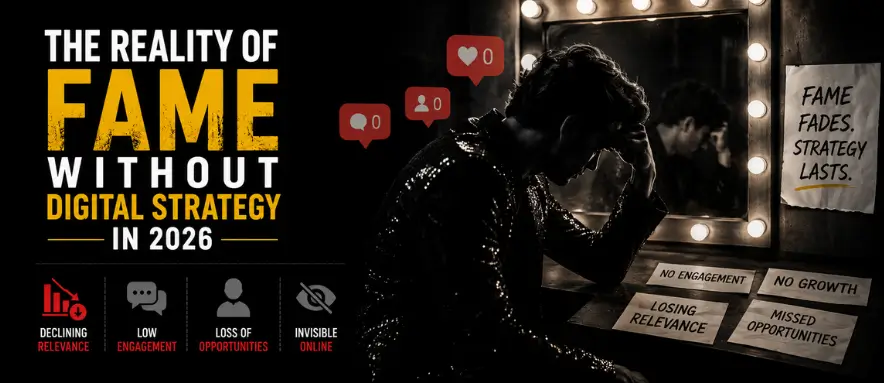
In this environment, showing up consistently and strategically isn’t optional. It’s the price of relevance.
The public figures winning the digital game in 2026 aren’t necessarily the most talented or the most famous. They’re the ones with the clearest strategy, the most consistent execution, and the right team behind them.
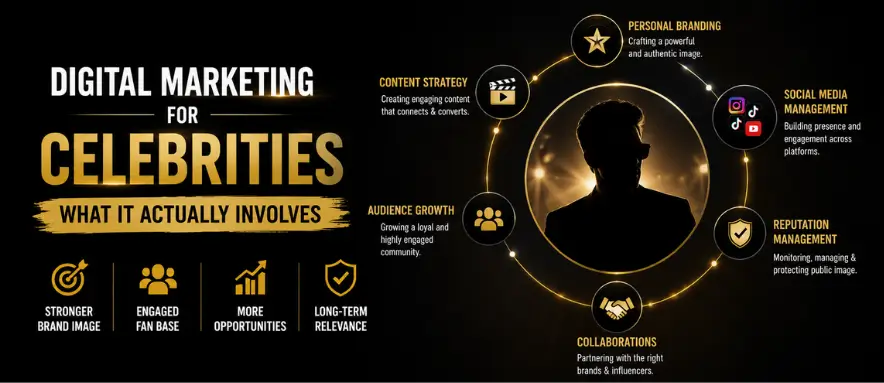
Digital Marketing for Celebrities — What It Actually Involves
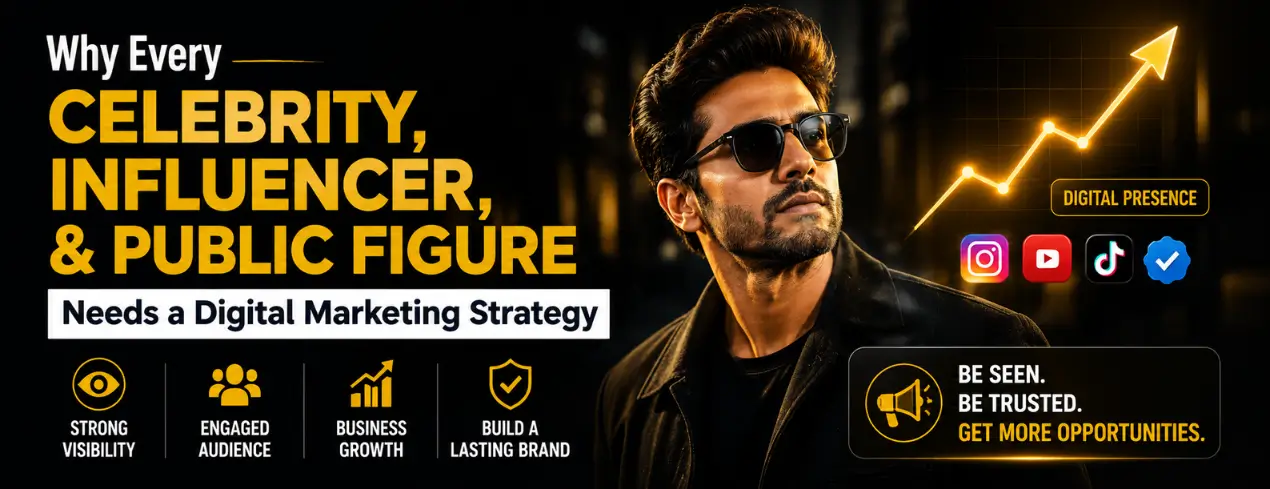
When we talk about digital marketing for celebrities, we’re not talking about posting a selfie and hoping for the best. We’re talking about a comprehensive, coordinated system that manages multiple dimensions of a public figure’s digital existence simultaneously.
Personal Brand Architecture
Every celebrity has a public persona — but not every celebrity has a deliberately constructed personal brand. There’s a meaningful difference.
A public persona is what people see. A personal brand is the intentional, consistent narrative you build across every touchpoint — your Instagram grid aesthetic, your YouTube content pillars, the way you speak in interviews, the brands you associate with, the causes you champion, the stories you tell about your journey.
For celebrities in 2026, personal brand architecture involves defining:
Core identity — what do you stand for? What are the three or four words that should come to mind when someone hears your name? For a South Indian actor crossing over to Bollywood, this might be “authentic,” “grounded,” “versatile,” and “pan-India.” For a fashion influencer from Mumbai, it might be “aspirational,” “accessible,” “India-meets-global,” and “body-positive.”
Audience architecture — who is your core audience, who is your growth audience, and what does each group need from you? A Bollywood star’s core audience in India requires Hindi and regional language content; their international growth audience in the UK, Canada, Australia, and the UAE requires content that translates culturally.
Visual identity — colour palette, photography style, typography in graphics, aesthetic consistency. Celebrities whose Instagram grids look curated and intentional generate higher engagement and better brand collaboration rates than those whose profiles look like a random collection of photos.
Social Media Marketing for Celebrities — Platform by Platform
Different platforms serve different strategic purposes for public figures. Understanding which platform to prioritise for what objective is fundamental to an effective digital strategy.
Instagram — this is the primary brand showcase for most Indian celebrities. Instagram marketing for celebrities involves a combination of grid posts (for brand presence and visual storytelling), Reels (for reach and discovery — Reels currently get 3x the reach of static posts), Stories (for daily connection and personality), and Close Friends/broadcast channels (for superfan engagement). For a TV actress or film star, Instagram is often where brand collaboration ROI is highest.
YouTube — the long-game platform. YouTube marketing for celebrities and influencers builds the deepest audience connection because long-form video creates genuine parasocial relationships. A 15-minute vlog builds more loyalty than 50 Instagram Stories. For vloggers, fitness influencers, and creators whose primary identity is content-first, YouTube is the mothership. For Bollywood stars and mainstream celebrities, YouTube is increasingly important for documentary-style content, song releases, and interview formats.
Twitter/X — for athletes, politicians, and opinion-driven public figures, X remains the platform where news is made, narratives are set, and real-time cultural conversations happen. A politician without an active X strategy in 2026 is absent from the conversations that shape public perception.
Facebook — often underestimated by younger celebrities, Facebook remains essential for social media page management for politicians and public figures targeting audiences over 35. In India’s Tier 2 and Tier 3 cities, Facebook is still the dominant platform. For political campaigns and cause-driven celebrities, Facebook’s community and group features are powerful.
Snapchat and emerging platforms — for Gen Z celebrities and creators, Snapchat, BeReal, and platform-native content formats on newer apps represent audience development opportunities that early adopters benefit from disproportionately.
Influencer Social Media Management — The System Behind the Success
Social media management for influencers isn’t just scheduling posts. At a professional level, it’s a complete operational system that covers content strategy, production workflows, community management, analytics, brand collaboration coordination, and crisis monitoring — running simultaneously, every single day.
What a Professional Influencer Social Media Management Company Actually Does
Let’s be specific, because “social media management” is a term that gets used to describe everything from a college student posting three times a week to a full agency operation running 24/7 for a major public figure.
Professional social media management for influencers and celebrities at scale involves:
Content calendar and strategy development — monthly and quarterly content calendars built around campaign objectives, key dates (film releases, brand launches, sporting events, election cycles, festivals), content pillars, and platform algorithm timing.
Content production coordination — briefing and managing photographers, videographers, editors, and designers. A celebrity who posts three times a week has, behind that, a production workflow involving multiple people, shooting schedules, editing queues, and approval processes.
Community management — monitoring and responding to comments across platforms, managing DMs, identifying and engaging with key fan accounts, flagging anything that needs direct celebrity response versus what can be handled by the team, and maintaining the tone and voice consistency that makes a celebrity’s online presence feel authentic.
Hashtag strategy and SEO optimisation — for Instagram, YouTube, and Twitter, the discoverability of content is heavily influenced by how it’s tagged, titled, and described. This is an ongoing technical function, not a one-time setup.
Analytics and performance reporting — tracking reach, engagement rate, follower growth, Story completion rates, Reel views, click-through rates on bio links, and correlating all of this with content types to inform strategy decisions. Without data, you’re guessing.
Brand collaboration intake and coordination — managing inbound brand partnership inquiries, assessing fit against the celebrity’s positioning, negotiating deliverables and rates, briefing content requirements, and managing delivery timelines. This function alone, for a major influencer, can be a full-time role.
Social Media Management for Vloggers — The Creator Economy Operating System
Vloggers and content-first creators have a particularly complex social media management need because their entire business is the content. Unlike a Bollywood star for whom social media is a promotional channel, for a vlogger it IS the product.
Social media management for vloggers requires understanding the creator economy’s specific mechanics:
YouTube algorithm optimisation — click-through rate on thumbnails, average view duration, engagement velocity in the first 24 hours, playlists, end screens, and cross-promotion. The technical side of YouTube growth is a specialist skill.
Cross-platform content repurposing — a long-form YouTube vlog generates material for Instagram Reels (highlights), YouTube Shorts (moments), Twitter clips (reactions), and podcast audio (conversations). Managing this repurposing workflow systematically is how top creators multiply their content output without multiplying their production time.
Merchandise and community platform management — top vloggers like Elvish Yadav have merchandise stores, Discord communities, and fan membership programmes that require dedicated management.
Sponsorship integration — the difference between a sponsored segment that feels natural and one that makes audiences click away is craftsmanship. Managing how sponsorships are integrated into content, briefed to the creator, and delivered to brand specifications is a professional function.
Social Media Management for TV Actresses, Film Stars, and OTT Talent
The entertainment industry’s digital dynamics have shifted dramatically with OTT. A TV actress who was exclusively reaching Cable India audiences five years ago now has a potential global audience through Netflix, Prime Video, and Disney+ Hotstar content.
Social Media Management for TV Actresses
A TV actress’s social media serves multiple strategic objectives simultaneously:
Show promotion — when a serial is airing, consistent social media activity directly impacts TRP awareness and digital viewership. Behind-the-scenes content, character moments, and off-screen personality drive audience investment.
Personal brand separation — building an identity beyond a single character is the career challenge every TV actress faces. Social media is where she builds the off-screen persona that makes her castable beyond her current role and attractive to brand collaborations that the character alone wouldn’t command.
OTT transition positioning — for TV talent crossing into OTT and films, social media strategy needs to consciously signal a repositioning — new content formats, new visual aesthetic, association with different content categories, and engagement with the film/OTT audience demographic.
Brand collaboration revenue — for many TV actresses, Instagram brand collaborations can generate income comparable to or exceeding per-episode fees. This requires a consistent, professionally managed Instagram presence with verified engagement rates that brands can evaluate.
Social Media Management for South Indian Actors — The Pan-India Play
South Indian cinema is having its moment globally. RRR’s international reception, the worldwide fanbase for Prabhas, Vijay, Allu Arjun, and Thalapathy changed the conversation permanently. For South Indian actors, digital strategy in 2026 involves a genuinely pan-India — and increasingly international — approach.
Key strategic elements for South Indian actor social media management:
Multilingual content strategy — Telugu, Tamil, Kannada, Malayalam, and Hindi content, calibrated by audience composition. A Telugu actor’s follower base has different language preferences than a Tamil star’s. Content localisation isn’t just translation — it’s cultural adaptation.
Cross-market audience development — South Indian actors targeting North Indian audiences need content that resonates with that demographic without alienating their core base. This balance requires careful strategy.
International market activation — the South Indian diaspora in the UK, USA, Canada, Australia, New Zealand, UAE, and Malaysia represents a significant engaged fanbase. International-facing content — English captions, culturally bridging storytelling — activates this audience.
OTT platform collaboration content — Netflix India, Amazon Prime Video India, and Disney+ Hotstar actively partner with talent on social content around their releases. Managing these partnerships professionally maximises both visibility and relationship value.
Instagram Marketing for Celebrities — The Monetisation Engine
Instagram is, for most celebrities and influencers, the primary revenue-generating digital channel. Understanding how to maximise Instagram’s commercial potential requires going well beyond follower count.
The Metrics That Actually Matter for Celebrity Instagram
Brands evaluating influencer and celebrity partnerships in 2026 are significantly more sophisticated than they were five years ago. Follower count is a vanity metric. The numbers that determine brand deal rates and partnership selection are:
Engagement rate — the ratio of likes, comments, shares, and saves to follower count. A celebrity with 10 million followers and 0.8% engagement is less commercially valuable than one with 2 million followers and 4.5% engagement. Top-performing accounts target 2-5%+ engagement.
Story completion rate — what percentage of followers watch Stories from beginning to end. High completion rates signal genuine audience investment and are increasingly used by brands to evaluate partnership value.
Reel view-to-follower ratio — Reels that regularly achieve 10x+ views relative to follower count indicate strong algorithm performance and content that resonates beyond existing audience.
Audience authenticity — brand agencies now routinely run follower audits before confirming partnerships. Accounts with artificially inflated followers are being blacklisted. Genuine, organic audience growth is table stakes for serious brand collaboration.
Audience demographics — age split, gender breakdown, geographic distribution, language preferences. A fashion influencer with 70% male audience may be a poor fit for a women’s clothing brand regardless of follower count. Professional audience reporting through Instagram Insights and third-party tools is essential.
Leads and Brand Collaboration Management for Celebrities
This is one of the most underserved functions in the Indian celebrity management space — and one of the highest-value.
Every major celebrity and influencer with a significant following receives inbound brand collaboration inquiries. The difference between maximising this opportunity and leaving money on the table is systematic management.
Inbound triage — not every brand inquiry deserves a response, and not every brand that wants to work with a celebrity is a good fit. Brand fit assessment against established positioning criteria should happen before any conversation goes further.
Rate card management — professional rate cards for Instagram posts, Reels, Stories, YouTube integrations, YouTube Shorts, live appearances, and event attendance. Rates that reflect audience size, engagement quality, content effort, and exclusivity terms.
Negotiation — beyond rate, collaboration terms matter enormously. Usage rights (can the brand use the content in their own ads? For how long? On which platforms?), exclusivity periods (are you locked out of competitor brands?), deliverable specifications, approval processes, and payment terms.
Campaign delivery — briefing, production, internal review, brand approval, and publish. Without a managed delivery process, brand collaborations create operational chaos that eats into the creative time that produces the content the audience values.
Long-term brand partnership development — the highest-value brand relationships are multi-campaign or annual partnerships. Building these requires relationship management that goes beyond transactional deal-by-deal interactions.
PR Management for Celebrities — Controlling the Narrative
PR management for celebrities in 2026 operates in an environment that previous generations of celebrities never had to navigate. A single social media moment can generate twenty news articles, hundreds of thousands of shares, and a reputation impact that takes months to address — in hours.
What Modern Celebrity PR Involves
Proactive media narrative building — placing stories, interviews, and features in target publications that advance the celebrity’s positioning goals. Not reactive to whatever journalists want to write — proactive control of what enters the media ecosystem.
Social media voice consistency — ensuring that what a celebrity says publicly across platforms is consistent, considered, and aligned with their positioning. A careless comment on a live stream can contradict months of carefully crafted brand building.
Launch and release PR — coordinating digital PR around film releases, music drops, brand launches, book publications, and other major career moments. The digital PR drumbeat around a major release should start weeks in advance, not days.
Media relationship management — building relationships with journalists, digital media platforms, and publication editors who are relevant to the celebrity’s field. These relationships are assets that compound over time.
Crisis communication — addressed in detail below. The PR function most people think of first but which, when handled well, is rarely needed because proactive PR reduces the circumstances that create crises.
Reputation Management for Celebrities — When Things Go Wrong
Reputation management for celebrities is the function nobody wants to need and everyone eventually does.
The reality of public life in 2026 is that controversy finds everyone eventually — a misquoted interview, a resurfaced old post, a collaboration that generates backlash, a social media comment taken out of context, a manufactured controversy from a competitor or enemy.
How a celebrity’s team responds in the first 24-48 hours of a reputation challenge determines whether it becomes a manageable news cycle or a lasting damage to brand equity.
Monitoring — 24/7 monitoring of mentions, sentiment, trending conversations, and news coverage. You cannot manage what you don’t see coming.
Response protocols — pre-agreed decision trees for different categories of reputation challenge. Does this require a public response? If yes, from whom — the celebrity directly or through a statement? On which platform? In what tone? Deciding these questions in real-time under pressure produces worse outcomes than having frameworks agreed in advance.
Counter-narrative building — when a false or misleading narrative has taken hold, the response isn’t just denial — it’s the construction and distribution of counter-evidence through credible channels.
Search engine reputation management — ensuring that the search results for a celebrity’s name are dominated by positive, accurate, and relevant content. This is a long-term SEO function that requires consistent execution to build and maintain.
Social media sentiment management — during a crisis, managing fan communities, moderating comment sections, and ensuring that the celebrity’s own platforms aren’t amplifying negative sentiment through algorithmic recommendation.
Social Media Page Management for Politicians — The Digital Campaign
Political social media management is one of the most high-stakes digital marketing applications in existence. Elections are won and lost on digital narrative now. In India, where over 600 million people are active on social media and WhatsApp reaches into every constituency, digital strategy is not supplementary to political campaigns — it IS the campaign.
What Effective Political Social Media Management Looks Like
Constituency-specific content strategy — a politician represents specific people in a specific place. Content that resonates in an urban Maharashtra constituency requires different messaging, language, and cultural references than content for a rural Rajasthan constituency. Generic, broadcast-style political content underperforms sharply compared to targeted, constituency-aware communication.
WhatsApp and messaging platform strategy — in India specifically, WhatsApp is the most politically influential social platform. Managing WhatsApp broadcast lists, coordinating with party networks, and ensuring accurate and effective messaging through WhatsApp requires a dedicated strategy.
YouTube for politicians — long-form YouTube content is where politicians can speak to their constituency without editorial filtering. Town halls, constituency work documentation, policy explainers, and genuine personality content build the kind of trust that produces votes. YouTube marketing for politicians is one of the highest-ROI digital investments available.
Facebook for political community building — Facebook groups, community pages, and targeted Facebook content remain essential for constituency engagement, particularly with voters over 40 in India’s Tier 2 and Tier 3 markets. Meta Ads for political awareness campaigns can reach hyper-specific geographic and demographic segments.
Twitter/X for political narrative — X is where India’s political conversations happen in real time. Politicians who are absent from X cede the narrative to their opponents, critics, and media. Active, strategic X presence — including rapid response capability during news cycles — is essential.
Opposition and narrative monitoring — understanding what opponents are saying, what narratives are gaining traction against you, and responding before they become entrenched is a 24/7 digital intelligence function.
ORM for politicians — reputation management for political figures requires particular sophistication because the opposition actively works to damage reputation. Search result management, proactive content publishing, and crisis response protocols are essential infrastructure.
Social Media Marketing for Athletes — Building the Personal Brand Beyond the Sport
Athletes have a unique digital marketing challenge: their primary value proposition — their athletic performance — happens in a context they don’t fully control. Injuries, selection decisions, team changes, and sporting results affect their public profile regardless of their digital strategy.
The athletes who build lasting personal brands are the ones who develop a digital presence that extends beyond results.
Social Media Marketing for Athletes — The Full Playbook
Performance content — training footage, match day build-up, post-performance reflection. This is the content fans expect and the foundation of athlete social media. But it’s not sufficient for building a brand that transcends sporting career length.
Personality content — off-field/off-court personality, interests, lifestyle, family (within the athlete’s chosen comfort level). This is what converts casual sport fans into personal brand followers who will follow you regardless of which team you play for or whether you’re in the national squad.
Cause and values content — athletes who align publicly with causes and values that matter to them attract deeper loyalty and the kind of brand partnerships that are genuinely lucrative. Sports brands pay for performance association. Lifestyle brands pay for values alignment. The latter category has higher commercial ceilings.
Athlete brand collaboration management — sports brand endorsements, health and fitness product partnerships, lifestyle brand associations. For Indian athletes specifically, the intersection of cricket and celebrity creates brand deal potential that rivals film stars. Managing this opportunity professionally is the difference between leaving value on the table and maximising commercial potential during peak athletic years.
Post-career brand building — the smartest athletes start thinking about their post-career personal brand during their career, not after it ends. Digital presence built during peak fame creates an asset that continues to generate value after playing days are over.
Social Media Marketing for Fitness Influencers — The Fastest Growing Creator Category
Fitness influencers represent one of the highest-growth segments of the creator economy globally — and in India specifically. The post-COVID wellness boom, combined with the aspirational fitness culture driven by Instagram and YouTube, has created enormous audience appetite for fitness content.
For fitness influencers specifically:
Transformation content and proof — before-and-afters, client results, personal progress. Fitness audiences want evidence that what you’re advocating works.
Educational authority — workout tutorials, nutrition guidance, supplement reviews. Fitness influencers who become trusted sources of education rather than just aspirational fitness content attract more loyal, commercially valuable audiences.
Programme and product monetisation — the highest-earning fitness influencers monetise through their own digital products (training programmes, meal plans, apps) rather than exclusively through brand deals. Social media is the distribution channel for these products.
Supplement and sports nutrition brand partnerships — among the most lucrative vertical for fitness influencers. Brands like MyProtein, MuscleBlaze, Optimum Nutrition, and dozens of others allocate significant influencer budgets to fitness creators with engaged audiences.
Social Media Marketing for Fashion Influencers — The Global Brand Play
Fashion influencer marketing is the vertical that put Indian creators on the global map. From Komal Pandey to Masoom Minawala, Indian fashion influencers have built genuinely international audiences and secured partnerships with global luxury and contemporary brands.
What Fashion Influencer Digital Marketing Looks Like at Scale
Aesthetic consistency across platforms — fashion is a visual medium. An inconsistent visual identity across Instagram, Pinterest, and YouTube undercuts the brand positioning that fashion audiences and brand partnerships require.
International market access — fashion influencers targeting global brand partnerships need to demonstrate reach and engagement in international markets. This requires strategic content that resonates with audiences in the UK, USA, France, Netherlands, and Australia — not just India. Digital marketing that bridges Indian and international fashion sensibilities is a specialist skill.
Trend participation and leadership — fashion influencers who participate in trends get reach; those who start trends get iconic status. Understanding the rhythm of fashion cycles and positioning content to lead rather than follow is a key strategic function.
Luxury brand relationship management — international luxury brands have specific requirements for how their products appear in influencer content. Managing these partnerships — creative briefing, approval processes, usage rights, and relationship maintenance — requires professionalism that builds long-term brand relationships.
Fashion week activation — London, Paris, Milan, New York, and Lakme Fashion Week represent annual major moments for fashion influencers. The content produced before, during, and after Fashion Week can drive significant follower growth and brand partnership interest.
Digital Marketing for Social Enterprises — Purpose as Brand Strategy
Social enterprises — organisations that pursue social, environmental, or community objectives through commercial activity — have a unique digital marketing opportunity that most underexploit.
Purpose-driven content consistently outperforms purely commercial content in organic reach, because algorithms and audiences both favour content that generates genuine emotional engagement. Social enterprises have this built into their DNA — the challenge is communicating it effectively.
Storytelling as marketing — impact stories, beneficiary profiles, mission documentation. The human stories that sit behind a social enterprise’s work are often genuinely compelling content that audiences want to share.
Movement building vs audience building — social enterprises aren’t just trying to attract customers. They’re building communities of people aligned with a cause. Digital strategy that recognises this distinction produces qualitatively different content and community.
Transparency content — impact reports, financial transparency, how donations or revenue are used. Social enterprise audiences value transparency; organisations that provide it build trust that commercial brands cannot buy.
Celebrity and influencer partnership activation — aligning with celebrities and influencers who genuinely share the social enterprise’s values creates content moments that drive awareness far beyond the organisation’s own reach.
AI-Powered Digital Marketing for Public Figures — The 2026 Frontier
The convergence of AI and celebrity/influencer marketing is creating capabilities that were science fiction three years ago.
How AI Is Changing Celebrity Digital Marketing
AI content generation and personalisation — AI tools can now assist in generating content variations in a celebrity’s voice, adapted for different platforms, different languages, and different audience segments. For a South Indian actor communicating in Telugu, Tamil, and Hindi simultaneously, AI-assisted content production is a genuine operational game-changer.
AI video creation for celebrities — AI video creation tools can generate promotional content, event recaps, and brand collaboration materials at a fraction of traditional production costs. For celebrities managing multiple simultaneous brand partnerships, this dramatically reduces production bottlenecks.
AI-powered reputation monitoring — AI tools that scan social media, news, and digital content in real time to flag mentions, sentiment shifts, and emerging narratives give celebrity PR teams the early warning capability to manage situations before they escalate.
AI marketing agents for public figures — custom AI marketing agents can be built to manage specific functions: inbound brand inquiry triage, comment moderation on social platforms, content calendar generation, and performance reporting. For celebrity management teams handling multiple clients, this automation creates capacity without adding headcount.
Agentic AI for celebrity management agencies — agentic AI development for celebrity and influencer management companies represents the frontier of the industry. AI agents that can autonomously manage posting schedules, respond to standard fan interactions, generate performance reports, and flag priority items for human attention are being deployed by forward-thinking agencies right now.
Deepfake protection and digital identity management — as AI-generated content becomes more convincing, managing a celebrity’s digital identity against unauthorised deepfakes and impersonation requires both legal and digital strategy. SEO and digital presence management play a role in ensuring authentic content dominates search results for a celebrity’s name.
The Global Picture — Celebrity Digital Marketing Across Markets
The market dynamics for celebrity and influencer digital marketing vary meaningfully across the geographies where public figures are building audiences.
India — the world’s largest creator economy market by volume. India’s creator ecosystem spans multiple languages, cultural contexts, and platform behaviours. Instagram and YouTube dominate, but WhatsApp, Moj, Josh, and regional platforms have significant reach. The intersection of Bollywood, cricket, and political celebrity creates high-value public figures whose digital footprints generate enormous commercial opportunity.
USA — the highest-value brand deal market globally. American brand partnerships pay premium rates for influencers and celebrities with genuine US audience reach. For Indian celebrities building international profiles, US audience development unlocks brand deal categories (global luxury, international sportswear, streaming platforms) not available domestically.
UK — significant South Asian diaspora audience, particularly relevant for Bollywood stars and Indian cultural content creators. UK-based brand partnerships increasingly include Indian celebrities as brands recognise the South Asian audience’s purchasing power.
Australia and New Zealand — growing South Asian diaspora markets with strong digital engagement. Australian brands in fitness, lifestyle, and wellness are increasingly looking to partner with Indian content creators who reach their target demographic.
Canada — the Canadian South Asian community, concentrated in Toronto, Vancouver, and Calgary, represents a significant engaged audience for Indian celebrities. Canadian brand partnerships for cultural products, entertainment, and lifestyle are a growing opportunity.
Netherlands, France, and Malta — European markets where South Asian cultural content has niche but loyal audiences. For celebrities with aspirational lifestyle positioning, European brand partnerships — particularly in fashion, luxury goods, and travel — are high-value targets.
Brazil — the creator economy in Brazil is one of the fastest-growing globally. While cross-cultural brand opportunities are more limited, Brazilian social media platforms and audience engagement levels make it an interesting market for global celebrity presence building.
What Working With a Celebrity Digital Marketing Agency Actually Looks Like
For public figures considering professional digital marketing management, understanding what you’re buying is important.
At DQOT Solutions, we work with celebrities, influencers, athletes, politicians, and public figures who are serious about building digital presence that creates lasting commercial value. Here’s what that looks like in practice:
Strategic audit — we start by understanding where you are. Current social media performance metrics, brand collaboration history, reputation status, content quality assessment, and competitive positioning in your category.
Strategy development — platform priorities, content pillars, audience development targets, monetisation strategy, PR and ORM requirements. A strategy document that everyone on the team works from.
Execution — social media management including content calendar, production coordination, community management, and analytics. Google Ads for specific campaign objectives. Meta Ads for audience growth and brand awareness. YouTube marketing for long-form content strategy and channel growth.
Reputation and PR management — monitoring, proactive narrative building, and crisis response capability.
Brand collaboration management — inbound inquiry management, rate negotiation, delivery coordination, and long-term brand partnership development.
Reporting and optimisation — regular performance reporting with clear metrics and strategic recommendations based on data.
The public figures who get the most from working with a digital marketing company are the ones who treat it as a genuine strategic partnership — not just a service provider relationship. The more access the team has to upcoming plans, brand preferences, content ideas, and commercial objectives, the better the strategy performs.
Frequently Asked Questions
Professional celebrity social media management ranges from ₹50,000-₹5,00,000+ per month depending on scope — number of platforms, content production involvement, community management intensity, and whether PR and ORM functions are included. The right question isn’t what it costs; it’s what it generates. A well-managed Instagram presence for a mid-tier celebrity can add ₹10-50 lakhs in annual brand collaboration revenue.
Instagram remains the primary commercial platform for most Indian celebrities and influencers. YouTube is the most important for long-term audience depth and loyalty. Twitter/X is essential for cultural and political relevance. The right prioritisation depends on the celebrity’s category and objectives.
Through a combination of inbound (brands approaching them because of their profile) and outbound (their management team pitching to brands). Professional brand collaboration management captures inbound opportunities that would otherwise be missed or mishandled, and proactively builds brand relationships that generate partnership opportunities.
ORM stands for Online Reputation Management. For celebrities, it involves monitoring what’s being said about them across digital channels, proactively publishing positive content that shapes search results, managing crisis situations when negative narratives emerge, and ensuring that a celebrity’s authentic story dominates their digital footprint.
Absolutely — and in 2026 this is not a question any serious political operation should be asking. Social media is where Indian voters increasingly form political opinions, encounter political information, and engage with candidates and elected representatives. A politician without a professional social media strategy is operating without one of the most important tools available to them.
Yes, and it’s increasingly standard. AI tools assist with content generation, scheduling, performance analysis, reputation monitoring, and brand inquiry triage. However, the strategic judgment, creative direction, and authentic human engagement that makes celebrity social media effective still requires human expertise. The best implementations use AI for efficiency and humans for quality.
The Bottom Line: Your Audience Is an Asset. Manage It Like One.
Fame is raw material. What you build with it is a choice.
The celebrities and influencers who will look back on 2026 as a turning point in their careers are the ones who made a decision — right now — to take their digital presence seriously. To invest in strategy. To build systems. To protect their reputation proactively rather than reactively. To turn their audience from a vanity metric into a genuine commercial and cultural asset.
The talent that got you here will keep you relevant. The digital strategy you build now will determine how far you go.
If you’re ready to build that strategy — whether you’re an actor, a creator, an athlete, a politician, or a public figure who’s built an audience and isn’t fully sure how to make the most of it — the conversation starts here.
Talk to DQOT Solutions about celebrity and influencer digital marketing →