
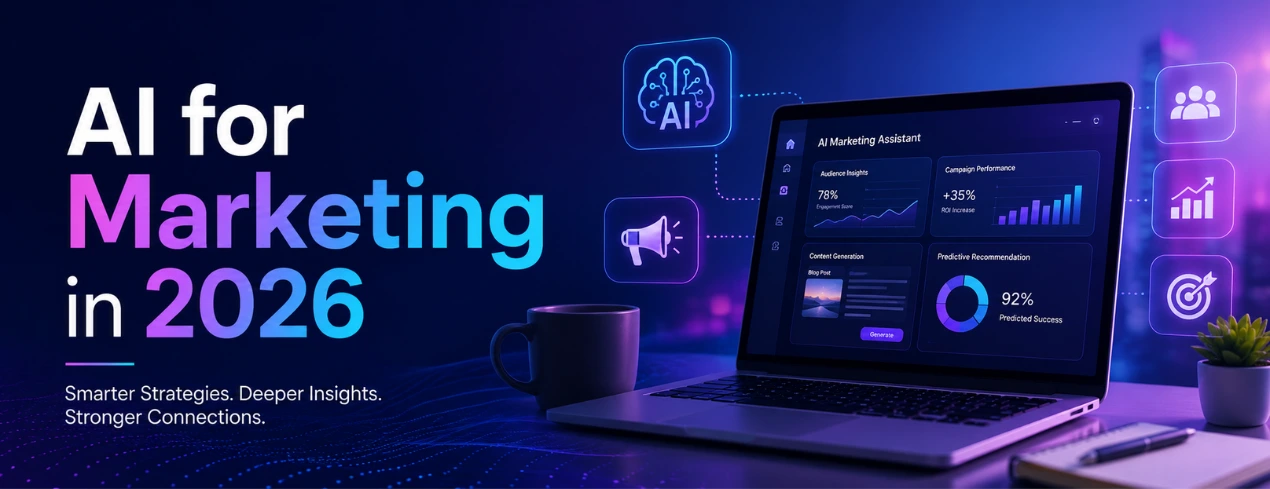
Let’s skip the part where I tell you AI is “revolutionising everything” and you roll your eyes.
You already know AI is a big deal. You’ve probably tried ChatGPT at least once. Maybe you’ve had a client ask you to “just use AI” for their content. Maybe you’ve read seventeen LinkedIn posts this week alone about how generative AI is going to change marketing forever — and walked away more confused than when you started.
This guide is different. It’s written for working marketers and business owners who want straight answers: what AI tools actually do, where they genuinely save time and money, where they still fall flat, and what the smartest marketers across the USA, UK, Australia, Canada, New Zealand, Netherlands, Malta, Brazil, and France are actually doing with AI right now in 2026.
No fluff. No robot hype. Just the real picture.
Table of Contents
The Numbers Are Impossible to Ignore
Before we get into the how, let’s establish the why — because the scale of what’s happening is genuinely significant.
92% of businesses want to invest in generative AI in their marketing and operations. That’s not a niche trend. That’s a near-consensus shift in how business is thinking about growth.
The AI in marketing market is expected to grow at a CAGR of 26.7% through 2034. For context, that’s faster than social media marketing grew during its peak years. It means more tools, more capabilities, more budget allocation, and — critically — more competitive pressure on businesses that aren’t adapting.
In a recent survey, 61% of marketers said AI was their most important data initiative. And yet, simultaneously, the top two concerns marketers have about AI are quality control and safety. Meaning: most marketers know they need AI, most are using it in some form, and most are still figuring out how to do it without producing content that sounds like it was written by a very confident robot who has never spoken to a human.
That tension — between the efficiency of AI and the quality it sometimes sacrifices — is the central challenge this guide addresses.
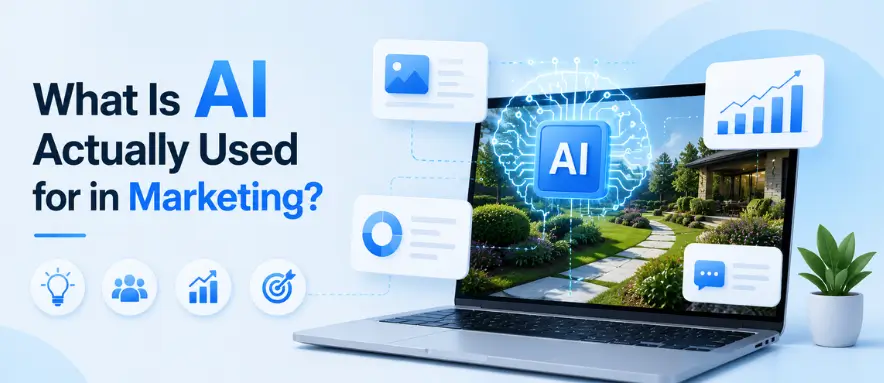
What Is AI Actually Used for in Marketing?
The honest answer is: a lot of things, at varying levels of usefulness.
Digital marketers use AI tools for a range of processes and tasks that span the entire marketing funnel. Understanding where AI genuinely adds value versus where it’s just a shiny feature nobody uses is the difference between using AI intelligently and paying for subscriptions that collect digital dust.
Here’s where AI is creating real, measurable impact:
Content Creation and Copywriting
Generative AI for content and image creation is the use case everyone started with, and for good reason. Tools like ChatGPT, Claude, Jasper, Copy.ai, and dozens of others can produce first drafts of blog posts, ad copy, email sequences, social captions, product descriptions, and website content at a speed that no human team can match.
The key word there is “first drafts.” The AI copywriting tools that marketers are actually getting value from aren’t ones replacing writers entirely — they’re the ones being used to eliminate the blank page problem, produce variation sets for testing, repurpose long-form content into social snippets, and generate AI writing prompts that help human writers work faster.
The marketers who use AI copywriting as a shortcut to skip editing entirely are producing content that reads like AI. Their SEO suffers. Their engagement drops. Their audience notices — even if they can’t articulate why.
The marketers who use AI as a thinking partner and drafting accelerator, then apply genuine human insight, brand voice, and editorial judgment to the output — those are the ones producing content at scale without sacrificing quality. That’s the AI-humanization pass that separates good content from mediocre.
SEO and Content Optimisation
AI has fundamentally changed how SEO works — both in terms of how marketers do SEO and how search engines work.
On the tools side, AI-powered SEO platforms like Surfer SEO, Clearscope, Frase, and Semrush’s AI features can analyse top-ranking content, identify topical gaps, suggest semantic keyword clusters, and generate content briefs that would have taken an experienced SEO strategist hours to produce manually.
On the search engine side, AI Overviews — Google’s AI-generated answer boxes that now appear at the top of many search results — have fundamentally changed what it means to rank. Understanding what AI Overviews mean for search is now a core skill for any SEO. The short version: they’re reducing clicks on informational queries while making it more important than ever to be the cited, authoritative source that the AI pulls from.
This is why Generative Engine Optimisation (GEO) — optimising content to be cited and referenced by AI search tools like Google AI Overviews, Perplexity, and ChatGPT search — is becoming as important as traditional SEO. An experienced SEO agency in 2026 needs to understand both.
Marketing Automation
AI for marketing automation has moved well beyond simple email sequences and drip campaigns. Modern AI automation tools can:
- Score and qualify leads based on behavioural signals across multiple channels
- Personalise website content in real-time based on visitor characteristics
- Predict churn risk and trigger retention campaigns before a customer disengages
- Optimise send times, subject lines, and content combinations at an individual level
- Automatically segment audiences based on patterns that no human analyst would have the time to identify
The result is that AI enables a level of personalisation at scale that was previously only available to enterprises with large data science teams. Small and medium businesses in the UK, Australia, Canada, and the US can now run marketing programmes that feel one-to-one without having a team of fifty people behind them.
Paid Advertising
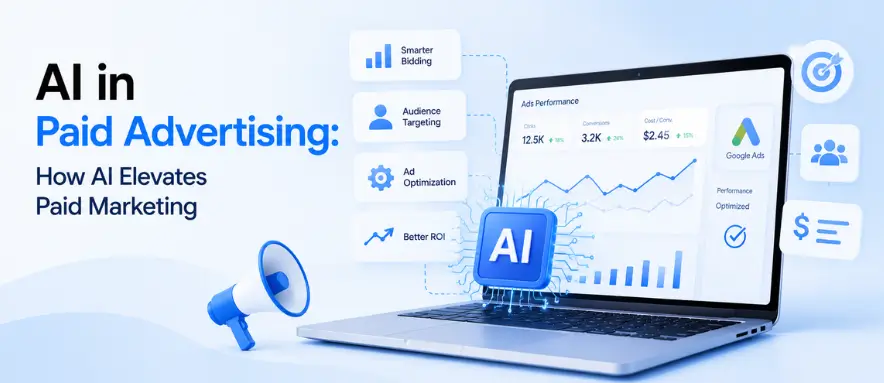
AI has arguably transformed paid media more than any other marketing channel. Google’s Performance Max, Meta’s Advantage+ campaigns, and similar AI-driven ad products now automate significant portions of what used to require constant manual management — bidding strategies, audience targeting, creative optimisation, budget allocation across placements.
But here’s what many marketers and business owners don’t realise: AI-driven ad platforms amplify what you give them. If your creative is weak, AI-optimised bidding on bad creative still underperforms. If your audience signals are poor, automated targeting can’t fix a data deficit. The skill in AI-powered paid advertising has shifted from manual bid management to strategic input — creative quality, audience architecture, landing page experience, and conversion tracking integrity.
We’ll go deep on this in the paid media section below.
ChatGPT for Digital Marketing: What It’s Actually Good At
ChatGPT is, for most marketers, the entry point into AI. And it’s genuinely excellent at specific tasks when used with clear, well-structured prompts.
Where ChatGPT delivers:
Campaign ideation and brainstorming — feed it your product, audience, and objective and ask for 20 campaign angle ideas. The quality varies, but the speed means you can generate a week’s worth of concepts in ten minutes and then apply judgment to identify the two worth developing.
Ad copy variations — for A/B testing, having ChatGPT generate 10 versions of a headline or 6 versions of a primary text gives you a testing set that would have taken a copywriter half a day. You still edit. You still apply brand voice. But the starting material is there instantly.
ChatGPT for LinkedIn is a particularly underused application. LinkedIn content has a distinct voice and format — the hook, the story, the insight, the CTA. ChatGPT can be prompted to match that format effectively, especially when you feed it a detailed brief about your professional perspective and target audience. The marketers getting traction on LinkedIn with AI are using it to articulate thoughts they’d already had, not to generate thoughts they haven’t.
Email subject line generation — ChatGPT can produce 20 subject line variants in 30 seconds. Run them against your historical open rates. Find patterns. This is legitimate, low-effort improvement.
Competitor analysis frameworks — ask it to structure a competitive analysis, build a SWOT, or generate a list of questions to ask in a customer interview. These structural outputs are where AI saves significant time.
Where ChatGPT struggles:
Real-time data. Brand voice at depth. Genuine creative originality. Long-form content that requires nuanced argument and consistent point of view. Anything that requires actual knowledge of your specific business, your specific customers, or the current state of your market.
The AI writing prompts that get the best results are the ones that treat ChatGPT like a very fast, very capable junior assistant who needs detailed briefs, clear constraints, and human review. Not like an oracle who can be given vague instructions and trusted to produce polished work.
Claude for Marketing: The AI That Thinks Differently
While ChatGPT dominates mindshare, Claude — Anthropic’s AI model — has quietly become the preferred tool for a significant number of professional marketers, particularly for long-form strategy work, nuanced copywriting, and complex analytical tasks.
Why Claude Dominates Marketing for Serious Practitioners
Claude’s approach to content is noticeably different. It reasons through problems rather than just pattern-matching to training data. It maintains consistent argument and voice across long documents. It pushes back on vague briefs rather than filling gaps with plausible-sounding nonsense. And it handles sensitive, nuanced, or contested topics with more care than many competing models.
Claude for Marketing: Core Use Cases
Strategy documents and proposals — Claude can take a client brief and produce a genuinely structured strategic recommendation, not just a list of tactics dressed up as strategy. This matters enormously for agencies and consultants.
Brand voice consistency — give Claude detailed examples of your brand’s tone, values, and audience, and it maintains that voice across long documents more reliably than most alternatives.
Audience research synthesis — paste in customer interview transcripts, survey data, or review analysis and ask Claude to synthesise the key insight themes. It does this with a level of analytical depth that saves significant research time.
Email and nurture sequence writing — where ChatGPT produces adequate email copy, Claude tends to produce email copy that sounds like a thoughtful human wrote it. The difference is subtle but consistently noted by experienced copywriters who use both.
Competitive positioning work — Claude is exceptionally good at structured comparison and contrast. Positioning statements, competitive battle cards, differentiation frameworks — these play to its analytical strengths.
Claude Marketing Skills Worth Knowing
Claude Code for Marketers is an emerging capability that matters more than most marketing teams realise. Claude’s code-generation abilities mean marketers with no technical background can:
- Build custom reporting dashboards by describing what they need
- Automate repetitive data tasks (pulling CSVs, cleaning data, merging reports)
- Create basic web scrapers for competitor monitoring
- Write Google Apps Scripts to automate Sheets-based workflows
None of this requires knowing how to code. It requires knowing what you want and being able to describe it clearly. That skill — translating marketing needs into precise instructions for AI — is rapidly becoming one of the most valuable capabilities a marketer can develop.
GenAI in Social Media Marketing: The Real Playbook
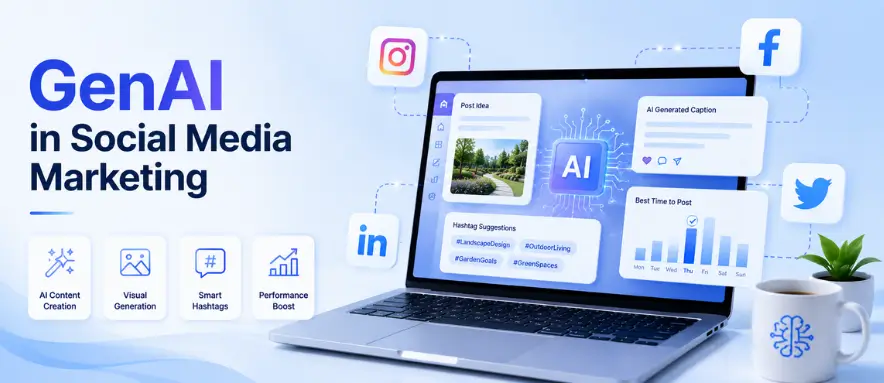
Generative AI in social media marketing is one of the highest-adoption areas — and one of the areas with the most variable quality. Everyone is using it. Not everyone is doing it well.
The challenge is that social media audiences are increasingly sensitive to AI-generated content. The cadence is wrong. The voice is too smooth. The cultural references are slightly off. The humour doesn’t land. Audiences may not be able to diagnose what’s bothering them, but engagement data shows clearly when content has lost the human element.
The social media management approach that’s working in 2026 uses AI as the engine and humans as the drivers — not the other way around.
What AI does in a smart social media workflow:
- Generates content calendar frameworks based on campaign objectives and seasonal opportunities
- Produces first drafts of captions across multiple platforms with format adaptation (LinkedIn long-form vs Instagram concise vs Twitter punchy)
- Repurposes long-form content (blog posts, podcast transcripts, video scripts) into platform-native social content
- Suggests hashtag clusters based on topic and platform
- Generates image prompts for visual content creation
- Analyses past post performance and recommends content adjustments
What humans do in a smart social media workflow:
- Inject actual brand personality, current cultural context, and genuine point of view
- Write the hooks — the first line that either stops the scroll or doesn’t
- Make the judgment calls about what’s appropriate, timely, and on-brand
- Respond to comments and DMs in ways that build real relationships
- Identify the trending conversations worth entering and those worth avoiding
For small businesses across the UK, Australia, New Zealand, and North America, AI-assisted social media management has made professional-quality content production accessible without requiring a full-time content team. That’s a genuine democratisation of marketing capability.
AI in Paid Advertising: How AI Elevates Paid Marketing
This is where AI has had the most dramatic impact on marketing results — and where the gap between marketers who understand AI-driven platforms and those who don’t is widest.
Google Ads and AI
Google’s shift to AI-driven campaign management has been systematic and aggressive. Smart Bidding, Responsive Search Ads, Performance Max, and Demand Gen campaigns all rely heavily on machine learning to optimise delivery, bidding, and creative selection in real time.
For marketers managing Google Ads, this means the strategic inputs matter more than ever:
Keyword research for PPC campaigns — AI tools like Google’s Keyword Planner, combined with third-party AI research tools, can now identify keyword opportunities at a granularity and speed that was previously impossible. Semantic clustering, intent mapping, and negative keyword mining are all being transformed by AI assistance.
Streamlined tech stack for paid ads — a key benefit of AI platforms is consolidation. Where a paid media team once needed separate tools for bidding, creative testing, audience management, and reporting, modern AI-integrated stacks can manage these from fewer platforms with better integration.
Creative optimisation — RSAs (Responsive Search Ads) use machine learning to test headline and description combinations at scale. Feeding the algorithm high-quality, varied creative inputs dramatically outperforms the approach of letting the system work with minimal material.
How to use AI in your PPC and paid media advertising effectively comes down to one principle: give the machine clear signals. That means conversion tracking that actually captures the actions you care about, audience lists that are properly built, and creative that represents genuine variation — not ten ways to say the same thing.
Meta Ads and AI
Meta Ads have undergone a similar AI transformation. Advantage+ campaigns automate audience targeting, placement selection, and creative optimisation using Meta’s vast behavioural data.
For Facebook advertising for small businesses and medium enterprises alike, the opportunity is real — but so is the risk of misuse. Advantage+ Shopping Campaigns, for instance, work exceptionally well for ecommerce businesses with strong product catalogues and good pixel data. Applied blindly to businesses that haven’t built the underlying data infrastructure, the results are inconsistent.
The AI marketing tools layered on top of Meta’s platform — for creative testing, audience analysis, and campaign reporting — help marketers make better decisions about what to feed the algorithm.
For small businesses specifically — internet marketing services for small businesses have been transformed by AI-driven Meta Ads. A solo operator in Manchester, a boutique in Melbourne, or a service business in Toronto can now run campaigns with the targeting sophistication previously only available to major brands, because Meta’s AI is doing the audience optimisation work that used to require a specialist.
The AI Marketing Team: Meet Your New Agents
This is where marketing is heading — and faster than most marketers realise.
An AI marketing team isn’t a room full of robots. It’s a set of specialised AI agents, each configured and prompted to handle a specific marketing function, working in coordination with human strategists who set direction, review outputs, and make judgment calls.
Here’s what a modern AI-augmented marketing team actually looks like:
Content Generation Agent
Configured with your brand voice, target audience personas, content calendar, and SEO priorities. Takes a content brief as input and produces a structured first draft — blog posts, ad copy, email copy, social content — ready for human review and refinement. The best implementations have the agent use web search to ensure content accuracy and recency.
Social Media Management Agent
Monitors brand mentions, schedules content across platforms, generates caption variations for testing, and surfaces engagement opportunities for human response. For a social media management company for small business or in-house team managing multiple accounts, this agent is one of the highest-ROI AI implementations available.
Email Campaign Automation Agent
Goes beyond simple drip sequences. A properly configured email agent can segment audiences dynamically based on behavioural signals, personalise content blocks based on recipient characteristics, A/B test subject lines automatically, and feed performance data back into a dashboard with recommended adjustments.
Lead Qualification and Scoring Agent
For B2B marketers especially, this is transformative. An AI lead qualification agent can review inbound leads against defined ideal customer criteria, score them based on fit and intent signals, route high-priority leads immediately to sales, and nurture lower-priority leads with automated follow-up sequences — all without human intervention until the lead reaches a defined qualification threshold.
SEO and Content Optimisation Agent
Monitors keyword rankings, identifies content decay (pages that are losing ranking over time), suggests optimisation opportunities, and generates updated content briefs. For agencies managing SEO across multiple clients, this agent alone can save dozens of hours per month.
Ad Management Tools for Agencies
AI-powered ad management platforms — tools like Optmyzr, Adalysis, and similar — function as agents for paid media teams, automatically flagging underperforming campaigns, suggesting bid adjustments, identifying negative keyword opportunities, and generating performance summaries. For agencies managing Google Ads, Meta Ads, and programmatic campaigns simultaneously, these tools are no longer optional.
This is the world of agentic AI development — building custom AI agents configured for specific business and marketing functions. It’s where the frontier of practical AI application currently sits.
AI Video Creation: The Channel Most Marketers Are Sleeping On
YouTube marketing and video content broadly have historically been bottlenecks for marketing teams — expensive to produce, time-consuming to edit, difficult to scale.
AI video creation tools have fundamentally changed this calculus.
Platforms like Runway, Kling, Higgsfield, and similar tools can now generate high-quality video content from text prompts, transform still images into video, create realistic talking-head videos from a script, and produce B-roll footage that previously required a production crew.
For digital marketing content specifically:
AI-generated video ads — short-form ad creative for Meta, YouTube pre-roll, and TikTok can be produced at a fraction of traditional production costs. The quality has reached a level where, for direct response advertising especially, AI-generated creative is regularly outperforming traditionally produced creative in A/B tests.
Product demonstration videos — for ecommerce businesses, AI video tools can generate product visualisation and demonstration content without a photoshoot or video shoot.
Educational and explainer content — blog posts and long-form content can be repurposed into video scripts and then produced as AI-narrated videos with AI-generated visuals. For businesses wanting YouTube marketing agency results without committing to full video production budgets, this is a viable path.Personalised video outreach — AI video tools are being used in B2B sales and marketing to create personalised video messages at scale, dramatically improving response rates on cold outreach compared to text-based messages.
The AI video creation space is evolving month by month. What’s technically achievable today would have been impossible two years ago. What’s achievable in two years from now will make today’s tools look rudimentary.
AI for Communication and Customer Experience
AI for communication extends well beyond chatbots on websites (though those matter too).
AI-powered communication tools are being used by marketing teams to:
Personalise customer communications at scale — email content, push notifications, and in-app messages tailored to individual user behaviour without manual segmentation work.
Handle inbound customer service enquiries — AI models trained on product knowledge can handle a significant percentage of common customer questions without human agent involvement, freeing customer service teams for complex issues while dramatically reducing response times.
Analyse customer feedback at scale — AI can process thousands of reviews, survey responses, and customer service transcripts in minutes, surfacing the themes and insights that would take a human analyst weeks to identify.
Sales enablement — AI tools that analyse sales calls, identify objection patterns, and suggest response frameworks are being used in B2B marketing teams to improve conversion rates through better sales-marketing alignment.
AI for sales and marketing alignment is an underappreciated application. When AI can analyse the gap between the leads marketing produces and the revenue sales closes, and surface the characteristics of leads that consistently convert versus those that don’t — that information transforms how marketing campaigns are built and targeted.
The Honest Truth: Common Skills Used in AI-Driven Digital Marketing
The skills that make marketers valuable have shifted. Here’s what actually matters in 2026:
Prompt engineering — the ability to brief AI tools clearly and precisely. This isn’t a technical skill. It’s a communication skill applied to AI. Marketers who can write specific, contextualised, well-structured prompts get dramatically better AI outputs than those who treat AI like a search engine.
Critical editorial judgment — AI generates content fast. The bottleneck is quality control. Marketers who can evaluate AI output quickly and accurately — identifying what’s usable, what needs work, and what needs discarding — are the ones adding genuine value in AI-augmented workflows.
Data literacy — AI platforms generate enormous amounts of performance data. Understanding what metrics matter, how to interpret them, and how to act on them is more important than ever.
Strategic thinking — this is the skill AI is least able to replicate. Understanding market dynamics, customer psychology, competitive positioning, and business context. AI can inform strategy with data. It can’t replace the judgment required to make strategic decisions.
Cross-platform integration thinking — understanding how AI tools across different platforms (ads, SEO, social, email, CRM) can work together as a system rather than in isolation.
Will AI Replace Digital Marketers?
Let’s address this directly because it’s the question everyone is thinking.
No. But with a significant caveat: AI will replace digital marketers who refuse to use AI.
The marketers most at risk are those doing primarily executional work that AI can now automate — producing basic content to a template, manually building reports, managing simple campaigns without strategic input. If your value is primarily in doing things that can now be done faster and cheaper by AI, that’s a genuine threat.
The marketers whose positions are strengthening are those who can use AI as a force multiplier for genuinely human capabilities — strategic insight, creative judgment, relationship management, brand stewardship, and the ability to make decisions with incomplete information.
This is where the concept of “humans in the loop” (HITL) matters. The most effective AI marketing implementations aren’t fully automated — they’re ones where AI handles volume, speed, and pattern recognition, and humans provide oversight, judgment, and the creative and strategic inputs that AI still can’t replicate.
AI marketers face challenges over quality and safety concerns that make human oversight non-optional for now:
- AI can generate confidently incorrect information — and if nobody reviews it, it gets published
- AI doesn’t understand your brand history, your current campaigns, or your sensitive business context unless you tell it
- AI can’t read the room — cultural moments, trending conversations, and appropriate brand positioning in real-time situations still require human judgment
- AI has real limitations with genuine creative originality — it remixes existing patterns, it doesn’t create genuinely new ideas
- The future isn’t AI marketers or human marketers. It’s human marketers who are dramatically more effective because of AI.
AI-Enabled Digital Marketing Services: What to Look For
For businesses considering working with a digital marketing company in 2026, AI capability should be a significant factor in how you evaluate agencies and service providers.
The questions worth asking:
How are you using AI in your content workflow? A credible answer involves AI-assisted production with human editorial oversight. A concerning answer involves “everything is AI-generated” or “we don’t really use AI at all.”
What AI tools are integrated into your paid media management? A modern Google Ads management company should be leveraging AI for bid optimisation, keyword opportunity identification, and creative testing at minimum.
How are you managing AI quality and safety? AI hallucinations, brand voice inconsistency, and factual errors are real risks. Any agency using AI extensively should have clear quality control processes.
Are you building custom AI agents or just using off-the-shelf tools? Businesses with specific, complex marketing needs are increasingly finding that custom AI marketing agent development — building agents configured for their specific workflows, data, and objectives — delivers better results than generic tools.
What does your AI tech stack look like? A mature AI-enabled digital marketing operation has integrated tools across content, paid media, SEO, email, and analytics — not one AI subscription used sporadically.
Key AI Applications in Marketing: The Quick Reference
For marketers who want the overview without the deep dive, here’s where AI is creating the most consistent value right now:
Content Production — first draft generation, variation creation, repurposing, localisation. 3-5x speed improvement typical.
SEO — content briefs, keyword clustering, technical audits, content gap analysis, GEO optimisation. Hours of work compressed to minutes.
Paid Advertising — Smart Bidding, Advantage+, creative optimisation, audience insight, negative keyword mining. The platforms are AI-powered whether you choose it or not.
Email Marketing — segmentation, personalisation, send time optimisation, subject line testing. Significant conversion rate improvements when implemented properly.
Social Media — content calendar generation, caption drafting, performance analysis, scheduling. High-volume management made feasible for smaller teams.
Video Content — script generation, AI-produced video creative, YouTube content at scale. Still evolving but moving fast.
Lead Generation — AI chatbots, lead scoring, qualification automation. Particularly valuable for 24/7 lead capture on websites.
Analytics and Reporting — automated insight generation, anomaly detection, performance narrative creation. Saves significant analyst time.
AI for Small Businesses: Levelling the Playing Field
One of the most significant shifts AI has enabled is genuine access for small and medium businesses to marketing capabilities that were previously out of reach.
Online marketing services for small businesses have been transformed. A small business owner in Brisbane, a boutique in Amsterdam, a service firm in Bristol, or a startup in São Paulo can now:
- Produce professional-quality content without a full-time writer
- Run AI-optimised paid media without a dedicated media buyer
- Manage digital marketing services for small businesses at a fraction of the previous cost
- Build customer communication workflows that feel personalised at scale
- Compete on SEO with businesses that have much larger teams
Managing social media and digital operations for SMEs is where AI has had perhaps the most democratic impact. The gap between what an enterprise marketing team and a solo business owner can produce has narrowed meaningfully — not closed, but narrowed. For small businesses in competitive local markets, this matters enormously.
Digital marketing agencies for small businesses that have integrated AI properly are now able to offer enterprise-quality services at SME-appropriate price points. The efficiency gains from AI implementation are being passed through to clients in the form of better outputs, faster turnaround, and lower costs.
What Is the Future of AI in Digital Marketing?
Straight answer: more autonomous, more integrated, and more indistinguishable from the marketing fabric itself.
The direction of travel is clear:
AI agents handling end-to-end campaigns — the ability to brief an AI agent on a campaign objective and have it handle creative production, audience targeting, bid management, performance monitoring, and optimisation without per-step human intervention is already partially real and will be substantially more capable within 24 months.
Hyper-personalisation at true scale — every customer receives genuinely different content, offers, and messaging based on their individual context, behaviour, and preferences. Not segmented emails, but truly one-to-one communication at millions of touchpoints simultaneously.
AI in the creative process — not just drafting content, but genuinely contributing to creative strategy, campaign concept development, and brand building. The creative partnership between human strategists and AI tools will deepen.
Predictive marketing becoming standard — AI systems that can accurately forecast which prospects will convert, which customers will churn, which campaigns will perform, and which messages will resonate — before campaigns launch rather than after.
Voice and multimodal AI in marketing — as AI voice and image generation mature, the content formats marketers work with will expand. Audio content, interactive AI experiences, and multimodal campaigns will become standard practice.
The businesses building their AI capabilities now — investing in agentic AI development, training their teams, building their data infrastructure — will be positioned to take disproportionate advantage of these developments as they mature.
Eye-Opening AI Marketing Stats Worth Knowing
- 92% of businesses want to invest in generative AI (McKinsey, 2024)
- AI in marketing market expected to grow at 26.7% CAGR through 2034
- 61% of marketers say AI is their most important data initiative
- 80% of retail executives expect to use AI automation by 2025
- Businesses using AI for personalisation report 40% higher revenue from personalised activities
- AI-powered chatbots handle up to 80% of routine customer queries without human intervention
- Marketers using AI tools report saving an average of 2.5 hours per day on content tasks
- 71% of consumers now expect personalised interactions from brands
- 54% of marketing executives say AI has had a significant impact on their marketing performance
Frequently Asked Questions: AI in Digital Marketing
Start with your highest-volume, most time-consuming tasks. Content production, keyword research, ad copy variation, and reporting are almost always the right entry points. Pick one workflow, implement an AI tool properly (with clear prompts and human review), measure the time and quality impact, then expand from there.
For content: ChatGPT, Claude, Jasper, Copy.ai. For SEO: Surfer SEO, Clearscope, Semrush AI. For paid ads: Smart Bidding (Google), Advantage+ (Meta), Optmyzr. For automation: HubSpot AI, Marketo, ActiveCampaign. For social: Hootsuite AI, Buffer. For video: Runway, Kling, Higgsfield. The best tool depends on your specific use case and workflow.
Speed, scale, cost efficiency, 24/7 availability, data processing capability, personalisation at scale, A/B testing velocity, and consistent baseline quality. AI can produce in ten minutes what would take a human team a day.
No — but it will replace marketers who refuse to adapt. Strategic thinking, creative judgment, relationship management, and brand stewardship remain fundamentally human capabilities. AI amplifies them rather than replacing them.
A framework for AI implementation where AI handles automated execution while humans provide oversight, judgment, and strategic direction. It’s the standard best practice for AI marketing implementation because it captures AI’s efficiency benefits while preserving the quality control and creative judgment that AI can’t provide independently.
Google’s AI Overviews appear above organic results and provide direct answers drawn from indexed content. They’re reducing click-through rates on informational queries while making it more important to be the authoritative, cited source that AI pulls from. This is driving the emerging practice of Generative Engine Optimisation — building content specifically designed to be referenced by AI search systems.
Agentic AI refers to AI systems that can take sequences of actions autonomously to accomplish defined goals — not just answer a question, but plan and execute a workflow. In marketing, agentic AI can run an email campaign from brief to send, manage a PPC campaign from setup to optimisation, or publish a content piece from research to live — with defined human checkpoints rather than step-by-step human management.
The Bottom Line: AI is a Tool. Strategy is Still the Differentiator.
Here’s what nobody’s AI hype article will tell you: AI makes average marketing faster, but it doesn’t make bad strategy good.
The businesses winning with AI right now are the ones that had strong strategic thinking, clear brand positioning, and genuine understanding of their customers — and are now using AI to execute that thinking faster and at greater scale.
AI can write a hundred emails. It can’t tell you which hundred people to send them to, what promise your brand should make, or whether your positioning is right for the market you’re targeting. That still requires a human who understands the business, the customer, and the competitive landscape.
What AI has done is remove the excuse of capacity. If your marketing isn’t where it needs to be in 2026, it’s not because you don’t have enough people or enough budget. It’s because the strategy isn’t clear enough to brief the tools that are now available.
Get the strategy right. Use AI to execute it at a speed and scale that wasn’t possible three years ago.
That’s the real opportunity.
DQOT Solutions builds AI-enabled digital marketing systems for businesses that want to grow faster. From custom AI agent development and AI video creation through to managed SEO, paid advertising, and social media — we combine strategic thinking with the best available AI tooling to produce results that matter.