
India just crossed 270 million online shoppers.
Let that number hit you for a second. Two hundred and seventy million people — more than the entire population of Brazil — buying things online in a single country. And the ecommerce market they fuel is on track to hit $225.9 billion in 2026, growing at 12.4% annually, according to GlobalData.
That sounds like incredible news for ecommerce brands. And it is — except for one painful reality.
Every single one of those 270 million shoppers is being chased by thousands of brands all spending money on the same Meta audiences, the same Google Shopping placements, and the same Flipkart and Amazon advertising slots. Meta CPMs in India went up 40 to 60 percent between 2023 and today. Your customer acquisition cost is higher. Your ROAS is lower. Your margins are thinner.
And if you’re still running your ecommerce marketing the same way you were running it three years ago, you are burning money.
This is the complete 2026 guide to what a serious digital marketing agency for ecommerce in India actually does — and what it takes to scale an online store profitably in this market.
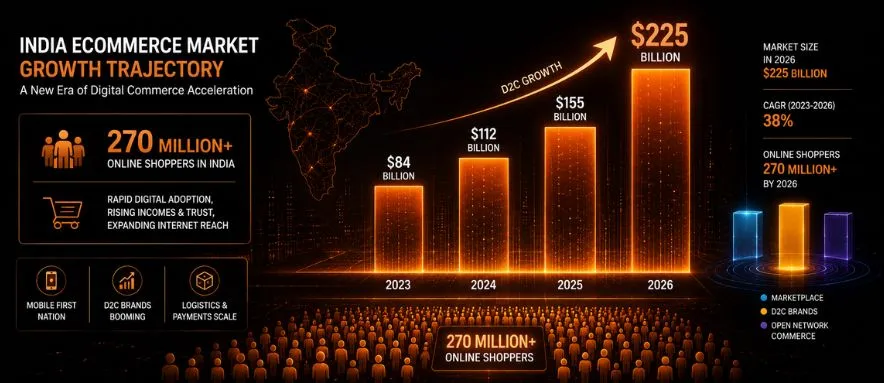
Table of Contents
Why Most Ecommerce Marketing in India Fails Right Now
I have reviewed the marketing accounts of over 200 Indian ecommerce brands in the last three years. Fashion, beauty, supplements, home decor, electronics — across categories.
And I see the same problem almost every time.
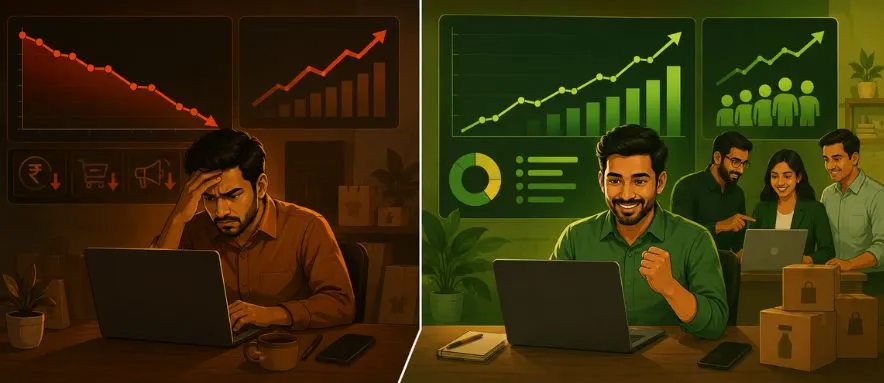
The brand is spending on Meta Ads. Running Google Ads. Maybe doing some basic Instagram posts. Getting traffic. But the traffic isn’t converting the way it used to. The ROAS that looked comfortable at 2.8x has slipped to 1.9x. The cost per acquisition that used to be ₹350 is now ₹680. And the brand owner has no idea why.
Here is why. Paid media alone is no longer a business model. It was never supposed to be.
Meta CPMs in India rose 40 to 60 percent between 2023 and today. iOS privacy changes broke the precision of lookalike audiences. And more ecommerce brands than ever are bidding on the same audience inventory, pushing costs up while conversion rates slide. The era of cheap Facebook traffic that made D2C scaling look easy is genuinely over. What worked in 2021 is actively losing money in 2026.
The brands growing profitably right now have made one fundamental shift. They stopped treating paid media as their entire marketing engine and started treating it as one layer of a full-stack digital strategy. SEO — the most underinvested channel in direct-to-consumer marketing in India — brings in people who are actively looking for your product. These visitors are far more likely to buy than people who just saw an ad.
The second piece everyone gets wrong is the math. If your AOV is ₹800 and your CAC is ₹600, you are barely breaking even on the first purchase. But three more orders from that customer changes everything. Retention is where your D2C marketing strategy gets profitable — and it is the metric that separates brands that scale from brands that stall.
A digital marketing agency for ecommerce in India that understands this builds a connected system — not a collection of separate campaigns. SEO for organic discovery. Paid media for acceleration. Email and WhatsApp for retention. Marketplaces for reach. Each channel feeds the next. That is what profitable ecommerce growth actually looks like in 2026.
The Full Ecommerce Marketing Stack — What Actually Moves the Needle
Let me break down exactly what a complete ecommerce digital marketing stack looks like in 2026 — not as a list of services, but as a connected growth system.
SEO: The Channel Nobody Invests In Enough
Indian D2C brands struggle to survive against giants like Amazon India, Flipkart, and Nykaa. Rising PPC costs during festivals like Diwali and the shift toward zero-click AI searches make organic visibility not just desirable but necessary for healthy margins.
Ecommerce SEO in India has a specific set of rules that most agencies — especially generalist ones — get completely wrong. Marketplaces dominate head-term searches. “Buy running shoes online” is owned by Flipkart and Amazon. But the real opportunity for independent D2C brands and Shopify stores sits in three places: category-level long-tail keywords, product-specific informational queries, and brand search authority.
A proper SEO strategy for ecommerce brands starts with product page architecture, then builds category page authority, then supports both with a content cluster of buying guides, comparison articles, and problem-solution blog posts that rank for the questions your buyers are asking at midnight before they make a purchase. For new stores with little domain authority, meaningful organic traffic typically takes 4 to 8 months to develop — but once it is there, it delivers purchase-intent traffic without a per-click cost.
That compounding, zero-cost traffic is the most valuable asset in ecommerce marketing. It does not vanish when you pause your budget.
Google Ads: Shopping, Brand, and Performance Max
Google Ads management for ecommerce in India in 2026 runs across four formats — Google Shopping for product-level discovery, Brand Search to defend your own traffic, Performance Max for algorithmic cross-channel reach, and standard search for high-intent category terms.
The critical principle: Google Shopping and Performance Max need exceptional product feed quality. Title structure, image selection, price positioning, and review count all affect both Quality Score and conversion rate. Most ecommerce brands in India run poor feeds and then blame the campaigns. The feed is the campaign.
For festival season — Diwali, Dussehra, Big Billion Days, Great Indian Festival — smart ecommerce Google Ads strategy begins building audience lists and warming signals 45 days before the sale window opens. The brands that start their retargeting infrastructure in August win October. The ones who turn it on the week of Diwali spend three times more for the same results.
Meta Ads: Still Essential, But Completely Different Now
Meta Ads are not dead for Indian ecommerce. They are just different.
The optimal budget allocation for D2C brands in India now looks like 40 to 50 percent Meta, down from 80 percent, with 25 to 30 percent going to Google, split between Shopping, brand search, and Performance Max, and 15 to 25 percent allocated to emerging channels like YouTube Shorts, WhatsApp Commerce, and influencer seeding.
Meta Ads management for ecommerce brands in 2026 is fundamentally a creative problem. When targeting precision has degraded and CPMs are high, the creative that stops the scroll is your single biggest lever. Brands running 8 to 12 new creative variants per month consistently outperform brands running 2 to 3 evergreen assets. UGC content — real customer videos, unboxing clips, before-and-after posts — outperforms polished studio creative in almost every Indian ecommerce category right now.
The second critical shift: Advantage+ Shopping Campaigns have become the default performance format for most ecommerce advertisers on Meta. Running broad, letting Meta’s algorithm optimize, and feeding it with high-quality creative and strong first-party data signals from your pixel is consistently outperforming manual targeting setups in 2026.
Social Media and YouTube: Building the Brand That Makes Ads Work Cheaper
When their ads show up in your feed, you do not start from zero. You already have a feeling about them. That is what brand recognition does. It reduces the amount of work your paid media has to do at the conversion stage. Think about Mamaearth or Minimalist. Their ROAS is better than comparable brands partly because organic brand equity lowers the friction in paid conversion.
Social media management for ecommerce brands is not just about posting. It is about building the brand presence that makes every other channel work more efficiently. A consistent content calendar across Instagram, Facebook, and YouTube builds the touchpoints that warm audiences before they ever click an ad.
YouTube marketing for Indian ecommerce brands is one of the most underutilized channels in this market. Product review content, how-to guides, category education videos, and founder story content on YouTube creates compounding organic reach that feeds both direct traffic and the consideration stage of your customer journey. A single well-performing YouTube video can drive qualified traffic for three to five years.
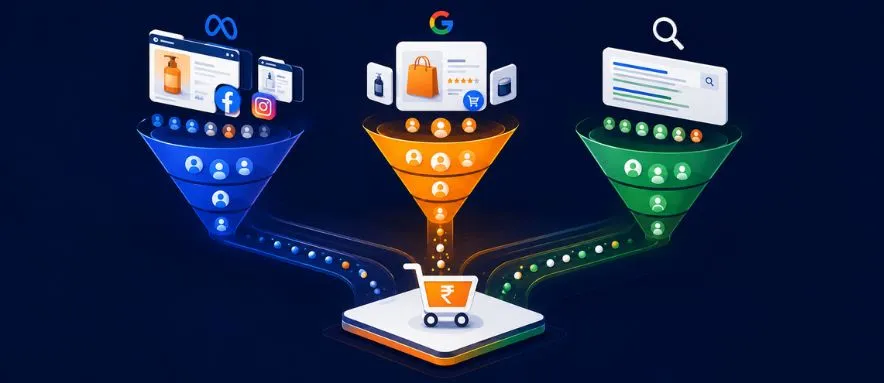
Marketplaces Are Not Optional — But You Need to Own Them, Not Depend on Them
By 2026, the game has shifted into a high-speed ecosystem where Amazon, Flipkart, and the new ONDC effectively dictate the winners. Simply having a website is the bare minimum. You have to actually own the digital shelf — whether that is on a massive marketplace, your own Shopify store, or a WooCommerce site.
Here is the strategic tension every Indian ecommerce brand faces. Marketplaces give you reach and trust signals. Amazon India and Flipkart collectively control over 60% of Indian online retail. You cannot ignore them. But marketplace sales mean the marketplace owns your customer data. You cannot retarget them. You cannot build an email list from them. You cannot understand their behavior. Every order you fulfill through a marketplace is revenue without relationship.
The right approach is not marketplace OR D2C. It is marketplace AND D2C — with a clear strategy for moving customers from marketplace to owned channels over time.
For marketplace marketing specifically, Amazon PPC management and Flipkart ads are not the same as Google Ads or Meta Ads. The keyword match type logic, bidding strategy, and content requirements are entirely different. Amazon A+ content, brand store optimization, and sponsored brand video ads require specific expertise. Marketplace visibility requires higher ranking, better keyword relevance, and optimized listings. Conversion rates matter — traffic without conversions is wasted spend. CRO on marketplace listings is just as important as on your own website.
ONDC is the wildcard. The Open Network for Digital Commerce is still building its ecosystem in 2026, but forward-thinking brands are already establishing presence and testing ONDC marketing strategy. The brands that build ONDC expertise now will have a significant distribution advantage as the network scales.
The AI Layer — Where Ecommerce Marketing Goes Next
Every digital marketing agency for ecommerce in India is talking about AI. Very few are actually deploying it in ways that move the metrics.
Here is where AI is genuinely changing the game for Indian ecommerce brands in 2026.
WhatsApp Automation at Scale
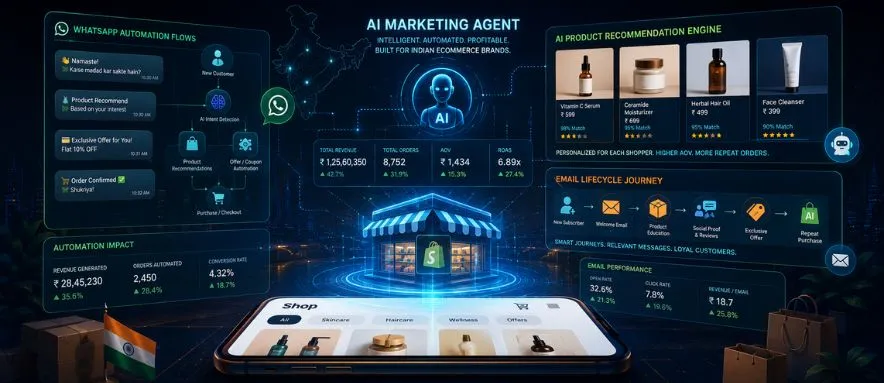
India is a WhatsApp-first country. Over 500 million Indian users are active on WhatsApp. For ecommerce brands, AI-powered WhatsApp marketing automation — abandoned cart recovery, order updates, post-purchase review requests, reorder nudges, festival offers — is the highest-ROI retention channel available right now. Open rates on WhatsApp run at 70 to 90 percent versus 20 to 25 percent on email. For COD-heavy categories especially, WhatsApp automation is reducing return rates and increasing repeat purchase rates across brands implementing it properly.
AI-Powered Creative Production
AI video creation for ecommerce brands has become a genuine competitive advantage in 2026. Producing 12 Meta ad creative variants per month through traditional production costs ₹4 to 8 lakh and takes 3 to 4 weeks. AI video production — trained on your brand assets, product imagery, and customer UGC — produces the same volume in 3 to 4 days at a fraction of the cost. Brands that test more creative more frequently win on Meta. AI removes the production bottleneck that was throttling creative testing.
Personalization and Product Recommendations
AI product recommendation engines — deployed across your Shopify store, email flows, and WhatsApp sequences — increase AOV by 15 to 30 percent on average by surfacing relevant upsells and cross-sells at the right moment in the customer journey. This is no longer enterprise-only technology. Agentic AI development services for ecommerce brands of all sizes are making personalized customer journeys accessible for brands doing even ₹50 lakh in annual revenue.
GEO and AEO for Ecommerce
Search is changing. Perplexity, ChatGPT with Browse, Gemini, and Google’s AI Overviews are rewriting how buyers discover products. Discovery engine SEO now demands a hybrid approach combining traditional search, Answer Engine Optimization, and Generative Engine Optimization. Ecommerce brands that optimize for AI-generated answers — through structured product data, review signals, and authoritative category content — will capture a growing share of AI-directed purchase traffic that will only increase over the next 3 to 5 years.
The Metrics That Actually Matter — Moving Beyond ROAS
ROAS is a vanity metric. I know that is a controversial thing to say. But hear me out.
A brand with a 4.2x ROAS and a 15% net margin is more profitable than a brand with a 6.8x ROAS and a 4% net margin. The ROAS number looks better on the second brand. The bank account looks better on the first.
The real question is not what your ROAS is. The question is what your LTV to CAC ratio looks like. In the Indian D2C market right now, brands spending 800 to 1,200 rupees to acquire a customer in beauty and personal care need at least 2.5 purchase cycles to even reach a 3.9X LTV to CAC ratio.
The metrics that matter for profitable ecommerce marketing in India in 2026:
Contribution Margin per Order — Revenue minus COGS, shipping, payment gateway fees, and the specific ad spend that drove that order. This is your real unit economics number.
LTV to CAC Ratio — If your LTV to CAC is below 3:1, your business is not sustainable at scale. Every marketing decision should be evaluated against improving this ratio.
Repeat Purchase Rate — For consumable categories, a 30% repeat purchase rate within 90 days is the floor for a healthy business. Below that, you’re on a treadmill of pure acquisition spend with no compounding.
Blended MER (Marketing Efficiency Ratio) — Total revenue divided by total marketing spend across all channels. This is the only metric that tells you whether your overall marketing investment is actually working, without the distortions of last-click attribution.
A serious ecommerce digital marketing agency in India tracks these numbers for you — not just clicks, impressions, and CTR. If your current agency’s monthly report does not include contribution margin, LTV to CAC, and repeat purchase rate, you are flying blind.
What to Look For When Choosing an Ecommerce Marketing Agency in India
The Indian ecommerce marketing agency market in 2026 is crowded. Every agency has a case study, a Google Partner badge, and a client list. How do you tell the difference between an agency that will actually grow your business and one that will grow their own retainer?
Here is what to evaluate — seriously evaluate, not just ask about:
Ecommerce-Native Thinking: Does the agency think in terms of ROAS, CAC, LTV, and contribution margin? Or do they talk about impressions, reach, and engagement? If their first conversation is about brand awareness, not revenue metrics, they are probably not ecommerce-native.
Marketplace Expertise: Look for agencies with proven ecommerce experience, marketplace expertise across Amazon and Flipkart, strong ROI focus, transparent reporting, and full-funnel capabilities including SEO and performance marketing. An agency that cannot run Amazon PPC and Flipkart advertising alongside your own store campaigns is leaving half your business unoptimized.
Platform Depth: Shopify and WooCommerce have different technical SEO requirements, different integration capabilities, and different conversion optimization levers. An agency that treats every ecommerce platform identically does not understand ecommerce SEO.
Creative Infrastructure: In 2026, creative velocity wins on paid media. How many new ad creative variants does the agency produce per month for your account? If the answer is fewer than eight, your Meta campaigns will plateau within 60 days.
Festival Season Experience: Diwali, Holi, and the Big Billion Days sales season account for 30 to 40 percent of annual ecommerce revenue for most Indian brands. An agency that has never managed a large Indian ecommerce account through a festival season will make expensive mistakes during the moments that matter most.
Transparent Attribution: Last-click attribution is dead. Any agency that still reports primarily on last-click conversion data is giving you a distorted picture of which channels are actually driving growth. Multi-touch attribution, incrementality testing, and MER tracking are the standard in 2026.
At DQOT Solutions, we build connected ecommerce marketing systems — from SEO and content to Google Ads, Meta Ads, marketplace management, AI automation, and WhatsApp retention — all measured against the metrics that actually determine whether your business is growing profitably.
The India Ecommerce Opportunity in 2026 — Who This Market Really Rewards
Here is the truth about the Indian ecommerce market in 2026 that most people are afraid to say.
The easy growth is over. The era of simply boosting posts or running sales ads is finished. Marketplace visibility requires higher ranking and better keyword relevance. Conversion rates determine whether traffic turns into revenue. Customer retention is where profit margins improve. Content and creative — high-converting product storytelling, UGC, and video ads — matter more than ever.
But the hard growth — the kind that comes from doing the fundamentals well, systematically, over 12 to 24 months — is just beginning.
India’s D2C ecosystem is expanding at a 40% CAGR projected through 2027. More brands are competing for the same customer attention across Amazon, Flipkart, Shopify, ONDC, and D2C websites. In this environment, the right digital marketing agency is no longer just a service provider. It becomes the difference between average growth and category leadership.
The brands that will own their categories in 2028 are making smart marketing investments right now. They are building SEO authority that will compound for years. They are testing creative faster than competitors. They are building first-party data through email, WhatsApp, and loyalty programs — not depending entirely on Meta and Google’s shrinking targeting precision. They are deploying AI marketing automation to scale personalization without proportionally scaling headcount. And they are tracking the right metrics — contribution margin, LTV to CAC, repeat purchase rate — not just the vanity numbers that look good in a slide deck.
That is the game. And the good news is, it is very winnable.
The ecommerce brands that partner with a specialist digital marketing agency for ecommerce in India — one that understands this market’s specific challenges, its festival seasonality, its marketplace dynamics, its language diversity, and its COD-heavy consumer behavior — are the ones that will still be growing three years from now.
The question is which side of that line you want to be on.
Frequently Asked Questions
An ecommerce digital marketing agency in India manages the full set of online marketing activities that drive traffic, conversions, and retention for online stores. This includes ecommerce SEO, Google Ads and Shopping campaigns, Meta Ads, Amazon and Flipkart advertising, social media management, email marketing, WhatsApp automation, influencer marketing, CRO, and marketing analytics. The best agencies manage all of these as an integrated system measured against revenue and profitability — not individual channel vanity metrics.
ROAS only tells you how much revenue a paid channel returned per rupee spent. It does not account for COGS, shipping, payment gateway fees, or return rates — which means a high ROAS can still be unprofitable. The metrics that actually matter for ecommerce profitability are contribution margin per order, LTV to CAC ratio, blended Marketing Efficiency Ratio, and repeat purchase rate. A good ecommerce marketing agency tracks and optimizes for all of these, not just ROAS.
For new ecommerce stores with limited domain authority, meaningful organic traffic typically develops within 4 to 8 months. For established stores, targeted SEO improvements can show ranking movement within 6 to 12 weeks. The critical point is that ecommerce SEO builds compounding traffic that continues to grow without a per-click cost — unlike paid media, which stops the moment you pause your budget.
Budget allocation depends on your current stage, category, and growth goals. A common framework for scaling D2C brands in 2026 is: 40 to 50 percent on Meta, 25 to 30 percent on Google, and 15 to 25 percent on emerging channels like YouTube Shorts, WhatsApp, and influencer seeding, with a separate allocation for SEO and content. The exact split should be driven by your LTV to CAC ratio and contribution margin — not by what your competitors are spending.
Extremely important. Amazon India and Flipkart collectively control over 60 percent of Indian online retail. Brands without an optimized marketplace presence are leaving a massive share of purchase-intent traffic untapped. But marketplace marketing must be managed alongside D2C strategy — not instead of it. The goal is to use marketplaces for reach and initial acquisition while building owned channels like your website, email list, and WhatsApp contacts for long-term profitability.
DQOT Solutions builds connected ecommerce growth systems — not siloed campaign management. Our team brings together performance marketing expertise across Google Ads, Meta Ads, Amazon, and Flipkart; technical SEO for Shopify and WooCommerce stores; AI automation for WhatsApp, email, and on-site personalization; AI video production for rapid creative testing; and data-driven reporting built around contribution margin and LTV — not just ROAS. We treat every brand’s marketing as an integrated revenue engine, not a collection of separate services.
AI marketing automation for ecommerce in India works across three high-impact areas: WhatsApp automation for abandoned cart recovery, order updates, and reorder nudges with open rates up to 90%; AI-generated creative production for rapid ad testing on Meta and Google; and AI-powered product personalization on your store and in email flows that increases AOV by 15 to 30 percent. These tools are now accessible to brands of all sizes — not just enterprise accounts.
The correct answer is both — with a clear strategy connecting them. Marketplaces offer reach, trust signals, and immediate traffic but at the cost of customer data ownership and margin. A D2C website offers full customer data ownership, higher margins, and direct relationship building — but requires its own traffic investment. The most profitable Indian ecommerce brands in 2026 use marketplace sales for broad discovery and initial acquisition, then invest in first-party data capture and owned channel retention to maximize LTV from every customer acquired.
The Bottom Line
India’s ecommerce market is not going to slow down. Two hundred and seventy million online shoppers. A D2C ecosystem growing at 40% CAGR. Festival seasons that can make or break an annual revenue target in 72 hours.
The brands winning in this market are not the ones spending the most. They are the ones spending the smartest — with a connected marketing system, the right agency partner, and a clear view of the metrics that actually determine whether the business is healthy.
If your ecommerce marketing is producing declining ROAS, rising CAC, and a customer base that does not come back, those numbers are telling you something. The market has changed. The strategy needs to change with it.
Ready to build an ecommerce marketing system that drives profitable growth — not just traffic?